


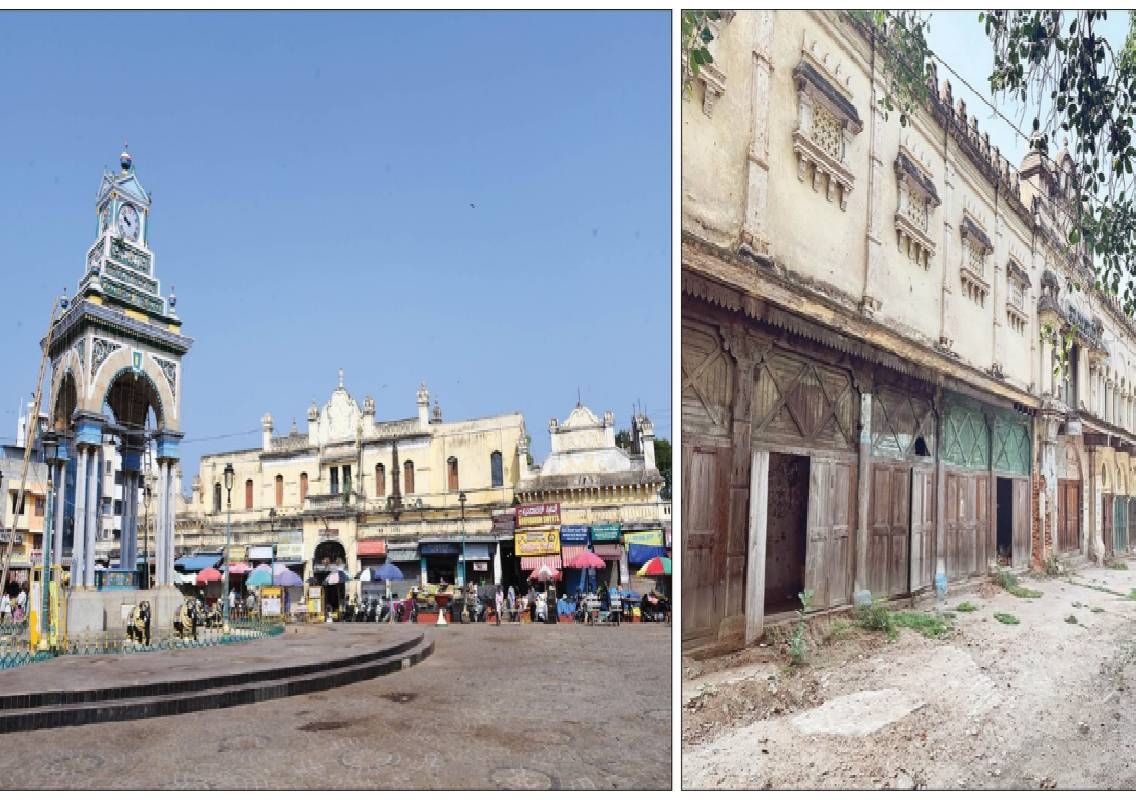


Mysuru: The Mysuru City Corporation (MCC) is preparing a ₹500-crore restoration plan for two of the city’s historic landmarks — the 140-year-old Devaraja Market and the 134-year-old Lansdowne Building. The civic body is awaiting directions from the State Government before proceeding with the project, which aims to conserve the heritage structures while retaining their original architectural character.
The proposed restoration follows directions from the Supreme Court to preserve both buildings rather than demolish and reconstruct them. MCC Commissioner M.K. Savitha told that a detailed blueprint for the project is expected to be ready within two months.
The corporation has already invited Expressions of Interest (EOIs) from companies interested in undertaking the restoration. The proposals are currently being reviewed, and further action will depend on the State Government’s directions.
Restoration, not demolition and reconstruction
MCC Commissioner Savitha clarified that the project would focus on conserving and strengthening the existing buildings instead of demolishing them and constructing new structures.
The restoration will retain the original architectural layout of both landmarks. Structural renewal will be undertaken wherever necessary, following the appropriate technical assessments and tendering procedures.
The earlier proposal to demolish and rebuild the two structures had faced opposition from members of the erstwhile Mysore Royal Family and heritage conservationists. They had argued that the historic buildings should be restored in their original form to preserve their architectural and cultural significance.
The matter eventually reached the courts. An expert team from IIT Roorkee inspected both buildings and submitted its report to the Supreme Court. The Court subsequently issued directions paving the way for their conservation.
At the final hearing of the Special Leave Petition on August 6, the Supreme Court Bench comprising Justices J.B. Pardiwala and K. Vinod Chandran asked the MCC to consider the reports submitted by IIT Roorkee and the Indian National Trust for Art and Cultural Heritage (INTACH) while planning the conservation work.
The petition was filed by heritage advocate and author G. Sathyanarayana, popularly known as Gouri Satya, R. Raja Chandra, son-in-law of late Maharaja Jayachamaraja Wadiyar, and others.
MCC invites Expressions of Interest
The corporation has initiated preliminary preparations by inviting EOIs from interested companies and agencies. According to Savitha, the tendering process has not yet begun, as the EOI submissions are being opened and evaluated.
Some firms, including companies associated with the American Embassy, have reportedly expressed interest in the project.
The proposals have been submitted to the State Government, and the corporation will proceed with the next stages after receiving its directions.
The detailed blueprint, expected within two months, will outline the restoration requirements and the work to be undertaken at both sites. The subsequent tender process will cover the portions requiring structural strengthening and renewal.
Lansdowne Building: A 134-year-old commercial landmark
The Lansdowne Building was constructed in 1892 by Maharaja Chamaraja Wadiyar in memory of British Viceroy Lord Lansdowne. It became one of Mysuru’s prominent commercial landmarks and once housed 92 business establishments.
However, years of inadequate maintenance affected the building’s structural condition. On August 25, 2012, a portion of the roof above a shop collapsed, killing four people.
Although repair work was initially undertaken, concerns over the deteriorating condition of the structure eventually led to the suspension of restoration efforts.
The proposed conservation project is expected to address the building’s structural concerns while preserving its historic appearance and architectural features.
Devaraja Market: Preserving a 140-year-old heritage site
Devaraja Market, built in 1886 by Chamaraja Wadiyar X, is among Mysuru’s oldest and most significant marketplaces. Spread across approximately 3.5 acres, it has remained an important part of the city’s commercial and cultural life for nearly 140 years.
The market suffered a major setback on August 29, 2016, when a portion of the building collapsed during repair work. No casualties were reported, but the incident raised serious concerns about the structure’s safety. Restoration activities were subsequently halted.
The MCC had earlier considered demolishing the existing market and constructing a new facility. However, the Supreme Court’s directions have made it clear that the heritage structure must be conserved and restored rather than razed.
The proposed project will therefore focus on strengthening the existing building while retaining its original architectural identity.
Heritage expert calls for committee supervision
Prof. N.S. Rangaraju, retired Professor of Ancient History and Archaeology at the University of Mysore and a member of the Heritage Committee, has welcomed the MCC’s decision to restore the two structures.
He has consistently opposed proposals to demolish the Lansdowne Building and Devaraja Market, advocating their preservation.
Rangaraju said a Heritage Expert Committee should supervise the restoration work to ensure the long-term sustainability of both buildings.
He also suggested that the MCC include a specific condition in the contract to prevent the selected contractor from sub-leasing the work to a third party.
His suggestions underline the importance of expert supervision and accountability during the restoration of heritage properties.
A significant step towards conserving Mysuru’s heritage
The proposed ₹500-crore restoration plan is an important development for two landmarks that have remained in a deteriorating condition for years.
Both the Devaraja Market and Lansdowne Building represent important chapters in Mysuru’s architectural, commercial and cultural history. Their conservation is expected to preserve these historic spaces for future generations while addressing structural safety concerns.
With the MCC awaiting the State Government’s directions and reviewing the EOIs, the next stage will involve finalising the restoration blueprint and initiating the tendering process.
The challenge will be to balance structural safety with heritage conservation, ensuring that the restoration strengthens the buildings without compromising their original character.