







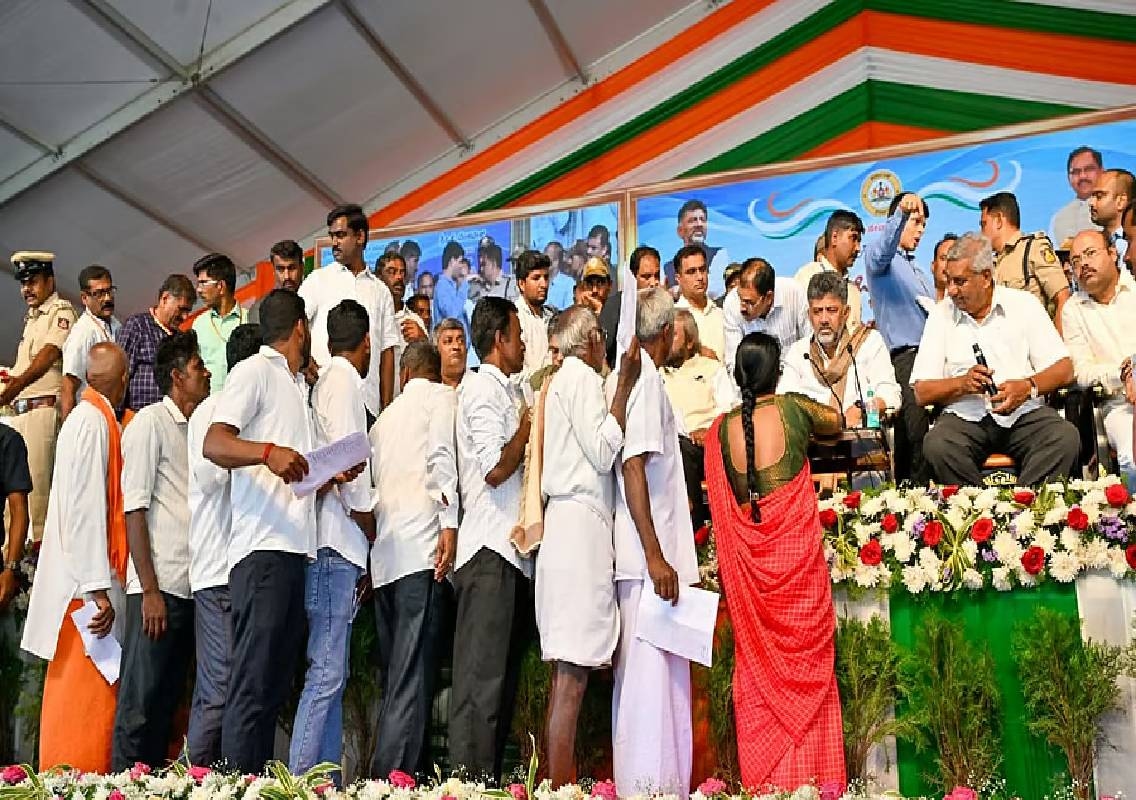


Mysuru: Chief Minister D.K. Shivakumar said the Karnataka Government’s Prajaseva initiative is intended to take administration closer to people and strengthen the voice of even the last person in society by addressing grievances at their doorstep.
Speaking at the launch of the Prajaseva programme in Periyapatna in Mysuru district on October 3, Shivakumar said the initiative was created to make government services more accessible, particularly for people living in rural areas.
He said citizens should not be forced to make repeated trips to government offices to access basic services or seek solutions to their problems. Instead, ministers, elected representatives and officials should visit local areas, listen to grievances and work towards resolving them.
Prajaseva launched to take administration to people
The Prajaseva department was launched on September 5 with the objective of making government administration more accessible and responsive.
According to the Chief Minister, more than one lakh applications have already been received through the initiative. The programmes have been conducted at hundreds of locations, with a large share of the grievances relating to revenue, rural development and panchayat raj, urban development and municipal administration.
The complaints received through the programme cover a wide range of issues, including land disputes, khata-related problems, roads, pensions, drinking water, electricity, police matters and other public services.
The initiative brings officials from different government departments together on a common platform so that applications can be examined and appropriate action can be initiated without requiring citizens to approach multiple offices separately.
CM stresses doorstep governance
Shivakumar said the fundamental idea behind Prajaseva was that government should reach people rather than expecting citizens to repeatedly approach government offices.
He said ministers, MLAs and officials should regularly visit their respective areas, hear people’s concerns and take steps to resolve them.
The approach is particularly relevant in rural areas, where residents may have to travel considerable distances to reach taluk or district-level offices.
By conducting grievance meetings locally, the Government aims to reduce this burden and provide people with a direct opportunity to explain their problems to officials.
The Chief Minister said the Government would continue strengthening the system at gram panchayat, taluk and district levels so that administration becomes more people-centric.
More than one lakh applications received
One of the significant figures highlighted by the Chief Minister was the number of applications received through Prajaseva.
More than one lakh applications have been submitted since the initiative was launched. According to the Government, revenue-related matters constitute a major portion of the grievances, along with issues concerning rural development and panchayat raj and urban development.
The large number of applications indicates the range of problems citizens approach government departments with at the local level.
The Government has said the disposal of applications will be monitored regularly. Officials responsible for pending grievances will be questioned about delays, according to the Chief Minister.
Such monitoring is intended to ensure that Prajaseva does not become merely a platform for receiving petitions but also functions as a mechanism for follow-up and resolution.
Legal aid centre added to Prajaseva
A legal assistance facility has also been introduced as part of the Prajaseva programme.
The centre is intended to provide free guidance to citizens facing legal difficulties. Lawyers can assist people with issues involving land, khata matters and court-related cases.
The facility is particularly relevant for citizens who may not be able to afford private legal assistance or who may be uncertain about which legal process to follow.
The Chief Minister said legal assistance would be available during Prajaseva programmes, with lawyers working alongside officials to guide citizens on matters that require legal intervention.
The addition of legal assistance broadens the scope of the initiative beyond routine administrative grievances.
Pension issues among grievances
Pension-related complaints have also emerged as one of the issues brought before the Government through the initiative.
Shivakumar referred to cases involving beneficiaries whose pensions had been stopped after their annual income crossed the earlier eligibility limit.
He said the Government subsequently increased the income ceiling to Rs 1.2 lakh, which he claimed had benefited around 12 lakh people.
The example highlights the role of grievance meetings in bringing administrative difficulties to the attention of the Government.
For beneficiaries dependent on social security payments, delays or interruptions can have a direct impact on household finances. The Government has therefore positioned Prajaseva as a mechanism through which such concerns can be identified and addressed.
Government plans housing support for homeless families
The Chief Minister also spoke about the Government’s plans to identify land for people who do not have housing sites.
Deputy commissioners have been instructed to identify government land or acquire suitable private land for developing new settlements and providing housing sites to people without shelter, he said.
The announcement forms part of the broader set of issues being addressed through the Government’s outreach programmes.
Housing, land ownership and revenue-related disputes are among the issues that frequently require coordination between several government departments. The Prajaseva model is intended to bring such departments together so that citizens can receive clearer guidance and action.
Programme to expand to local levels
The Government plans to continue Prajaseva at different levels of administration.
According to the Chief Minister, the initiative will be strengthened at the district, taluk and gram panchayat levels.
The Government has also directed district ministers and MLAs to conduct grievance meetings regularly. At the taluk level, officials are expected to participate and hear people’s problems. If elected representatives are unable to attend, officials have been asked to visit and hear grievances instead.
The objective is to ensure that the absence of a particular elected representative does not prevent citizens from accessing the grievance-redressal system.
This structure could also help identify recurring problems in particular areas and allow departments to track whether solutions are being implemented.
Focus on accountability and follow-up
A key feature of Prajaseva is the emphasis on monitoring applications after they are submitted.
The Chief Minister said applications would be regularly reviewed and officials would be questioned if grievances remained pending.
This monitoring mechanism is intended to create greater accountability within the administrative system.
For citizens, the effectiveness of Prajaseva will ultimately depend on whether petitions result in actual solutions. Receiving applications is only the first stage; timely action, communication with applicants and completion of departmental processes will determine the programme’s impact.
The Government’s decision to involve officials from multiple departments is aimed at reducing delays caused when a grievance falls under more than one administrative authority.
Mysuru programme brings officials and citizens together
The Periyapatna programme brought the Chief Minister directly into the grievance-redressal process.
Minister Yathindra Siddaramaiah, Forest Minister Eshwar Khandre, MLA K. Venkatesh and MLC K. Shivakumar were among those present during the programme.
Citizens approached the authorities with individual grievances during the event, demonstrating the direct interaction that the programme seeks to promote.
Such interactions can also help the Government identify issues that may not be immediately visible through routine administrative reviews.
For rural residents, the ability to raise concerns directly before senior officials can provide an additional channel beyond conventional government offices.
Prajaseva aims for people-centric administration
The Government has presented Prajaseva as part of a broader effort to make administration more accessible and people-centric.
The initiative seeks to combine public grievance meetings with departmental officials, legal assistance and follow-up mechanisms.
The approach also places greater responsibility on elected representatives and government officers to remain connected with their constituencies and administrative areas.
For the system to deliver long-term results, however, effective coordination between departments and timely disposal of applications will remain crucial.
Conclusion
Mysuru: Chief Minister D.K. Shivakumar said Prajaseva is intended to strengthen the voice of ordinary citizens by taking government services and grievance redressal closer to their doorsteps.
More than one lakh applications have reportedly been received since the department was launched on September 5, covering issues ranging from land and khata disputes to roads, pensions, drinking water and other civic services.
With legal assistance centres being added and the programme planned at district, taluk and gram panchayat levels, the Government aims to create a more accessible system for citizens. The effectiveness of the initiative will ultimately depend on how quickly and effectively the grievances received through Prajaseva are resolved.