







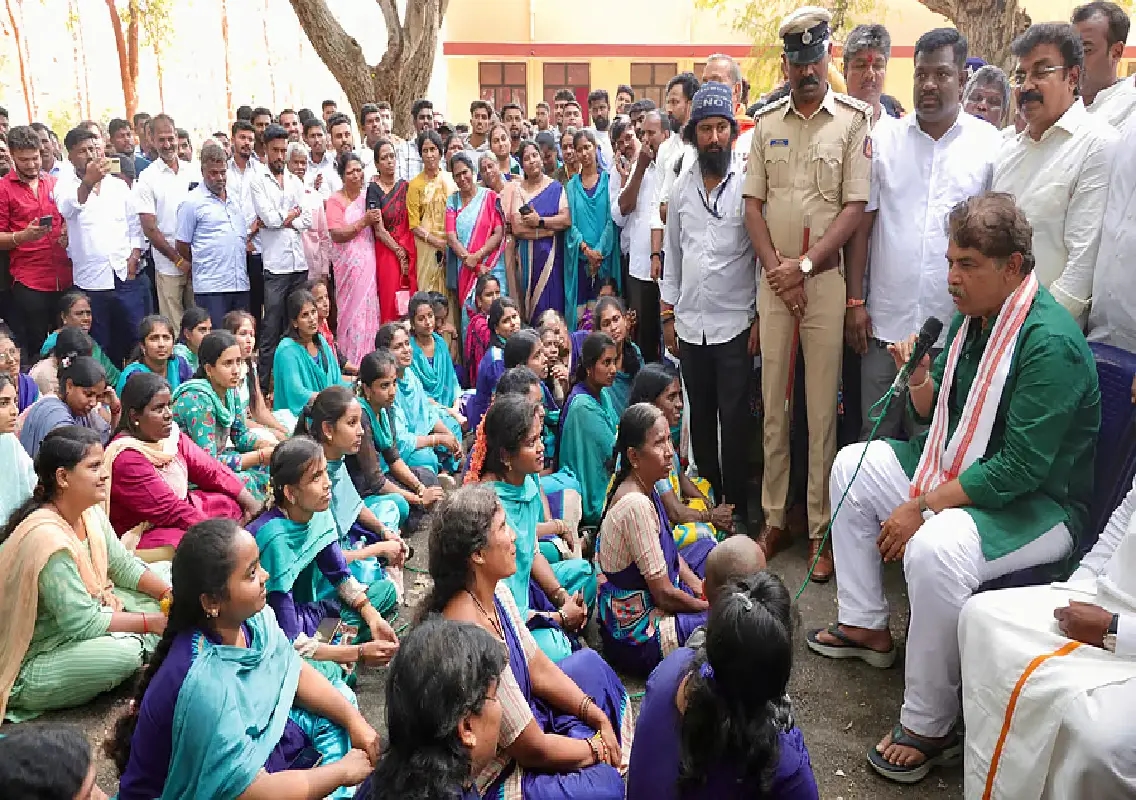


Mysuru: Leader of the Opposition in the Karnataka Legislative Assembly R. Ashoka visited units of the Karnataka Silk Industries Corporation (KSIC) in Channapatna and Mysuru before proceeding to the mother unit at T Narsipur in Mysuru district to extend support to the ongoing ‘Save Mysore Silk’ protest.
The protest is being staged by 1,092 employees of KSIC’s three units, who are opposing the State government’s reported move to utilise 5 acres of land belonging to the raw silk yarn reeling unit at T Narsipur for the construction of a sports stadium.
Addressing the media in Mysuru on Friday, Ashoka warned that if the government does not drop the proposal, the Opposition would launch a major agitation and raise the matter in the upcoming Assembly session.
“Mysore Silk is Karnataka’s pride”
Ashoka emphasised that Mysore Silk carries a Geographical Indication (GI) tag and is globally recognised as a premium brand. “Mysore Silk is the pride of Karnataka. It has a rich legacy. In 1912, impressed by the silk used by the Queen of England, Maharaja Nalwadi Krishnaraja Wadiyar imported machinery from Switzerland to establish KSIC units to produce Mysore Silk,” he said.
He noted that despite high demand for Mysore Silk sarees and healthy profits earned by KSIC, the government was allegedly attempting to divert its land for a stadium project instead of investing in expansion and modernisation.
According to Ashoka, profits generated by KSIC are being deposited with Bangalore Electricity Supply Company (BESCOM) rather than being reinvested in the development of the corporation.
Allegations over stadium project
Ashoka alleged that a “lobby” connected to a local Congress leader from Varuna constituency was influencing the decision to build the proposed stadium, reportedly estimated at Rs 6 crore. He claimed the move was politically motivated and aimed at benefitting select interests.
“Owing to pressure from a local Congress leader, the contract for the stadium is being pushed. Instead of protecting an iconic industry, they are trying to weaken it,” he alleged.
He further claimed that if KSIC’s production is disrupted, it would adversely affect weaving units in Mysuru and Channapatna, potentially leading to a decline in the production of authentic Mysore Silk sarees.
Call for alternative site
While stating that he supports the development of sports infrastructure, Ashoka argued that the stadium should be constructed on a larger and more suitable plot. “As a sports person, I support stadiums. There should be at least a 400-metre track in a proper playground. Let them build a bigger stadium on a larger site,” he said.
He suggested that the Department of Youth Empowerment and Sports could utilise its budget to acquire land from private owners if government land was unavailable.
Raising safety concerns, he questioned the feasibility of constructing a stadium adjacent to the boilers of the silk filature unit. “How safe will it be to have a stadium next to industrial boilers? If the stadium comes up here, the KSIC mother unit may be forced to shut down,” he warned.
Employees vow to continue protest
Employees participating in the ‘Save Mysore Silk’ protest have expressed apprehension that loss of land could affect operations of the mother unit at T Narsipur, which plays a crucial role in silk yarn processing. They fear that any disruption at the source could impact weaving units and allied industries dependent on the supply of quality silk yarn.
Ashoka asserted that the Opposition would continue to fight until the government withdraws its decision. “We will pursue this issue until it reaches a logical end and the State government reconsiders taking over KSIC land,” he said.
The State government has yet to issue a detailed clarification regarding the proposal. Meanwhile, the issue is expected to generate heated debate in political and industrial circles in the coming days.