







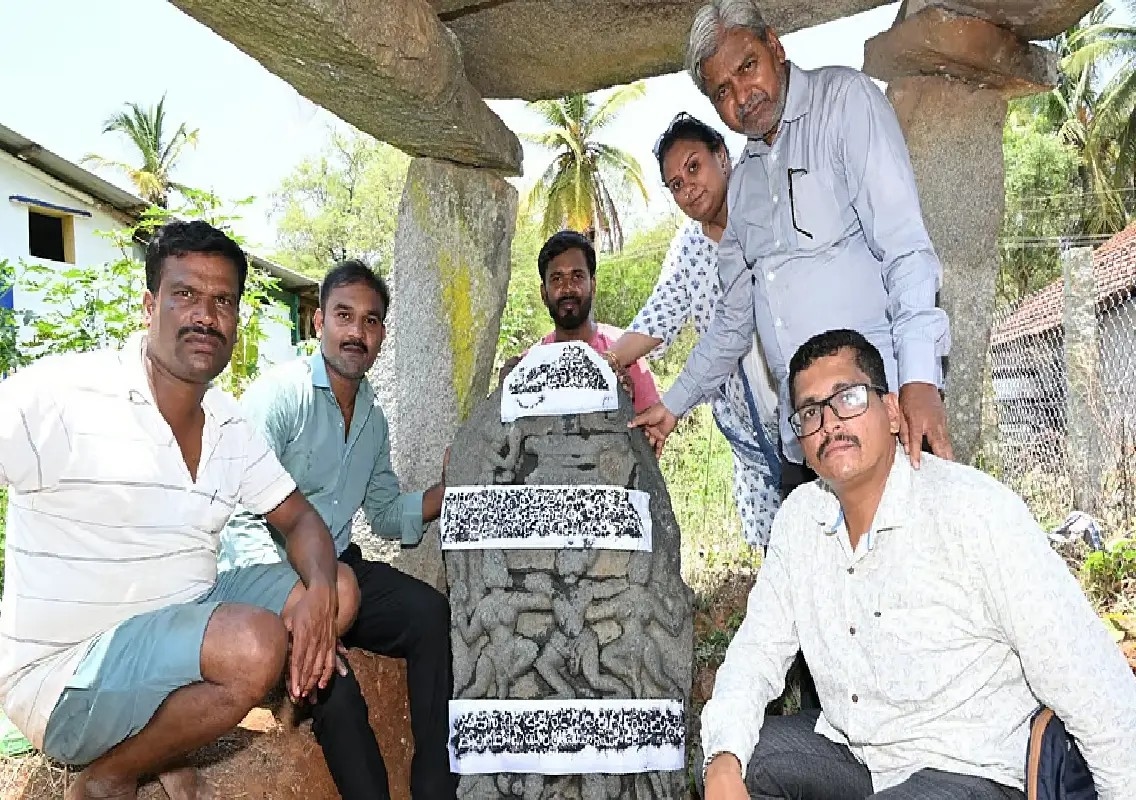


Mysuru: A team from the Centre of Excellence for Studies in Classical Kannada (CESCK), Mysuru, has discovered a rare 12th-century east-facing Turugolu (battle for cattle) hero stone, or Viragallu, belonging to the reign of Hoysala king Vishnuvardhana. The hero stone was found in a farm belonging to Ramakrishnegowda at Maniyur village, around 10 km northwest of Nagamangala taluk in Mandya district.
Researchers described the discovery as historically significant as it sheds light on the cultural, social and military practices of the Hoysala period and highlights the importance attached to cattle protection during that era.
Hero stone dates back to Hoysala period
According to C.A. Shashidhara, archaeologist and researcher at CESCK, the newly discovered inscription is written in Kannada language and Kannada script and extends across seven lines.
He stated that the inscription had remained unpublished and was sculpted as a memorial stone to honour the bravery and sacrifice of a warrior who lost his life while defending cattle during the 12th century.
Researchers said hero stones or Viragallu were traditionally erected in memory of individuals who sacrificed their lives in battles, while protecting villages, serving rulers or safeguarding people and livestock.
The recently discovered sculpture has been carved in soapstone and consists of three sculptural panels portraying different stages of the hero’s journey.
Inscription mentions Hoysala king Vishnuvardhana
Researchers explained that although part of the inscription has suffered damage over time, several significant details remain visible.
The second panel of the inscription carries royal titles associated with Hoysala king Vishnuvardhana, including “Mandalesvara”, “Tribhuvanamalla”, “Talakadugonda” and “Viraganga Poysaladevaru”.
According to experts, these titles identify the ruler and help establish the historical timeline of the inscription.
Assistant Superintendent Epigraphist of the Archaeological Survey of India, Mysuru, R.V. Anilkumar said the script style and royal epithets strongly indicate that the inscription belongs to the first half of the 12th century CE.
He noted that the inscription mentions the cyclic year “Sadharana”, which when correlated with the reign of Vishnuvardhana beginning in 1108 CE, places the inscription around 1130 CE.
Senior archaeologist and heritage expert Prof. N.S. Rangaraju also observed that the royal titles and sculptural style make the inscription an important subject for further research.
Sculpture depicts hero’s sacrifice
Researchers explained that the hero stone includes detailed bas-relief sculptures narrating the story of the warrior’s sacrifice.
In the lower panel, the hero is shown attacking an opponent with a dagger while the opposing figure carries a bow. Four cows are carved behind the hero to indicate that the conflict was related to cattle protection.
The middle section depicts celestial maidens carrying the fallen hero to Kailasa.
The upper panel portrays the hero seated before a Shiva linga with folded hands after attaining Moksha.
Above the Shiva linga, sculptural depictions of the Sun and Moon have been carved. Researchers said these symbols traditionally represent eternal remembrance, signifying that the hero’s bravery would endure as long as the Sun and Moon exist.
Discovery made during field exploration
The discovery was made following information provided by local resident H.L. Umesh.
Shashidhara subsequently visited the location and carried out field exploration that led to the identification of the hero stone.
After obtaining permission from Central Institute of Indian Languages Director Basavaraja Kodagunti, a CESCK team led by Project Director Prof. N.M. Talawar excavated the site with assistance from local residents.
The team included Shashidhara, dance researcher Dr. Santoshi Subrahmanya, library assistant V. Nagendra and videographer Ramesh Patel.
Researchers later took estampage copies of the inscription after the sculpture became fully visible.
Prof. Talawar explained that in ancient times cattle were considered “living wealth” and often became targets during conflicts and raids.
According to researchers, the inscription commemorates Maviga Manimara, son of Attisetti, who died while defending cattle from raiders nearly 900 years ago.
Shashidhara further suggested that the village name “Maniyur” may itself have evolved from the hero’s name as a tribute to his sacrifice and courage.
The discovery is expected to provide valuable insights into Hoysala history, ancient Kannada inscriptions and the social traditions of medieval Karnataka.