


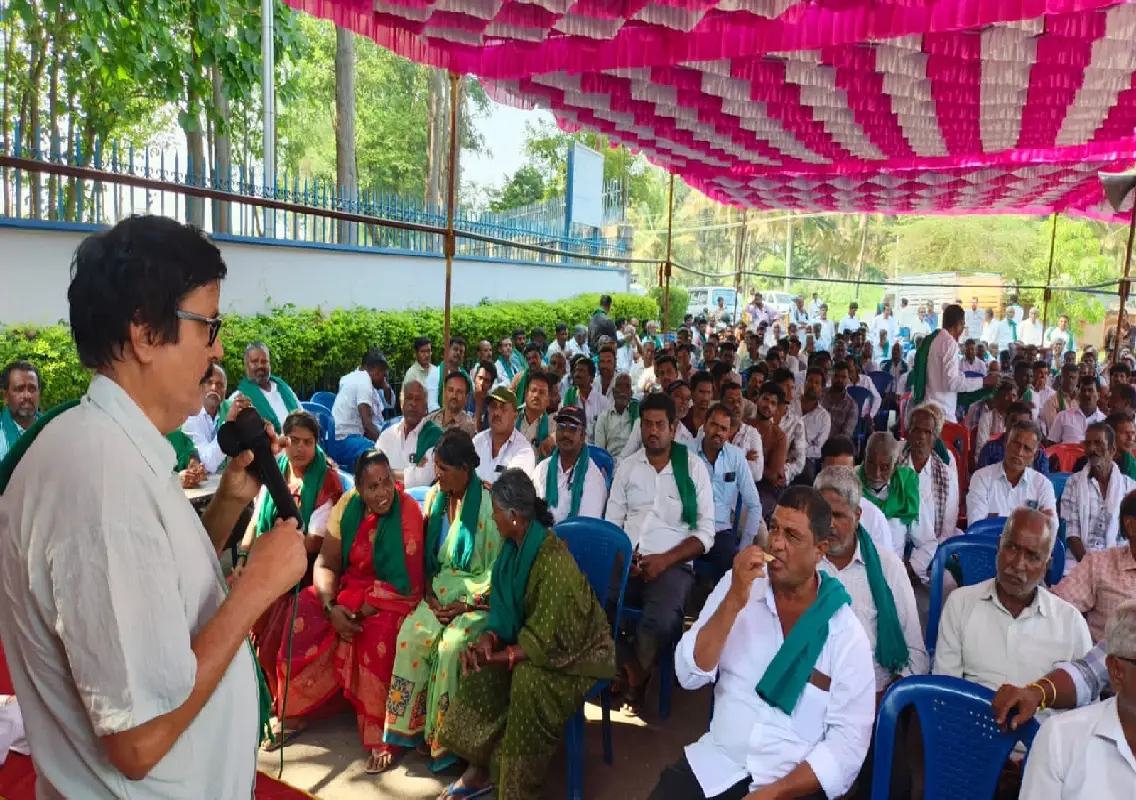


Nanjangud: Hundreds of sugarcane growers from Mysuru and Chamarajanagar districts staged a protest against the management of Bannari Amman Sugar Factory near Alaganchi in Nanjangud taluk on Saturday, demanding a fair price for their produce and immediate settlement of pending dues.
The protest was organised by the Sugarcane Growers Coordinating Committee under the leadership of State Farmers’ Union leader Kuruburu Shanthakumar. The farmers accused the factory management of neglecting their concerns and delaying decisions on the price payable for sugarcane during the 2026-27 crushing season.
The protesters submitted a memorandum to Tahsildar Dr Smitha Ramu, urging the authorities to intervene and ensure that the factory addresses their demands without further delay.
Farmers demand higher sugarcane price
One of the principal demands raised during the agitation was an increase in the price offered for sugarcane during the current 2026-27 season.
Shanthakumar said sugarcane growers across Karnataka were intensifying their struggle to secure remunerative prices. He pointed out that several sugar mills were competing to offer better rates to farmers, with some reportedly fixing prices of up to Rs 4,200 per tonne, inclusive of harvesting, labour and transportation costs.
However, he accused Bannari Amman Sugar Factory of failing to respond adequately to the growers’ demands and delaying the announcement of a suitable price.
The farmers said sugarcane cultivation involved considerable investment in seeds, fertilisers, pesticides and labour. Growers also had to bear the burden of rising cultivation and harvesting expenses. Without a fair price for their produce, they risked falling into debt despite their hard work.
They urged the factory management to recognise the contribution of farmers and announce a price that adequately covers their production costs.
Rs 50 additional payment from previous season sought
The protesters also demanded immediate disbursement of the additional Rs 50 per tonne payment fixed by the state government for the previous crushing season.
They alleged that the amount had not yet been paid to the eligible growers and insisted that the factory settle the outstanding dues without further delay.
The farmers maintained that payments announced or fixed by the government must reach growers promptly. Delays in settlement, they said, placed additional financial pressure on farming families who depend on the proceeds from sugarcane cultivation to meet their expenses and repay loans.
Demand for transparent weighing and sugar recovery
Apart from pricing and pending payments, the growers raised concerns over alleged irregularities in the weighing of sugarcane and the reporting of sugar recovery.
They demanded that a sugarcane weighing scale be installed directly in front of the factory to ensure transparency in the weighing process. According to the protesters, the arrangement would help prevent possible discrepancies and protect farmers from being short-changed.
They also called for an end to the alleged practice of underreporting sugar yield, stating that inaccurate reporting of sugar recovery could result in financial injustice to growers.
Shanthakumar said sugar factories must maintain transparency in both weighing and sugar recovery calculations. Farmers, he stressed, should receive payments based on accurate measurements and fair assessments.
Warning of intensified agitation
The protesters warned that the agitation would be intensified if the factory management failed to address the demands.
Shanthakumar said farmers’ patience should not be tested and called upon sugarcane growers from Mysuru and Chamarajanagar districts to unite in support of the movement.
He urged growers to participate in the struggle to secure fair prices, timely payments and transparent practices at sugar factories.
Hundreds of farmers from the two districts took part in Saturday’s protest, raising slogans against the factory management and demanding an immediate response to their concerns.
The growers reiterated that their demands were essential to protect their livelihoods and ensure that sugarcane cultivation remained financially viable. They called for timely government intervention and action from the factory management to resolve the issues.