







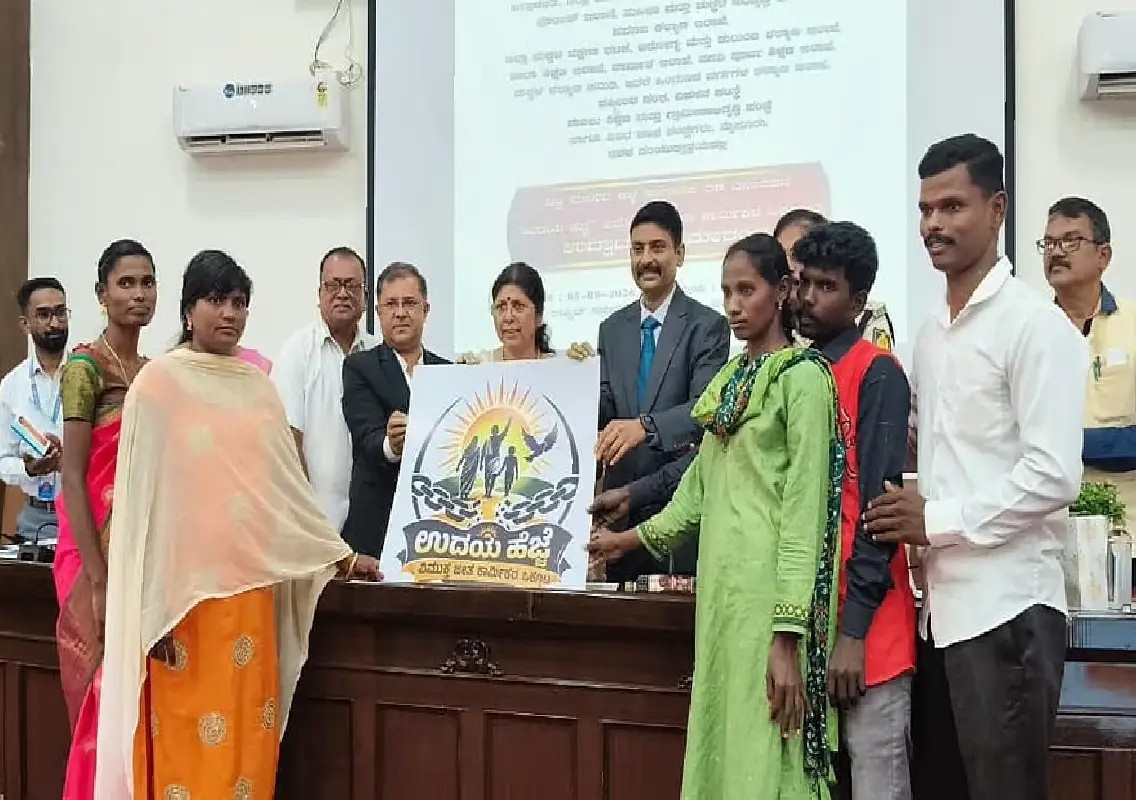


Mysuru: A new union named ‘Udaya Hejje’ has been launched in Mysuru to support rescued bonded workers and help them access basic rights, government benefits and rehabilitation services.
The initiative was launched by Mysuru district Principal and Sessions Judge and Mysuru District Legal Services Authority (DLSA) President Usha Rani, along with DLSA Member Secretary Nagaraja Siddappa Ankasadoddi, as part of an event marking the World Day Against Trafficking in Persons.
The programme was organised by the Mysuru district administration, Mysuru DLSA and NGOs including Vikasana, IGM and Madilu on Thursday.
Rescued workers seek basic rights
Murthy, a rescued bonded worker who is leading the organisation, said many workers continue to face exploitation despite legal safeguards and government rehabilitation measures.
“Even in this advanced era, relief for many bonded workers is still a mirage,” he said, pointing out that people continue to be forced into different forms of bonded labour for inadequate wages and poor working conditions.
Around 150 to 200 rescued bonded workers from across Karnataka are associated with the ‘Udayonmuka’ union. Among them are 23 workers rescued from a brick factory at Bevinahalli in T Narasipura taluk of Mysuru district and 22 workers recently rescued from Ganganadoddi in Hanur taluk of Chamarajanagar district.
Murthy said the newly formed union would work with NGOs to help survivors secure basic documents, government benefits and other facilities.
Trafficking taking newer forms
Usha Rani expressed concern that human trafficking and bonded labour are taking new forms in the digital era, including through cyber-related methods.
She said poverty, unemployment and illiteracy continue to make vulnerable people susceptible to exploitation.
According to her, several laws, government provisions, standard operating procedures, court judgments and Supreme Court guidelines are available for the rescue and rehabilitation of bonded workers. However, effective implementation requires coordinated efforts by government departments, legal services authorities and NGOs.
She stressed that the right to life guaranteed under Article 21 of the Constitution extends beyond mere physical existence and includes the right to live with dignity.
Usha Rani also urged members of the public to alert the concerned authorities whenever they suspect that a person is being forced into bonded labour.
She recalled the case of a trafficking survivor who died by suicide after being rejected by her family, highlighting the need for sustained support even after victims are rescued.
Workers exploited in different sectors
A M Varghese Cletus, president of Vikasana, Tarikere, Chikkamagaluru, said bonded labour continues to exist in several sectors despite changes in its form.
Workers are reportedly employed to pluck coffee, extract ginger, cut sugarcane and work in quarries and other industries. While they may not necessarily be physically chained, many remain trapped through contractors and middlemen and are deprived of minimum wages and basic facilities.
He said a major challenge was the lack of awareness among rescued and vulnerable workers about their legal rights.
Many workers are illiterate and unable to submit written complaints, while some do not possess essential identity documents such as Aadhaar cards and voter identity cards. The absence of documents can also make it difficult for them to access government welfare schemes.
Survivor recalls ordeal
A rescued bonded worker from Bevinahalli shared his experience of being trapped in bonded labour.
He said he had borrowed Rs 40,000 around eight years ago and was subsequently paid only Rs 500 a week while having to support his wife and son.
According to him, workers were provided medicines when they fell ill but were not taken to hospitals. When he attempted to escape, he alleged that his child was locked in a room and tortured.
The survivor said he still does not have a job card under the rural employment guarantee programme or an Aadhaar card.
He now works from 6 am to 10 am and earns Rs 200 a day.
Union to support rehabilitation
Murthy said rescued workers receive around Rs 30,000 at the time of their rescue, but alleged that there are limited special facilities available to them thereafter.
He said ‘Udaya Hejje’ would work alongside NGOs to help survivors obtain basic documents and access government welfare schemes and other essential facilities.
The launch of the union is expected to provide a collective platform for rescued bonded workers to raise concerns, seek assistance and work towards rebuilding their lives after exploitation.
The event also brought together legal authorities, government representatives and organisations working for the rights and rehabilitation of bonded workers, underlining the need for continued coordination to prevent trafficking and ensure dignified rehabilitation of survivors.