


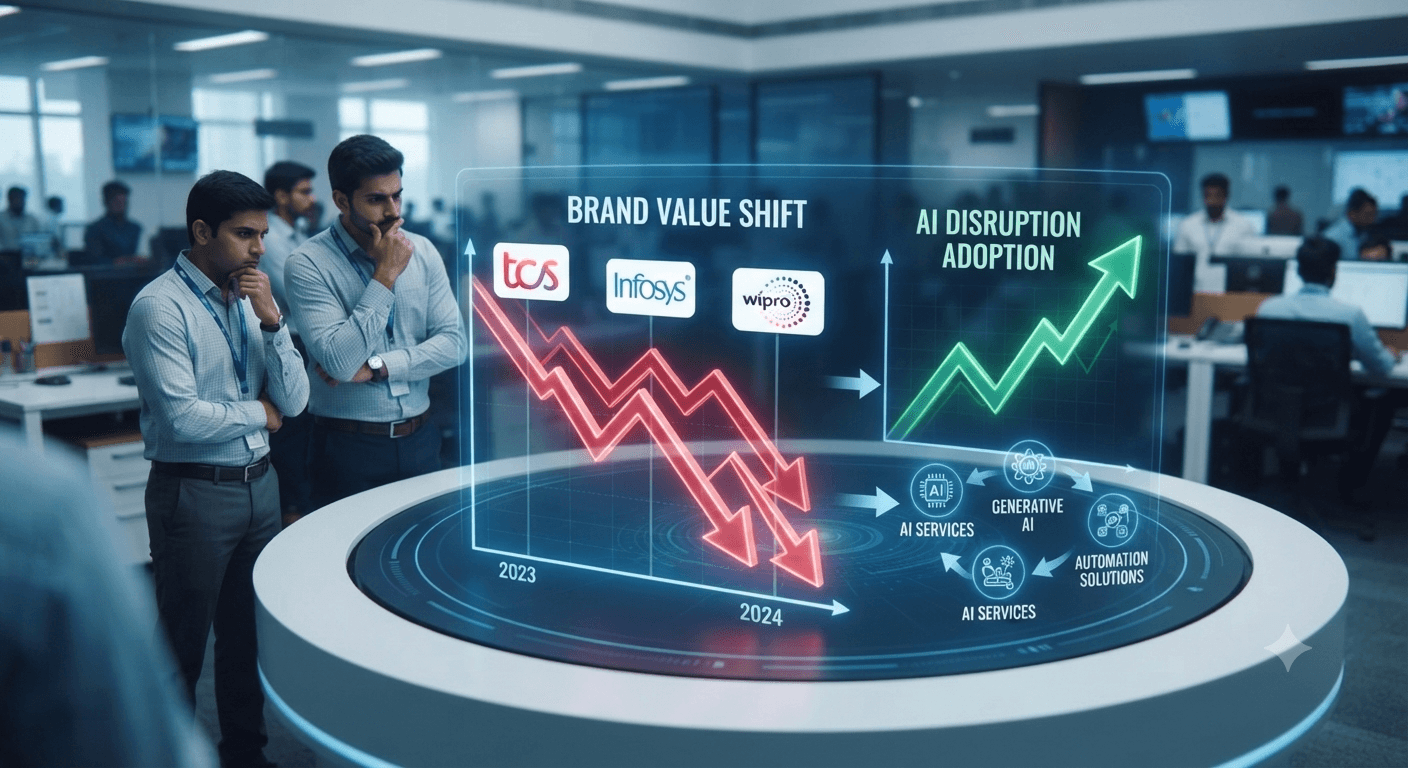


New Delhi: India’s leading IT services companies have suffered a sharp fall in brand value, with Tata Consultancy Services (TCS), Infosys and Wipro recording declines of up to 45% over the past year. Artificial intelligence-driven disruption, intensifying competition and pressure on traditional business models have emerged as key factors behind the downturn, according to Kantar’s BrandZ 2026 ranking of India’s most valuable brands.
The figures point to a difficult period for India’s technology and business services sector, which has traditionally benefited from its scale, global client base and established outsourcing model. As companies increasingly adopt artificial intelligence to automate tasks and improve productivity, established IT service providers are facing questions about how quickly they can adapt their offerings and protect their competitive positions.
TCS recorded the steepest decline among the three major IT companies, with its brand value falling 45% year-on-year to $24.11 billion. Infosys saw a 41% decline to $15.08 billion, while Wipro’s brand value dropped 40% to $2.97 billion.
The declines highlight the pressure facing some of India’s best-known technology brands at a time when AI is changing the nature of business services and creating new competition.
TCS, Infosys and Wipro see steep valuation declines
According to the Kantar report, TCS remained India’s third most valuable brand despite its 45% fall in brand value. Its valuation stood at $24.11 billion, reflecting the scale of the decline compared with the previous year.
Infosys ranked seventh, with its brand value decreasing 41% to $15.08 billion. Wipro, placed 37th in the overall ranking, recorded a 40% fall to $2.97 billion.
The figures are significant because the three companies have long been among India’s most recognised global technology services brands. Their businesses span software development, consulting, digital transformation, IT outsourcing and technology support for clients across different industries.
However, the rapid development of AI tools is changing how some of these services are delivered. Tasks that previously required large teams and considerable time can increasingly be automated or completed with AI assistance.
This shift is putting pressure on traditional service models and raising expectations around productivity, pricing and the value companies provide to clients.
The decline in brand value does not necessarily mean that these companies have experienced an equivalent fall in revenue or market capitalisation. Brand value is a separate measure used to assess the financial contribution and strength of a brand.
HCLTech’s brand value fell 33% to $8.61 billion. LTIMindtree, which has rebranded as LTM, recorded a 31% decline to $2.78 billion.
Persistent Systems saw its brand value decrease 29% to $2.10 billion.
The broad-based fall suggests that the challenges facing India’s IT services sector extend across companies of different sizes and business models. While individual companies may have different client portfolios and areas of specialisation, the wider industry is dealing with the implications of AI adoption and changing customer expectations.
The emergence of AI-focused companies and specialised technology providers is also intensifying competition. Established IT services firms must now demonstrate that they can offer more than scale and access to a large workforce.
Their ability to integrate AI into existing services, develop new technology solutions and deliver measurable business outcomes is becoming increasingly important.
Kantar identifies AI as a major source of pressure
Kantar attributed part of the decline in Indian brand valuations to broader economic challenges, particularly the disruption caused by artificial intelligence in the business services sector.
“There are macro headwinds spurring this decline – most notably an AI-driven wobble in the business service sector,” the report said.
The report’s foreword also highlighted how AI is reshaping India’s business-to-business landscape. While the technology is creating new opportunities, it is also challenging established business models and forcing companies to reconsider how they operate.
For India’s IT services industry, the transition could have far-reaching consequences. Traditional outsourcing models have relied on skilled professionals delivering technology services at scale. AI-powered automation is changing the economics of several such activities, potentially reducing the time and resources required for certain tasks.
This does not mean that demand for technology services will disappear. Instead, the nature of that demand is changing, with clients increasingly looking for AI integration, automation, advanced analytics and specialised technology capabilities.
Companies that adapt their offerings to these requirements could find new areas of growth, while those that depend heavily on traditional service models may face greater competitive pressure.
AI disruption could affect jobs and consumer spending
Kantar’s assessment also points to consequences beyond corporate brand valuations.
The report said artificial intelligence has challenged India’s large business services sector, with possible knock-on effects for the labour market and consumer spending.
India’s IT and business services industry has been an important source of employment, particularly for skilled professionals in urban centres. It has also supported spending across housing, retail, transport, education and other sectors through the incomes generated by technology-related jobs.
If AI changes the industry’s workforce requirements or reduces demand for certain traditional services, the effects could extend to these wider economic activities.
At the same time, AI adoption could create demand for new skills and specialised roles. The overall impact will depend on how companies reorganise their operations, retrain employees and develop new services.
The report highlights the broader significance of the technology shift, although it does not suggest that every decline in brand value can be attributed exclusively to AI.
India’s top 100 brands lose 12% of their combined value
The decline among IT services companies comes amid a difficult year for India’s largest brands overall.
Kantar’s BrandZ 2026 ranking put the combined value of the country’s 100 most valuable brands at $460 billion, a 12% decline compared with the previous year.
The report said the fall was concentrated in large, historically important sectors. Consultancies and companies in the Business Technology and Services Platforms category were among those facing significant pressure.
Kantar also highlighted growing competition from domestic niche players and global AI disruptors. These companies are challenging established businesses by offering specialised products and services, often with technology-led operating models.
The changing competitive environment is reflected in the composition of the rankings. Business Technology and Services Platforms accounted for a smaller share of total brand value, while Automotive and Retail brands gained ground.
This indicates a shift in the relative contribution of different sectors to India’s most valuable brands.
Scale alone may no longer be enough
Despite the sharp declines, Kantar’s assessment does not suggest that established Indian brands have become irrelevant. Instead, it points to a changing environment in which size and long-standing market presence may no longer be sufficient to protect a company’s position.
For India’s IT services leaders, the challenge is to demonstrate that their scale can be converted into new capabilities and stronger customer value.
Artificial intelligence is both a competitive threat and an opportunity. Companies that successfully integrate it into their services could improve efficiency, develop new offerings and strengthen their relationships with global clients.
However, the transition also requires changes in workforce skills, business strategies and the way technology services are priced and delivered.
The BrandZ 2026 findings underline how quickly the competitive landscape is changing. For TCS, Infosys, Wipro and other Indian IT companies, the next phase will depend on how effectively they respond to AI-driven disruption and establish their relevance in a market where traditional advantages are being challenged.