







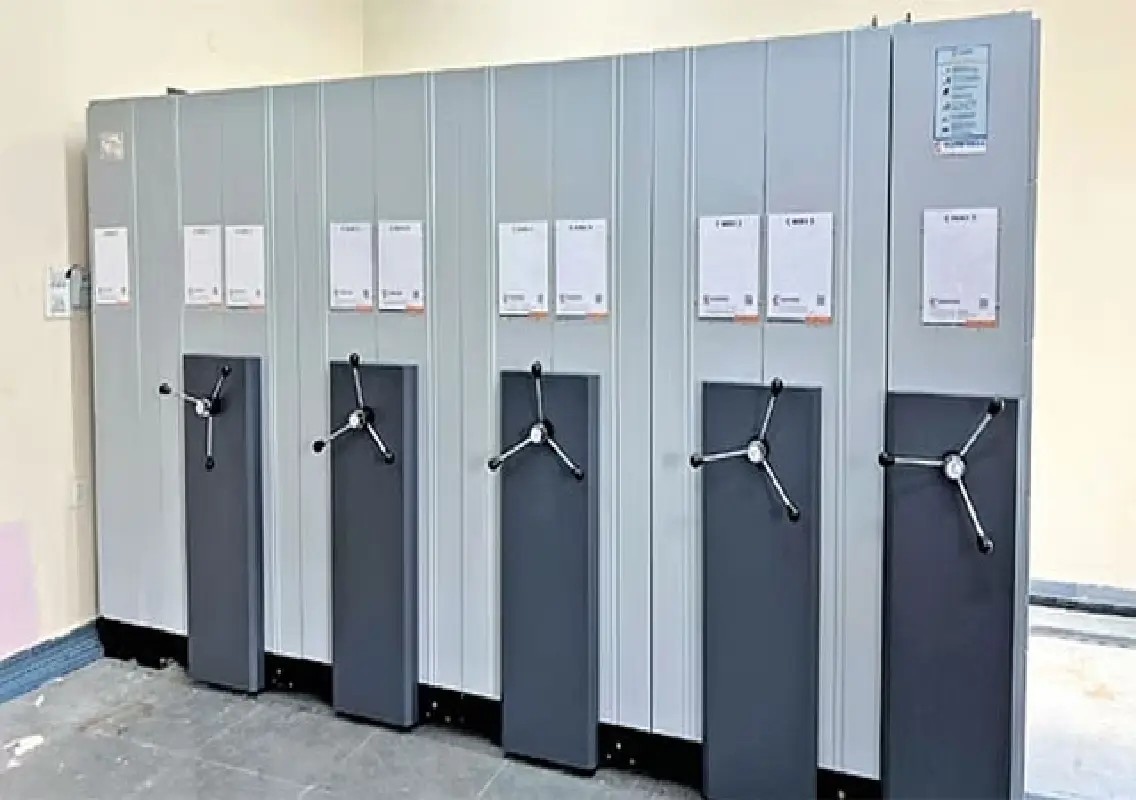


Bengaluru: Karnataka has become the first state in the country to secure more than 120 crore government land records in fireproof, high-security compactors designed for the long-term preservation of important documents.
The records include historical documents dating back 100 to 150 years, many of which are considered significant for land administration and government records. The initiative is aimed at protecting valuable documents from fire, unauthorised access and deterioration while also improving records management across revenue offices.
The fire-resistant compactors are fitted with key-locking systems and can be accessed only by authorised personnel. They have been installed in restricted record rooms equipped with biometric access, adding multiple layers of security to the preservation system.
85 crore pages already digitised
The Karnataka Revenue Department has digitised around 85 crore pages of important revenue records across tahsildar, assistant commissioner and deputy commissioner offices in the state.
Another 35 crore pages remain to be digitised. The department has simultaneously undertaken measures to physically preserve important documents and improve the management of records that are no longer required to be retained.
Modern record rooms equipped with high-capacity compactors have been established to ensure that valuable records remain protected for extended periods.
The compactors are specifically designed to withstand fire and provide a secure environment for the storage of physical records. The system is intended to ensure that historically significant documents remain available for future administrative, legal and archival requirements.
Records classified into five categories
The Revenue Department classifies government records into Categories A, B, C, D and E based on their importance and the period for which they need to be preserved.
Category A records, which include old and historically significant documents, including some records more than 150 years old, will be preserved permanently.
Category B records will be retained for 30 years before being reviewed. Category C records will be preserved for 10 years, while Category D records will be retained for five years. Category E records will be preserved for one year.
The classification system is intended to ensure that important documents are protected permanently or for the prescribed period while records that have completed their retention period can be disposed of through an authorised process.
Bhoo Suraksha Yojana strengthens preservation
Under the Bhoo Suraksha Yojana, Category A and B land records have already been indexed, scanned and preserved.
The system is now expected to help the department identify records that can be disposed of after completing the prescribed retention period. Officials have been instructed to identify and classify closed files before initiating the disposal process.
The department has stressed that the exercise is not intended to remove important records. Instead, the classification and digitisation process is aimed at ensuring that essential documents are retained while obsolete records are systematically removed to free up valuable storage space.
Checks required before destruction
Additional Chief Secretary (Revenue) Rajender Kumar Kataria has issued a circular directing revenue-related offices to dispose of records whose prescribed retention periods have expired.
However, officials have been instructed to carry out detailed checks before any physical record is destroyed.
Files must be examined to determine whether they are connected with pending court cases, audit objections, RTI matters, departmental orders or other administrative requirements. This scrutiny is intended to prevent the accidental destruction of records that may still be required for legal or administrative purposes.
Officials have also been directed to ensure that all significant records are placed under Categories A or B and retained accordingly.
Digital approval process introduced
After the records are indexed, a software-generated list of documents proposed for disposal will be placed before the concerned advisory boards for scrutiny.
Following examination and approval, the records will be uploaded with digital signatures. Once the required approvals are completed, the physical records can be destroyed in the presence of the designated authority.
The head of the concerned office will then be required to prepare and submit a destruction report and obtain the necessary approval.
The process is designed to create a documented trail for every batch of records that is destroyed, thereby ensuring accountability and reducing the possibility of unauthorised disposal.
Shredded records to be disposed of through auction
The physical records approved for destruction will be shredded rather than simply discarded. The resulting paper waste will be disposed of through e-auction or tender in accordance with government rules.
The proceeds generated through the sale of the shredded paper waste will be remitted to the government.
The process is expected to help revenue offices manage the large volume of physical documents accumulated over several decades while ensuring that records with continuing legal, administrative or historical value are not lost.
Focus on secure and organised record management
Kataria said the initiative would help save storage space while ensuring that government records are maintained in a more organised and secure manner.
The move combines physical preservation with digitisation and regulated disposal, allowing the Revenue Department to address the challenges posed by the large volume of land and revenue records maintained across the state.
With around 85 crore pages already digitised and more than 120 crore records secured in fireproof compactors, Karnataka’s initiative represents a major shift towards modern records management while retaining the historical documents needed for administration, legal proceedings and future reference.
The preservation of records dating back more than a century also provides an important archival resource for tracing land ownership and administrative history. At the same time, systematic disposal of expired records is expected to reduce the pressure on storage facilities in revenue offices across Karnataka.