


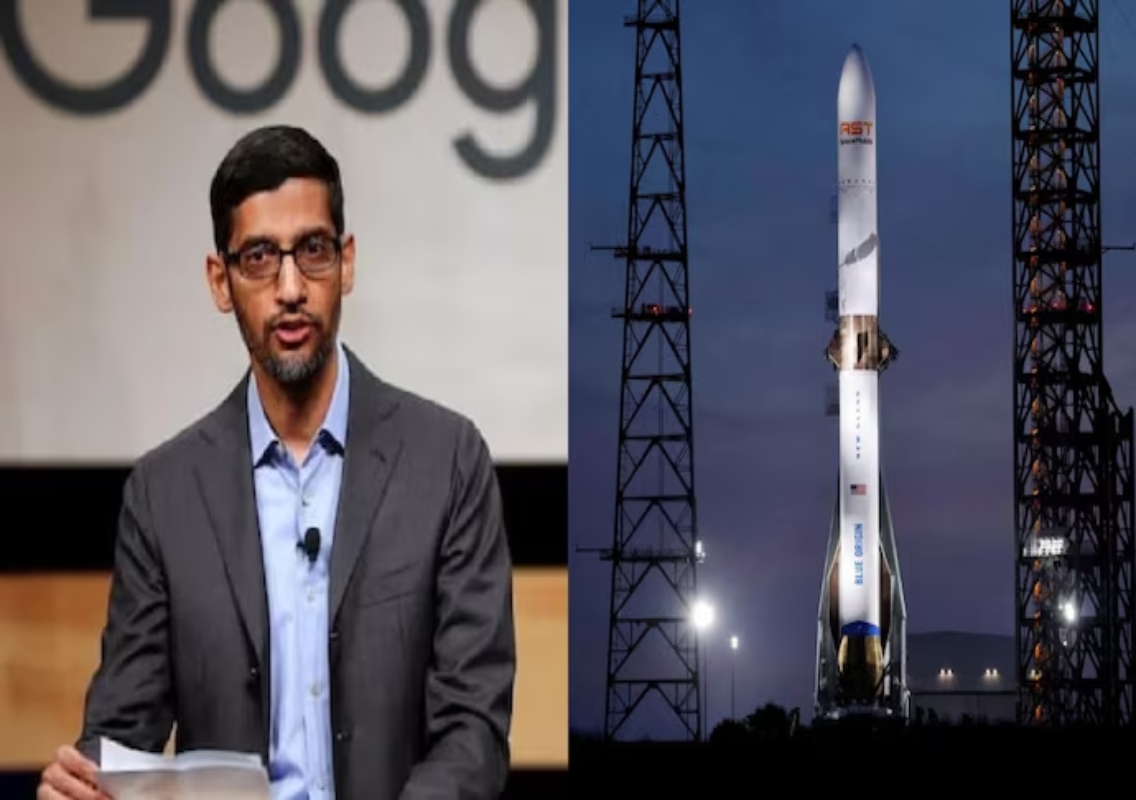


New Delhi: Google has partnered with Jeff Bezos’ space company Blue Origin to send artificial intelligence (AI) computing satellites into orbit, taking its ambitious plan to build data centres in space a step closer to reality. The first dedicated launch under the partnership is targeted for the first quarter of 2029 and will use Blue Origin’s heavy-lift New Glenn rocket.
The project, called Project Suncatcher, aims to explore whether solar-powered satellites equipped with Google’s custom AI chips can operate as interconnected computing infrastructure in space. Each satellite is expected to carry computing capacity roughly equivalent to a rack of servers in a conventional data centre.
Google announced the partnership on November 19, describing it as an important milestone in its long-term effort to expand AI infrastructure beyond Earth. The company believes that abundant solar energy in orbit could eventually help address some of the electricity, land and cooling requirements associated with large data centres on the ground.
However, the initiative remains an experimental research project. The upcoming launch will test the technology’s potential rather than establish a fully operational commercial data centre network in space.
Google selects Blue Origin’s New Glenn rocket
Under the agreement, Blue Origin will provide launch services for Google’s Project Suncatcher satellites. The company’s New Glenn rocket will carry several computing satellites into a sun-synchronous orbit during the first quarter of 2029.
This will be Google’s first dedicated heavy-lift launch for the project. The satellites will carry Tensor Processing Units (TPUs), Google’s specialised processors designed to handle artificial intelligence and machine learning workloads.
According to Google, each satellite will have computing capacity approximately equal to a conventional data centre rack. The spacecraft will be placed in an orbit that offers near-continuous exposure to sunlight, allowing the company to investigate whether solar energy can reliably power intensive computing operations.
The partnership is significant for Blue Origin as well. Founded by Amazon founder Jeff Bezos, the company has been working to expand its launch services business through New Glenn, a heavy-lift rocket designed to transport large payloads into orbit.
The agreement gives Blue Origin another major customer for its launch vehicle while providing Google with a dedicated rocket mission for its space-computing research.
What is Google’s Project Suncatcher?
Project Suncatcher is Google’s long-term research initiative to explore the possibility of running AI computing workloads in space.
The concept involves placing specialised computing hardware aboard satellites powered by solar energy. Instead of building all computing infrastructure on land, Google wants to investigate whether networks of satellites can perform certain AI processing tasks while operating in orbit.
The idea is connected to the growing demand for computing power as artificial intelligence becomes more widely used. Training and operating advanced AI models require substantial computing resources, and conventional data centres need large amounts of electricity, land and cooling infrastructure.
Google is exploring whether solar-powered orbital systems could eventually offer an alternative way to expand computing capacity.
The proposed satellite network would use Google’s TPUs to process machine learning workloads. The satellites would also need reliable communication links to exchange information and connect with systems on Earth.
The company has described the initiative as a long-term technological ambition rather than a near-term replacement for existing data centres.
Google has already tested AI computing in space
The partnership with Blue Origin builds on an earlier milestone achieved by Google in October 2026.
Google and satellite company Planet Labs launched the first Project Suncatcher prototype aboard a SpaceX rocket on October 1. The satellite was designed to test whether Google’s AI processors could operate in the challenging environment of space.
On October 30, Google announced that the prototype had successfully generated its first AI response using a data-centre-class TPU in orbit.
Engineers sent a prompt to the satellite’s onboard Gemma 4 open model, asking it to write a haiku about space. The satellite processed the request and transmitted the response back to Earth during a ground-station communication window.
Google described the achievement as its first successful AI response from a data-centre-class processor operating in orbit.
The prototype is also being used to assess how the computing hardware performs under radiation exposure and thermal stress. These tests are important because electronic components in space face conditions that are very different from those inside conventional data centres.
The company has said that its next major milestone is to test two interconnected satellites in 2027. Such a system would help engineers examine how multiple spacecraft could communicate and share computing workloads.
Why does Google want to build data centres in space?
One of the main attractions of space-based computing is access to solar energy.
Ground-based data centres require substantial electricity to operate servers and specialised AI processors. They also need cooling systems to manage the heat generated by high-performance computing equipment.
In orbit, satellites can be positioned to receive sunlight for much of their orbital period. This could potentially provide a consistent source of solar energy without depending entirely on electricity infrastructure on Earth.
Space-based computing could also reduce some of the land requirements associated with building large facilities. As AI adoption increases, technology companies are looking for ways to expand computing capacity without placing additional pressure on local power grids and infrastructure.
However, solar energy alone does not make orbital data centres commercially viable. Satellites must carry power-generation equipment, processors, communication systems and thermal management hardware. The cost of launching and maintaining these systems also needs to be considered.
Google’s experiment is intended to determine whether the potential advantages can outweigh these challenges.
Cooling and radiation remain major technical challenges
Operating powerful AI processors in space presents several engineering difficulties.
The first major challenge is radiation. Satellites are exposed to high-energy particles that can damage electronic components or cause errors in computing operations. AI processors must therefore be tested to determine whether they can continue working reliably under prolonged exposure.
The second challenge is heat management. On Earth, data centres use fans, air-conditioning systems and liquid-cooling arrangements to remove heat from servers. Space does not have the surrounding air required for conventional cooling.
Heat generated by processors must instead be transferred through specialised systems and released using radiators and other thermal-control equipment.
This becomes particularly important when several high-performance processors operate together on a satellite. Engineers must ensure that the hardware can maintain safe operating temperatures without relying on conventional data-centre cooling infrastructure.
Communication is another challenge. A network of satellites would need reliable, high-speed links to exchange information and coordinate computing tasks. Maintaining these connections between spacecraft moving in orbit requires sophisticated technology.
These issues will need to be addressed before space-based AI infrastructure can become commercially practical.
Blue Origin joins the competition for space data centres
Google is not the only company exploring the possibility of moving computing infrastructure into orbit.
SpaceX, led by Elon Musk, and other emerging companies such as Starcloud are also investigating space-based data centres as demand for AI computing continues to grow.
The concept has attracted attention because orbital infrastructure could potentially use solar power while reducing dependence on land-based electricity systems.
Blue Origin has also expressed interest in the broader space data-centre opportunity. The company previously sought regulatory permission in the United States for a large satellite constellation under a separate initiative called Project Sunrise.
Google’s agreement for Project Suncatcher, however, is specifically a launch-services partnership involving New Glenn. It should not be confused with a confirmed deployment of a large commercial satellite constellation.
The growing interest in orbital computing indicates that technology companies are considering alternatives to conventional data-centre infrastructure. But the technical and economic feasibility of these plans remains to be demonstrated.
When will Google’s AI data centres reach space?
Google’s first dedicated heavy-lift launch with Blue Origin is targeted for the first quarter of 2029. The mission will deploy several computing satellites using the New Glenn rocket.
Before that, Google plans to continue testing its existing prototype and work towards the interconnected satellite milestone expected in 2027.
The 2029 mission will be an important step in evaluating whether the technology can be scaled. It will not necessarily mean that commercial AI data centres will immediately become operational in orbit.
High launch costs, limited satellite manufacturing capacity, radiation protection, cooling systems and reliable communications remain significant obstacles. These factors could delay the transition from experimental satellites to a commercially viable network.
For now, Project Suncatcher represents Google’s attempt to explore a different future for AI infrastructure. Its partnership with Jeff Bezos’ Blue Origin gives the initiative a dedicated heavy-lift launch opportunity, but the larger question remains whether computing in space can eventually become practical and affordable.
If successful, the technology could open a new direction for the global AI industry. For the moment, however, Google is focused on proving that powerful AI processors can operate reliably beyond Earth.