







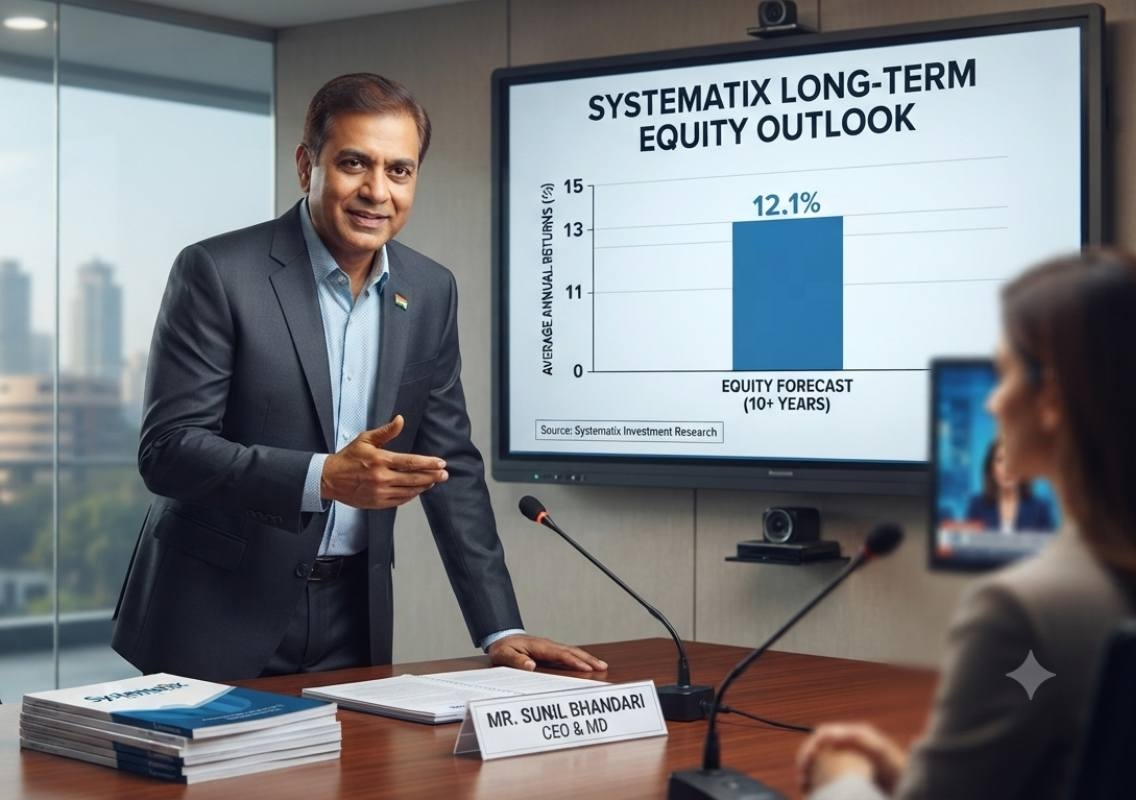


Mumbai: Indian investors should moderate their expectations from the equity market and use annual returns of 11-13% as a long-term planning assumption, rather than treating historical returns of 13-14% as a guaranteed outcome, Bhaskar Hazra, joint managing director and CEO of Systematix Private Wealth, has said.
In an emailed interaction with NDTV Profit, Hazra said historical 15-year rolling returns of 13-14% provide a useful reference for investors but should not be considered a promise of future performance.
“Historical 15-year rolling returns of 13-14% are a useful reference, not a promise,” Hazra said. “For planning, we would use a range of 11-13% a year over 10 years or more, rather than extrapolate past highs.”
His comments come amid continuing interest in Indian equities, supported by the country’s long-term economic growth prospects and structural investment themes. However, Hazra cautioned that economic growth and stock market returns do not necessarily move in tandem.
Equity returns depend on several factors, including corporate earnings growth, market valuations and, for foreign investors, currency movements. He said investors should distinguish between the country’s economic potential and the returns they can realistically expect from their portfolios.
Earnings growth will drive the next phase of market gains
Hazra said India’s long-term investment drivers remain intact. Consumption, infrastructure development, manufacturing and the increasing financialisation of household savings continue to offer opportunities for businesses and investors.
However, he believes the next phase of market gains will need to be supported by stronger corporate earnings rather than liquidity alone.
This distinction is important because abundant liquidity can push stock prices higher even when earnings growth does not fully justify valuations. For market performance to remain sustainable, companies will need to demonstrate their ability to grow profits.
Hazra said investors with a five-to-10-year investment horizon should focus on businesses with structural growth opportunities. Those investing over a shorter period of around 12 months, however, need to monitor valuations, liquidity conditions, interest rates, crude oil prices and global risk appetite more closely.
The difference in investment horizons also means that market volatility may affect investors differently. Long-term investors can assess companies based on their earnings potential and business fundamentals, while shorter-term investors may need to pay greater attention to macroeconomic developments.
Nifty valuations and India’s market premium
Hazra said the Nifty is currently trading at 20.5 times earnings, compared with its 10-year average of 20.9 times.
Although the valuation is close to its historical average, Indian equities continue to trade at a premium of around 60-75% over broader emerging markets.
This premium makes consistent earnings delivery particularly important. If corporate profits fail to meet expectations, elevated valuations could limit the scope for further market gains.
According to Hazra, a sustained rally would require three key conditions: broad-based earnings growth, macroeconomic stability and continued foreign portfolio investment inflows.
The valuation gap between India and other emerging markets also means that investors need to be selective. Companies with strong balance sheets, reliable earnings and sustainable growth prospects could be better positioned to justify their valuations.
Historical returns offer a reference, not a guarantee
Hazra pointed to the long-term performance of the Nifty 50 Total Return Index to explain why investors should avoid assuming that past returns will automatically continue.
The index’s 15-year rolling returns have averaged around 14% since June 1999. However, depending on the investment period, returns have ranged from approximately 9% to 19%.
The index has compounded at around 12.4% since its inception.
These variations show how the timing of an investment can influence the returns an investor receives, even when the investment is held over a long period.
Hazra therefore recommends using an annual return assumption of 11-13% for financial planning over 10 years or longer. Investors should also account for rupee depreciation when evaluating returns in US dollar terms, particularly those comparing Indian equities with international investments.
The broader message is that investors should remain invested in equities if their financial goals and risk appetite support it, but should avoid building plans around unusually strong historical performance.
Large-caps preferred over small-caps
In terms of market capitalisation, Hazra favours large-cap stocks and selective accumulation of quality mid-cap companies. He remains underweight on small-cap stocks.
He expects large-cap earnings growth of around 14-15%, making the segment an important part of his market preference.
His approach reflects the importance of earnings visibility and business quality in a market where valuations remain a key consideration. Selective exposure to mid-caps may offer opportunities, but investors need to assess individual companies rather than assume that the entire segment will perform uniformly.
Financials, industrials and healthcare among preferred sectors
Hazra identified financials, industrials and healthcare as his preferred sectors over the next three years.
His preference for financial companies is linked to credit growth and the continued expansion of India’s financial system. Industrials could benefit from infrastructure investment and manufacturing activity, while healthcare offers opportunities supported by rising demand.
These sectors also reflect some of the structural themes that Hazra believes will support India’s long-term investment outlook.
However, he emphasised the importance of earnings performance and valuations in determining which companies are positioned to benefit from these trends.
Crude oil and inflation remain important risks
Hazra said a sustained rise in Brent crude prices above $100-$105 a barrel for two to three quarters would prompt him to reassess earnings estimates and exposure to oil-sensitive sectors.
Higher crude prices can increase input costs for several industries and put pressure on corporate margins. The impact can be particularly significant for businesses that are unable to pass higher costs on to consumers.
He identified consumer staples, automobiles, chemicals, aviation and oil marketing companies as sectors that could face vulnerability if food and energy prices rise.
Inflationary pressures could also influence interest rates and household spending, creating additional challenges for businesses and the broader market.
For investors, crude oil prices therefore remain an important indicator to monitor while assessing the outlook for corporate earnings.
Foreign investor buying needs closer monitoring
Hazra described the foreign portfolio investor (FPI) buying recorded in November as a positive signal. However, he cautioned that it was too early to conclude that foreign capital was returning to Indian equities on a sustainable basis.
Foreign investment flows can be influenced by global interest rates, currency movements, geopolitical developments and investor appetite for emerging markets.
A sustained return of foreign capital could support market sentiment, but Hazra said investors should look for continued inflows rather than draw conclusions from a single month’s activity.
Private credit and real estate outlook
Beyond listed equities, Hazra also discussed opportunities and risks in private credit and real estate.
He said senior-secured private credit strategies offer gross yields of around 11-15%. However, strategies targeting higher returns can involve a wider range of outcomes and depend heavily on the quality of underwriting, deal structuring and enforcement mechanisms.
The stated yields should therefore not be viewed as assured returns, as the underlying credit risks and recovery prospects can vary across investments.
In real estate, Hazra sees a gradual shift towards financial investment avenues such as real estate investment trusts (REITs). These instruments provide investors with an alternative way to participate in income-generating property assets.
Physical property, however, continues to have a role in wealth preservation and legacy planning.
Long-term discipline remains important for equity investors
Hazra’s outlook points to a continued role for Indian equities in long-term portfolios, but with more measured return expectations.
The country’s consumption, infrastructure, manufacturing and financialisation themes remain important growth drivers. However, market performance will increasingly depend on whether companies can translate these opportunities into earnings growth.
For investors, the suggested annual return assumption of 11-13% over a decade or longer offers a more cautious basis for financial planning than simply extrapolating historical highs. Valuations, crude oil prices, inflation, interest rates and foreign investment flows will remain important factors to monitor.
I’m not a financial advisor. The return figures and market preferences above reflect Hazra’s views and are not guaranteed outcomes or personalised investment recommendations.