







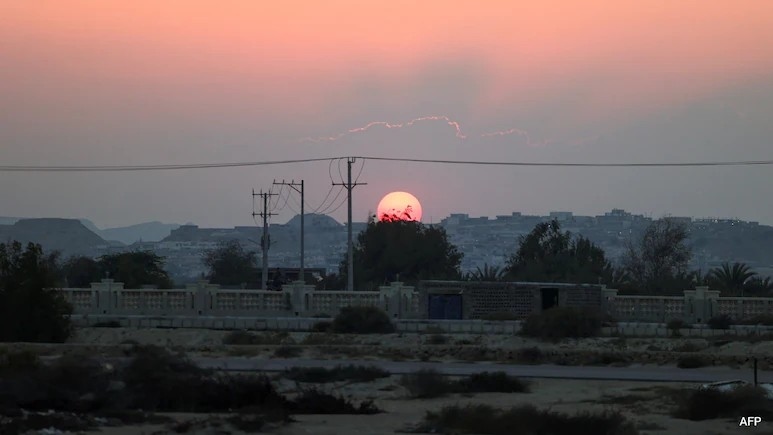


Qeshm Island, Iran: Explosions were heard off the coast of Iran’s Qeshm Island in the Strait of Hormuz, according to Iranian state media, adding to concerns over security in one of the world’s most strategically important waterways.
Iran’s official IRNA news agency reported that two explosions were heard from the direction of the sea near Qeshm Island. The report, carried by NDTV in a syndicated feed, did not provide immediate details about the cause of the blasts, possible targets or casualties.
The development comes amid continuing military tensions between Iran and the United States and growing disruption to maritime traffic in and around the Strait of Hormuz. The waterway is a crucial route for international energy shipments, and heightened military activity in the region has raised concerns about the safety of commercial vessels and the potential impact on global oil supplies.
Explosions reported from the direction of the sea
According to IRNA, residents on Qeshm Island heard two explosions coming from the sea. The report did not immediately establish whether the explosions were linked to an attack, an interception operation or another military incident.
Qeshm is Iran’s largest island and lies close to the Strait of Hormuz, a narrow maritime passage connecting the Persian Gulf with the Gulf of Oman. Its location gives the island considerable strategic importance, particularly during periods of military confrontation.
The latest report follows other incidents involving explosions and military activity around Iran’s southern coast. Reuters reported earlier this month that explosions were heard in Bandar Abbas, Sirik and on Qeshm Island after Iranian media reported attacks in the area.
Strait of Hormuz remains under severe pressure
The latest incident comes against a backdrop of serious disruption to shipping through the Strait of Hormuz.
Commercial vessels have been affected by the continuing tensions, with some ships remaining anchored between Qeshm and nearby Larak Island. Footage made available through Reuters showed commercial vessels gathered in the area as shipping activity through the strategic waterway remained sharply reduced.
The situation has also raised concerns about energy supplies. Reuters reported on September 13 that a vessel in the Strait of Hormuz was struck by a projectile, with the extent of damage still unclear. The incident has intensified fears about threats to global oil supplies amid the wider regional conflict.
The Strait normally carries a significant share of the world’s oil shipments, making any prolonged disruption potentially consequential for energy markets and economies that depend heavily on Gulf supplies.
Shipping risks continue to grow
The security situation has already affected commercial shipping in the region. Reuters reported that a Thai-flagged bulk carrier, the Mayuree Naree, was damaged in a missile attack near the Strait of Hormuz and later ran aground off Qeshm Island. The vessel had been travelling from the United Arab Emirates towards India when it was struck.
The damaged vessel remained near the coast, with local fishermen reportedly warning about the risks posed by the wreck. Reuters Connect noted that the material was supplied by Anadolu Agency and that Reuters had not independently verified or endorsed the accompanying claims.
The presence of damaged vessels and ships waiting offshore illustrates the wider difficulties faced by maritime operators navigating the region.
Diplomatic efforts face major challenges
Alongside the military tensions, diplomatic efforts have continued over the future of the Strait of Hormuz.
Iranian President Masoud Pezeshkian has indicated that Tehran could reopen the waterway under conditions linked to the conflict with the United States. Reuters reported that an understanding between Iran and Oman did not provide for an immediate reopening of the Strait, although it could lay the groundwork for reopening it in the future.
Meanwhile, Iran and the United Arab Emirates backed a BRICS statement calling for restraint, protection of civilians and the safeguarding of global trade and maritime stability. The diplomatic engagement took place amid continuing tensions between Iran and several regional states.
Global energy concerns deepen
The risks extend beyond the immediate region. Saudi Arabia recently shut down its East-West oil pipeline after a drone attack, according to Reuters. The pipeline normally provides an alternative route for Saudi oil exports when the Strait of Hormuz is disrupted and can transport around 4–5 million barrels of oil per day.
Oil prices have consequently come under renewed pressure, while governments and energy markets are closely watching developments around both the Strait of Hormuz and the Red Sea.
For now, the precise cause of the explosions heard off Qeshm Island remains unclear. No immediate details of casualties or damage were provided in the initial report. The incident nevertheless highlights the continuing volatility around the Strait of Hormuz, where military confrontation, commercial shipping risks and diplomatic negotiations are unfolding simultaneously.