









CHRISTCHURCH: Former India fast bowler Dodda Ganesh has questioned the selection of young pacer Gurnoor Brar for the second Test against New Zealand, suggesting that the Punjab-born bowler earned his place primarily because of his bowling abilities rather than his first-class cricket record.
Brar made his much-awaited Test debut at Hagley Oval in Christchurch on November 27, becoming India’s 321st Test cricketer. However, his inclusion in the playing XI attracted attention after Ganesh publicly expressed reservations about the decision.
Reacting to a cricket fan’s post highlighting Brar’s domestic cricket statistics, Ganesh shared a blunt assessment on social media platform X.
“He’s definitely picked only on the basis of his skill set. Nothing to show for at the FC level,” Ganesh wrote.
His comments sparked discussion about the selection criteria for India’s Test squad, particularly the importance of domestic red-ball performances when identifying players for the country’s longest format.
Dodda Ganesh raises questions about Brar’s first-class record
Ganesh’s criticism centred on whether Brar’s performances in first-class cricket were sufficient to justify his elevation to the national Test side.
The 26-year-old fast bowler has played 22 first-class matches and claimed 71 wickets at an average of 26.41. While those figures demonstrate his ability to take wickets in the longer format, Ganesh appeared to suggest that his selection was influenced more by his natural bowling attributes and potential than by his overall domestic record.
A significant portion of Brar’s first-class success came during the 2024-25 Ranji Trophy season, when he picked up 26 wickets in seven matches for Punjab.
His performances during that campaign helped establish him as a promising fast-bowling prospect. Nevertheless, Ganesh’s remarks have brought renewed attention to the debate over whether recent international white-ball performances should influence Test selection.
The former India pacer did not suggest that Brar lacked bowling ability. Instead, his observation focused on the distinction between selecting a player for his potential and rewarding consistent performances in first-class cricket.
Impressive ODI performances earned Brar his opportunity
Brar’s recent performances against New Zealand in the ODI series played an important role in his elevation to the Test squad.
The right-arm fast bowler enjoyed an impressive run during the limited-overs contest, claiming nine wickets in three innings. His standout performance came in Wellington, where he returned figures of 4/30.
His ability to generate bounce, maintain pace and trouble New Zealand’s batters made him one of the notable performers in the series.
Following those performances, the Board of Control for Cricket in India (BCCI) added Brar to the Test squad as a replacement for left-arm wrist-spinner Kuldeep Yadav.
Brar was subsequently withdrawn from the fifth ODI at Bay Oval so that he could join the Test squad.
The decision provided him with an opportunity to make his mark in the longest format, despite the debate surrounding his domestic red-ball credentials.
Brar replaces Prasidh Krishna in the playing XI
India made one change to their playing XI for the second Test against New Zealand following the drawn opening match in Wellington.
Brar replaced Prasidh Krishna, earning his maiden Test cap at Hagley Oval. India captain Shubman Gill won the toss and elected to bowl first, expecting the grass-covered surface to provide assistance to the fast bowlers.
The occasion was particularly special for Brar, who received his Test cap from senior fast bowler Jasprit Bumrah.
Bumrah congratulated the youngster and reminded him of the hard work, dedication and sacrifices required to represent India in Test cricket.
He also encouraged Brar to respect the honour and make the most of the opportunity.
The presentation was an important milestone in the young pacer’s career, marking his transition from domestic and limited-overs cricket to the highest level of international red-ball cricket.
Brar makes an immediate impact on Test debut
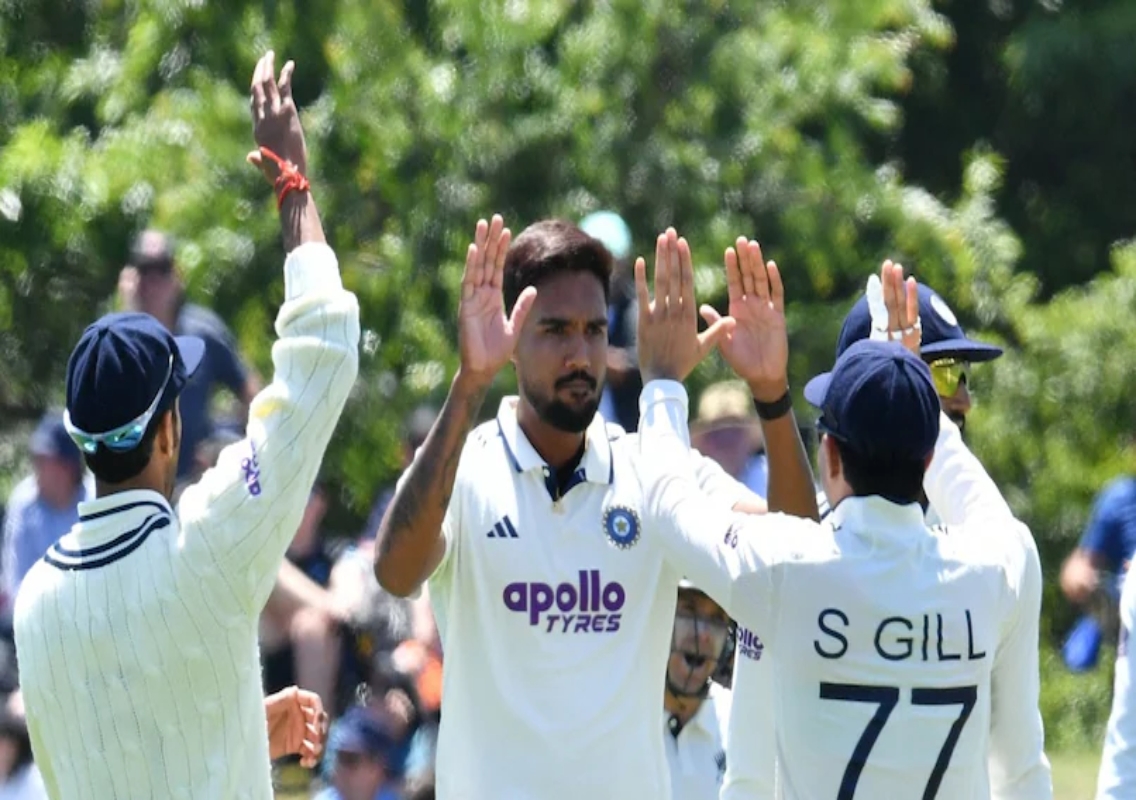
Brar did not have to wait long to claim his maiden Test wicket.
New Zealand openers Devon Conway and Tom Latham provided a steady start to their innings, putting together a 77-run opening partnership.
However, Brar struck on the final delivery before lunch, trapping Conway leg-before-wicket for 31 runs.
The breakthrough gave India an important opening after the hosts had negotiated the initial bowling challenge.
Brar finished the opening day with figures of 1/52 from 19 overs. Although he could not add to his wicket tally after dismissing Conway, his first Test wicket represented a memorable beginning to his international red-ball career.
India’s bowlers subsequently made progress during the afternoon session, putting New Zealand under pressure.
Akash Deep dismissed Tom Latham for 59 and later removed Rachin Ravindra for a duck. Anshul Kamboj also contributed by dismissing Henry Nicholls, while Washington Sundar sent Daryl Mitchell back to the pavilion for 31.
New Zealand attempted to rebuild through their middle order, with Tom Blundell and Glenn Phillips providing resistance towards the end of the day.
The hosts eventually finished the opening day at 246/5, leaving the match delicately balanced.
Gurnoor Brar’s first-class and international statistics
Brar’s selection has drawn attention to the importance of evaluating fast bowlers across different formats.
His first-class record includes 71 wickets from 22 matches at an average of 26.41. His best first-class bowling figures are 6/68, while his performances for Punjab during the 2024-25 Ranji Trophy season helped strengthen his reputation.
His nine wickets against New Zealand in the preceding ODI series also demonstrated his ability to perform against international opposition.
The two sets of performances offer different indications of his development. His domestic record reflects his experience in longer-format cricket, while his recent ODI performances highlighted his ability to trouble established international batters.
At 26, Brar has an opportunity to establish himself as a regular member of India’s pace-bowling group. His height and ability to extract bounce could also provide the team with another option in conditions that favour fast bowling.
However, Test cricket demands consistency over longer spells, disciplined line and length, and the ability to adapt to changing match situations.
His performances in the New Zealand series will therefore be closely followed as he begins his journey in international red-ball cricket.
Selection debate puts spotlight on India’s fast-bowling choices
Ganesh’s remarks have once again highlighted the discussion surrounding India’s approach to Test selection.
First-class cricket, particularly the Ranji Trophy, has traditionally been an important pathway for players seeking to represent India in Test matches.
Domestic competitions allow selectors to assess a player’s technical abilities, temperament, fitness and consistency over several days.
At the same time, modern cricket increasingly requires selectors to consider performances across formats, individual skill sets and the conditions expected during overseas tours.
Brar’s inclusion reflects the importance attached to his recent performances and fast-bowling potential. Ganesh’s criticism, meanwhile, raises questions about the weight given to sustained first-class performances when making such decisions.
Ultimately, the responsibility now rests with Brar to justify the confidence shown in him by the team management.
Brar faces the challenge of establishing himself in Test cricket
Making a Test debut is a significant achievement for any cricketer, but maintaining a place in the team presents an entirely different challenge.
For Brar, the New Zealand series provides an opportunity to demonstrate that his bowling skills can translate into consistent performances in the longest format.
His ODI performances have already given him recognition, and his first Test wicket will provide confidence as he continues his international journey.
Ganesh’s comments have added another dimension to the discussion surrounding his selection. While the former India pacer has questioned the first-class credentials behind the decision, Brar now has an opportunity to answer those questions through his performances on the field.
The coming matches will be important in determining how effectively the young pacer can adapt to the demands of Test cricket and establish himself as a dependable option for India.