


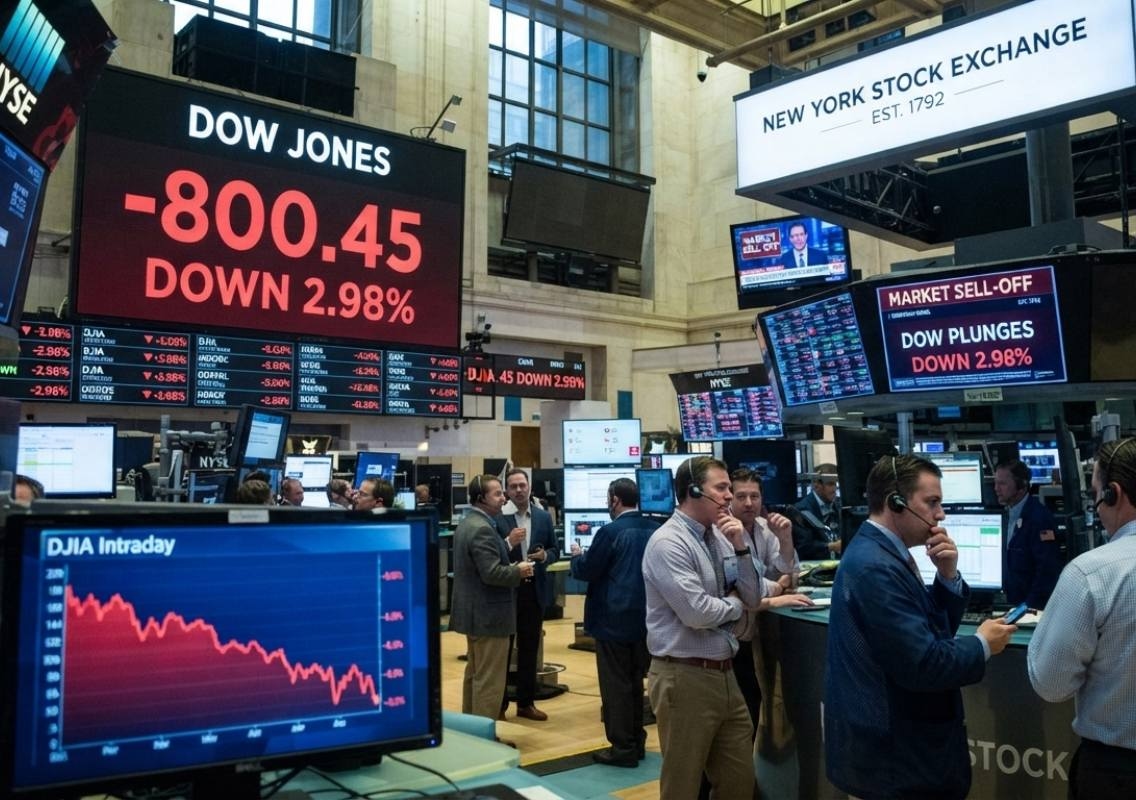


New York: US stock markets reversed their early gains on Thursday, with the Dow Jones Industrial Average falling sharply after an initial rally fuelled by optimism surrounding artificial intelligence company Anthropic’s record-breaking initial public offering (IPO).
The Dow was down 538 points, or 1.07%, at 49,660 around 10.40 am ET, nearly 800 points below its session high of 50,455. The S&P 500 slipped 0.67% to 7,275, trading approximately 1.9% below its intraday peak.
The technology-heavy Nasdaq Composite, which had surged as much as 2% at the opening, was almost flat at 24,410 after briefly moving into negative territory.
The reversal came even as investors awaited Anthropic’s first trade on the Nasdaq under the ticker symbol ANT. The company, which develops the Claude artificial intelligence chatbot, had priced its IPO at $83 per share on Wednesday, above its marketed range of $70 to $78, raising $81.3 billion.
According to Reuters, indications suggested that the stock could open near $99.82 as of 9.50 am ET, around 20% above its offer price.
Despite the excitement surrounding the listing, three major factors weighed on Wall Street: fading momentum in AI stocks, weakness in major Dow components and renewed concerns over inflation and interest rates.
1. AI trade loses momentum despite Anthropic IPO
The first reason behind the market reversal was the inability of technology stocks to sustain their early gains.
Investors initially viewed Anthropic’s massive IPO as a potential catalyst for the artificial intelligence trade, which had come under pressure amid concerns about high valuations and the enormous investment required to develop AI infrastructure.
However, chipmakers that had led the early rally gave back a significant portion of their gains.
Nvidia was up around 1.2% at $152.74 at approximately 10.30 am ET, well below its session high of $158.13. Micron, which had climbed as much as 6% in early trading, was up around 2.7%, approximately 4.7% below its peak.
The pattern was similar to Wednesday’s trading session, when AI hardware stocks initially advanced but lost momentum by the close. Nvidia fell nearly 3% despite reporting earnings above estimates.
The fading gains suggest that investors remain cautious about buying technology stocks at elevated valuations, even when companies deliver strong results or attract substantial market interest.
Jake Behan, head of capital markets at Direxion, told Reuters before Anthropic’s debut that the week’s market movements represented a broader assessment of the AI sector.
He said Nvidia had provided an indication of the strength of the AI infrastructure buildout, while Anthropic’s listing would offer insight into investor appetite for the next generation of AI companies.
Matt Maley, chief market strategist at Miller Tabak + Co, raised a similar question in a note cited by CNN. He questioned whether Anthropic’s IPO could breathe new life into the AI trade and support another phase of the technology sector’s bull market.
The market’s reaction suggested that investors were not yet convinced that one major IPO could reverse the broader weakness in AI-related stocks.
2. UnitedHealth and Walmart weigh on the Dow
The Dow’s heavier losses were also driven by weakness in companies outside the technology sector, particularly UnitedHealth and Walmart.
UnitedHealth shares fell around 4%, extending a selloff in managed-care stocks that began after the Centers for Medicare & Medicaid Services proposed recovering Medicare Advantage overpayments dating back to 2018.
The stock had already declined more than 10% on Wednesday, adding to the pressure on the healthcare sector.
The proposed recovery of overpayments has raised concerns among investors about the financial implications for companies operating in the Medicare Advantage market.
UnitedHealth’s continued decline contributed to the Dow’s weakness, showing that the index’s performance was being affected by more than the reversal in technology shares.
Walmart also traded lower, slipping around 1.4% following the release of its quarterly results.
Although the retailer raised its full-year guidance, its outlook implied fourth-quarter earnings below Wall Street estimates. The market reaction indicated that investors were looking beyond the improved annual guidance and focusing on the weaker earnings expectations for the final quarter.
The declines in these major companies added to the pressure on the Dow, which had already surrendered much of its opening advance.
3. Inflation concerns and interest rates return to focus
The third factor weighing on equities was renewed anxiety about inflation and the possibility of further interest rate increases by the US Federal Reserve.
The bond market offered little relief to investors. The yield on the 10-year US Treasury stood at 5.07%, after touching 5.11% earlier in the session.
Higher government bond yields can make fixed-income investments more attractive relative to equities. They can also increase borrowing costs for businesses and consumers, putting pressure on company valuations and economic activity.
Economic data released before the market opened added to inflation concerns.
The Philadelphia Federal Reserve’s manufacturing index fell to 6.3 in November, significantly below economists’ expectations of 18.
At the same time, its prices received gauge climbed to its highest level since June 2022, indicating continued pressure on prices received by manufacturers.
Initial jobless claims also increased to 203,000, above economists’ estimates of 197,000.
The combination of weaker manufacturing activity and rising price pressures created uncertainty about the direction of the US economy. While the manufacturing index indicated a slowdown, the increase in the prices received gauge raised concerns that inflation could remain persistent.
The data arrived a day after minutes from the Federal Reserve’s October meeting showed that almost all officials expected further interest rate increases.
Markets were consequently pricing in a near-certain quarter-point rate hike in December.
The prospect of higher borrowing costs has become another concern for equity investors, particularly at a time when technology companies are committing substantial amounts of capital to artificial intelligence development and infrastructure.
Investors question the outlook for equities
The sharp reversal on Thursday highlighted the uncertainty surrounding Wall Street, despite the excitement generated by Anthropic’s record IPO.
While the listing attracted strong interest and offered a fresh test of investor demand for AI companies, technology stocks struggled to hold on to their early gains.
At the same time, weakness in healthcare and retail shares added pressure to the Dow, while inflation data and expectations of further Federal Reserve rate increases weighed on broader market sentiment.
Some market participants have become increasingly cautious about the outlook for equities.
Joachim Klement, a research analyst at Panmure Liberum, said on Thursday that he would exit equities entirely.
“I will sell my personal holdings in stocks and move into long-term government bonds,” he said.
His comments reflect the concerns among some investors about the balance between equity valuations, economic uncertainty and the attractiveness of government bonds.
For Wall Street, the immediate question is whether Anthropic’s market debut can restore confidence in the AI trade or whether broader concerns about inflation, interest rates and corporate earnings will continue to dominate trading.