







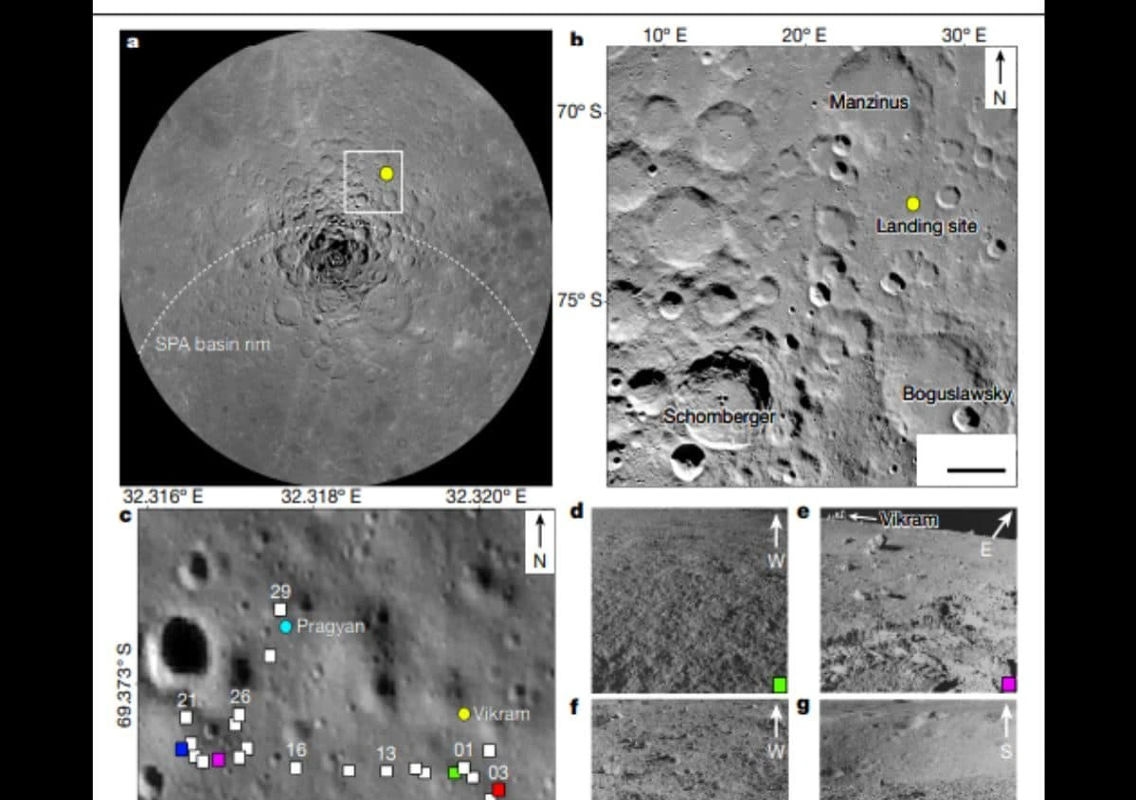


New Delhi, 22 August 2024 — India’s Chandrayaan-3 mission has provided groundbreaking evidence supporting the hypothesis of a vast magma ocean that once covered the Moon’s southern highlands. Launched by the Indian Space Research Organization (ISRO) on July 14, the spacecraft made history by landing near the lunar South Pole on August 23.
The findings, revealed by scientists from Ahmedabad’s Physical Research Laboratory (PRL), were published in the peer-reviewed journal Nature on the mission’s first anniversary. The study presents concrete evidence supporting the Lunar Magma Ocean (LMO) hypothesis, which posits that the Moon was once enveloped by a giant ocean of magma during its early formation.
Lead author Professor Santosh Vadawale, an astrophysicist at PRL, explained that although previous lunar missions provided some insights, they primarily focused on the Moon’s equatorial and mid-latitude regions. Chandrayaan-3’s data from the South Pole provided the first in-situ measurements of the lunar soil (regolith) from this relatively unexplored area, revealing crucial details about the Moon’s early composition.
The mission used the Alpha Particle X-ray Spectrometer (APXS) aboard the Pragyan rover to analyse the lunar soil. The data showed a uniform elemental composition of the regolith, consistent with samples previously collected from different lunar regions. This similarity in chemical composition supports the LMO hypothesis, which suggests that during the Moon’s formation, less dense ferroan anorthosite rocks floated to the surface, while heavier minerals sank, forming the mantle.
The analysis confirms that the landing site was composed predominantly of ferroan anorthosite, a rock type that formed the Moon’s highlands. This discovery aligns with the theory that the Moon’s surface evolved from a molten state, with the lighter materials solidifying into the highlands as the Moon cooled.
These findings are significant for understanding the Moon’s formation and evolution. They also have implications for future lunar exploration missions. With countries racing to establish lunar bases, NASA’s Artemis programme and ISRO’s planned 2027 mission aim to collect and return lunar samples to Earth. The new data will aid in these future endeavours, enhancing our understanding of lunar geology and preparing for sustained lunar exploration.
Chandrayaan-3’s Pragyan rover travelled 103 meters on the lunar surface, conducting 23 scientific observations. The APXS instrument measured the elemental composition of the Moon’s regolith, providing essential data on the Moon’s formation and evolutionary history. The mission’s success underscores the capabilities of India’s space exploration programme and its contributions to lunar science.
India’s Chandrayaan-3 mission has delivered a major breakthrough in lunar science, confirming the presence of a primordial magma ocean on the Moon. This discovery enhances our understanding of the Moon’s early history and will influence future space missions and research.