


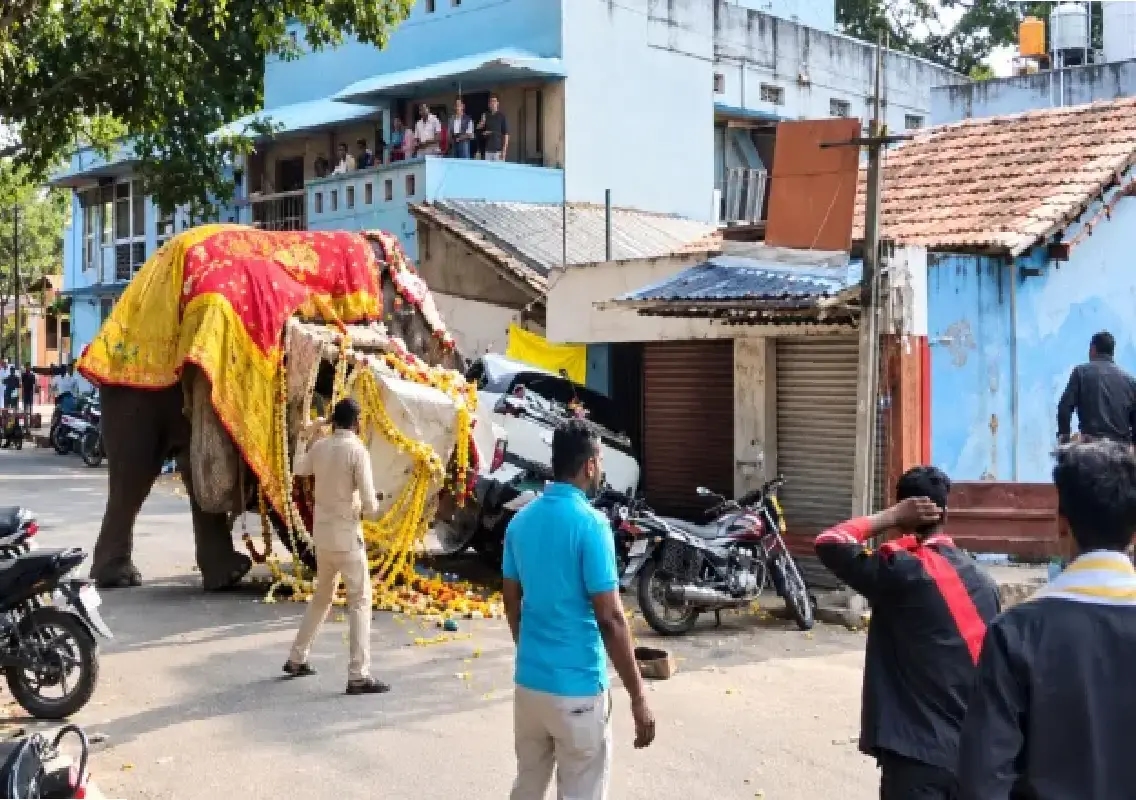


Shivamogga: The recent incident in which a trained elephant ran amok during Shivamogga Dasara has reignited the debate over the use of elephants in religious and cultural celebrations across Karnataka, with wildlife experts and animal welfare activists calling for safer, animal-friendly alternatives.
Experts have raised concerns over animal welfare, public safety and compliance with wildlife protection laws, pointing out that elephants are increasingly being used in processions and religious events at various locations. They argue that traditions can be preserved without subjecting animals to stressful conditions or exposing people to potential danger.
The debate has gained urgency following the Shivamogga incident, which has prompted the state Forest Department to consider stricter conditions for allowing elephants to participate in religious and cultural processions.
Elephant processions spread beyond Mysuru Dasara
The use of elephants is most closely associated with the Mysuru Dasara Jamboo Savari, during which an elephant carries the Golden Howdah, weighing more than 750 kg, with the idol of Goddess Chamundeshwari.
However, similar Dasara processions have also been organised in Nanjangud, Srirangapatna, Shivamogga, Dharwad, Tumakuru, Hampi and other places over the years.
The growing use of elephants at public events has prompted questions about whether adequate arrangements are in place to ensure the safety of both the animals and spectators.
A Mysuru-based expert who works closely with the Forest Department said elephants were captured from the wild and brought into captivity for various purposes. While most captive elephants are under the care of the Forest Department, some remain under private ownership, the expert noted.
The expert also raised concerns about the methods used to train elephants and argued that their bodies were not designed to carry heavy loads on their backs.
Animal welfare concerns over training and processions
Suparna Ganguly, trustee of Bengaluru-based Compassion Unlimited Plus Action (CUPA), said the training elephants undergo to participate in processions and carry howdahs, statues and people could cause severe stress and potentially result in trauma-related behavioural problems.
She pointed out that elephants are sensitive to noise and may become distressed by firecrackers, loud music, crowds and traffic. Prolonged exposure to heat and walking on hard concrete roads can also cause discomfort, she said.
Ganguly warned that elephants exposed to such stressful conditions could behave unpredictably, creating risks for both people and the animals themselves.
She questioned whether the spectacle of a procession justified the potential danger and suffering involved.
Ganguly also referred to government directives and court orders that impose restrictions on the use of elephants in certain activities, arguing that existing safeguards must be taken seriously.
Animal welfare advocates say the issue requires a broader review of how elephants are housed, trained and used at religious and cultural events, rather than relying solely on measures introduced after an incident.
Experts suggest alternatives to carrying the Golden Howdah
Raman Sukumar, former chairman of the Karnataka Elephant Task Force, said he was not opposed to Dasara traditions or celebrations but believed it was time to consider alternative ways of preserving them.
He suggested using mechanised elephants as one possible option. He also pointed to a mural at Jaganmohan Palace in Mysuru that depicts an earlier Dasara procession in which elephants pulled a chariot carrying the idol of Goddess Chamundi, rather than carrying the idol on their backs.
Sukumar suggested that this approach could be reconsidered alongside the possibility of using a lighter Ambari.
Such alternatives, he said, could allow the festival to retain its cultural significance while reducing the physical burden on elephants.
The suggestions also raise the possibility of separating the symbolic elements of the procession from practices that may place animals under physical or psychological stress.
Call for better care of captive elephants
Sukumar also expressed concern about the living conditions of privately owned elephants, saying many lived solitary lives despite elephants being social animals.
He suggested that temples, mutts and other religious institutions could form societies and establish common facilities to improve the overall welfare of elephants under their care.
Shared facilities could, in principle, help institutions coordinate care and provide better living conditions. Any such arrangement would need to account for the animals’ individual needs, veterinary care and applicable legal requirements.
Experts say improvements in housing and care must accompany any review of the use of elephants in public events.
Forest Department plans stricter conditions
Following the Shivamogga incident, Forest Minister Ramalinga Reddy instructed the department to introduce stricter conditions before granting permission for elephants to participate in processions.
Kumar Pushkar, Principal Chief Conservator of Forests (Wildlife), said the preparation undertaken for Mysuru Dasara differed from that for many other events.
According to Pushkar, elephants selected for Mysuru Dasara undergo a preparation period of around two months to acclimatise them to crowds, noise and the overall festival environment. Similar preparation is often lacking at other events, he said.
The department is expected to formulate revised guidelines specifying stricter conditions that must be fulfilled before elephants can be used in religious and cultural processions.
The proposed changes are intended to strengthen oversight and ensure that organisers meet the necessary requirements before elephants are brought into crowded public settings.
Balancing cultural traditions and animal welfare
The debate over elephants in Dasara celebrations highlights the challenge of preserving longstanding cultural practices while responding to concerns about animal welfare and public safety.
Experts advocating alternatives say mechanised elephants, lighter howdahs and changes to procession formats could offer ways to retain important elements of the celebrations without placing live animals under excessive strain.
The proposed revisions to the Forest Department’s guidelines could also bring greater scrutiny to the preparation and conditions required for elephant participation at events beyond Mysuru.
The outcome of the review may influence how religious and cultural processions involving elephants are organised across Karnataka in the coming years.