


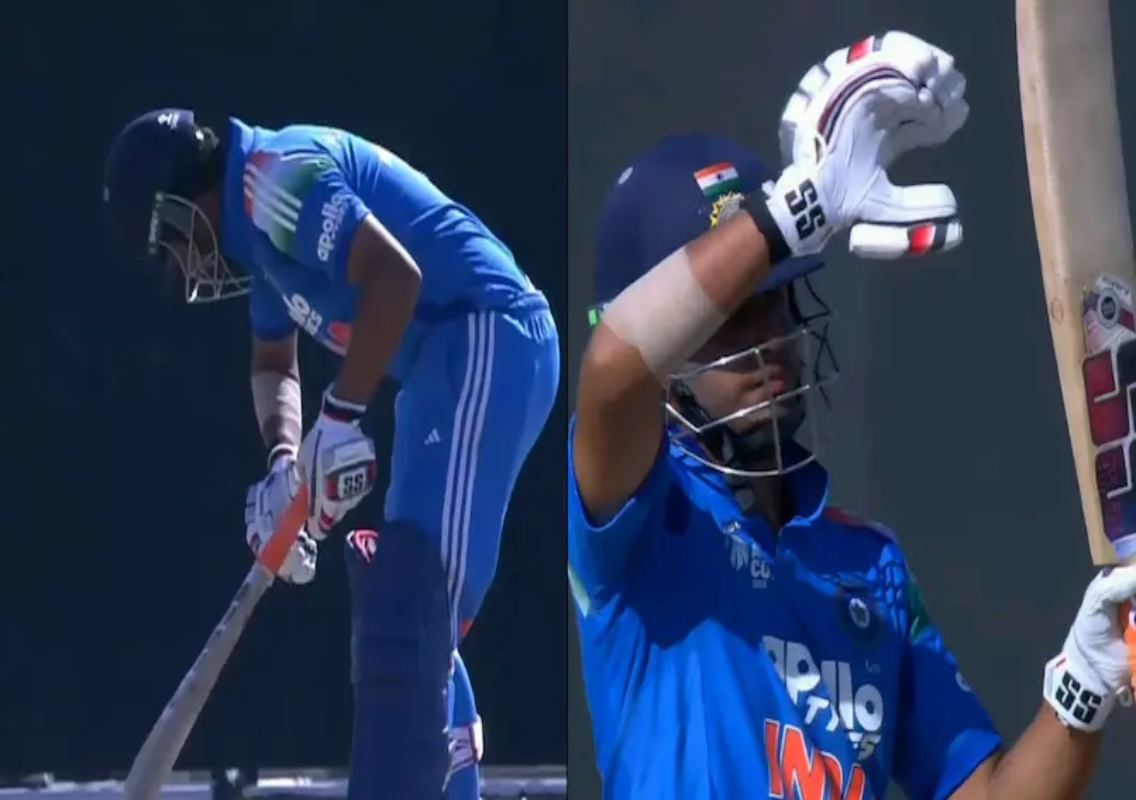


Al Amerat: India’s Under-19 batter Aaryavir Sehwag has revealed how repeatedly chanting “Sitaram, Sitaram” helped him remain composed during the tense closing stages of the team’s thrilling victory over Pakistan in the 2026 Under-19 Asia Cup final.
India pulled off a remarkable one-wicket victory after chasing down Pakistan’s 338-run target in a last-ball finish at the Al Amerat Cricket Ground in Oman on November 14. The contest swung repeatedly between the two teams before No. 10 batter Mohit Ulva struck the winning boundary from the final delivery.
Sehwag, who scored an important 58 off 61 balls, said the pressure of the occasion was intense. Recalling the dramatic moments in a video shared by the Board of Control for Cricket in India (BCCI), he explained that he began chanting “Sitaram, Sitaram” from the 32nd over as the Indian team attempted to keep its hopes alive.
His account offered a glimpse into the emotions inside the Indian camp during a final that tested the team’s belief, composure and batting depth.
‘Sitaram, Sitaram’: Sehwag’s way of handling pressure
Sehwag said he noticed India captain Lakshya Raichandani also trying to remain calm during the tense chase. Although he was unsure which name his captain was chanting, Sehwag said he repeatedly took the name of Sita Ram from the 32nd over.
“I had noticed Lakshya also. I don’t know which name he was chanting, but I was chanting ‘Sitaram Sitaram’ from the 32nd over,” Sehwag said.
He explained that there was considerable belief within the team despite the difficult position India found themselves in. Players and support staff were closely following the contest, with several members of the dugout remaining in the same place as the final overs unfolded.
“There was belief in the team, and quite a lot. Everyone was sitting in one place, not moving from their place. And everyone had the belief that the boys would do it, the boys would do it,” he recalled.
The young batter said the team’s belief was ultimately rewarded when Ulva struck the decisive boundary. Sehwag credited God’s grace for the outcome and described the victory as a memorable experience.
The chants became a personal way for him to manage the tension as Pakistan continued to put pressure on India’s lower order.
Sehwag battled severe pain after being hit on the arm
The final was not only a test of Sehwag’s temperament but also of his physical resilience. The opener revealed that he was in considerable pain after being struck on the arm while batting.
He said the impact left his arm numb and caused significant swelling. When a member of the support staff, referred to by Sehwag as Suresh sir, came to assess the injury, he also noticed the swelling.
Despite the discomfort, Sehwag decided to continue batting. His motivation was the possibility that he might not get another opportunity to play Pakistan in such a high-profile final at the Under-19 level.
“When I got hit on the arm, my arm went numb and it was really paining, it was really paining a lot,” he said.
He recalled thinking about the importance of the occasion and the possibility of missing a rare opportunity to represent India against Pakistan in a major final.
“I might not get the chance for India-Pakistan again, and definitely not in the final, the last Under-19 India event, and I could not leave India, my team like this, and I had to fight it out,” he said.
Sehwag added that he was grateful for the strength and courage to play through the pain and contribute to the team’s effort.
His 58-run contribution helped India establish a strong platform in the chase. Although he was dismissed before the finish, the innings was an important part of India’s successful pursuit of the target.
India recover from a difficult position in the final
Pakistan had posted a formidable 337 for nine in their 50 overs after batting first. Usman Khan led the scoring with 107 off 111 balls, while Abdul Qadir made an aggressive 80 off 54 deliveries. Captain Farhan Yousaf also contributed 63 off 60 balls.
India’s bowlers faced a challenging innings, but Kavya Patel claimed four wickets and Chigurupati Venkata picked up three to prevent Pakistan from pushing the total even higher.
The target of 338 required a strong start, and Sehwag provided exactly that alongside captain Lakshya Raichandani. The pair added 95 runs for the opening wicket, giving India a solid foundation.
Sehwag scored 58 from 61 balls, hitting nine fours. Raichandani continued to anchor the innings and eventually made 80 from 101 deliveries.
However, Pakistan fought back through regular wickets. India’s middle order came under pressure as the chase moved towards its decisive phase. The scoreboard eventually showed 252 for eight, leaving the lower order with a difficult task.
Manal Chauhan then scored 47 from 32 balls, helping keep the chase alive. His contribution included an important partnership with Ulva, who took responsibility for the final stages.
Mohit Ulva delivers a memorable last-ball finish
With India needing eight runs in the final over and only one wicket remaining, the match was still in the balance. Mohit Ulva remained at the crease, supported by Chigurupati Venkata.
Three runs were required from the final delivery. Ulva held his nerve, moved down the track and struck the ball to the boundary, sealing India’s victory by one wicket.
Ulva finished unbeaten on 49 from just 26 balls, with five fours and three sixes. Venkata remained not out on 11 from eight deliveries.
The final partnership was worth 30 runs and completed a chase that had appeared increasingly difficult when India lost their eighth wicket.
Ulva was named Player of the Match for his decisive contribution. His innings turned a high-pressure situation into one of the most memorable finishes of the tournament.
India finished on 339 for nine in 50 overs, just two runs ahead of Pakistan’s total.
Aaryavir Sehwag named Player of the Tournament
Sehwag’s performance in the final was part of an outstanding tournament. He finished as the competition’s leading run-scorer, accumulating 361 runs in five innings at an average of 90.25.
His tally included one century and three half-centuries. He also hit 16 sixes, the highest number by any batter in the tournament.
The young opener had already demonstrated his ability to perform in important matches, scoring a half-century in the semi-final against Afghanistan before producing another valuable innings in the final against Pakistan.
His 160 against the UAE earlier in the competition was another highlight of his campaign.
The consistency earned him the Player of the Tournament award. However, Sehwag indicated that winning the trophy had been his main objective rather than concentrating on individual statistics.
He said he had approached the competition one game and one ball at a time, adding that the tournament had given him several lessons and memories he hoped to carry into the future.
Lakshya Raichandani reflects on an emotional campaign
Captain Lakshya Raichandani also spoke about the pressure and emotions surrounding the final. His contribution with the bat was crucial, particularly after India’s middle order lost wickets during the chase.
Raichandani scored 80 from 101 balls, providing stability at the top and helping India remain in contention despite Pakistan’s efforts to regain control.
His tournament also featured a strong turnaround in form. After scoring 70 runs across his first three innings, he produced a 93 in the semi-final and followed it with an 80 in the final.
The captain praised the team’s belief in its batting depth and the contributions of the lower-order players. India’s ability to continue believing in the chase after losing wickets proved decisive.
The title was particularly significant because India had lost to Pakistan earlier in the tournament. The final victory therefore gave the young side an opportunity to respond on the biggest stage of the competition.
A final remembered for belief and composure
India’s one-wicket win was built on contributions from several players rather than a single innings. Sehwag and Raichandani established the foundation, while Manal Chauhan and Mohit Ulva carried the chase through its most difficult phase.
For Sehwag, the final will also be remembered for the pain he played through and the chants that helped him handle the pressure. His story reflects the emotional intensity of an India-Pakistan contest at the highest level of age-group cricket.
The young batter’s tournament-winning performance has added another significant milestone to his early career. His 361 runs and Player of the Tournament award demonstrated his consistency, while the final showed his willingness to contribute under difficult circumstances.
Ultimately, the repeated “Sitaram, Sitaram” chants became part of his personal recollection of a remarkable evening. As Ulva struck the winning boundary, the tension inside the Indian camp gave way to celebration, completing a final that the players and supporters are likely to remember for years.