


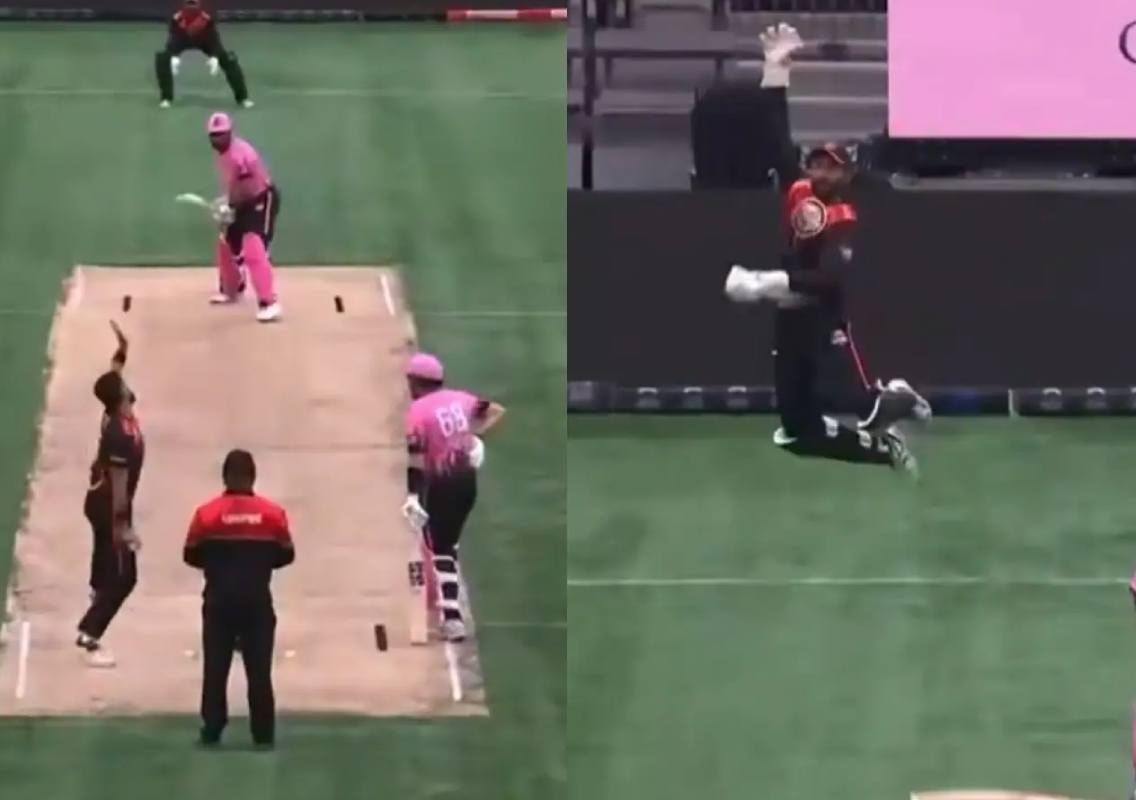


Vancouver: A bizarre delivery from USA pacer Ali Khan during the Canada Super60 semi-final between Toronto Sixers and Mississauga Masters left players, commentators and fans stunned — but the unusual scoring decision was ultimately explained by the laws of cricket.
The incident occurred during Toronto Sixers’ innings at BC Place in Vancouver. A short delivery from Khan sailed over batter Kieron Pollard and also cleared the wicketkeeper before travelling all the way into the stands.
What initially appeared to be a possible six left commentators wondering how the ball should be scored. The umpire, however, signalled a wide and awarded five runs to Toronto.
The reason lies in a fundamental distinction in the laws of cricket: a boundary six can only be scored when the ball has been struck by the bat.
Ali Khan’s delivery clears everyone
Toronto Sixers were batting first in the 10-over semi-final and posted 130/4, with former West Indies star Kieron Pollard providing the late-innings fireworks with a 16-ball 40.
During the ninth over, Khan bowled a bouncer that rose sharply and travelled beyond Pollard’s reach.
The ball also went over the wicketkeeper and continued towards the boundary. It eventually crossed the rope without making contact with the bat.
The extraordinary trajectory created a moment of confusion in the commentary box. Given that the ball travelled over the batter and all the way into the stands, it looked visually similar to a conventional six.
But the scoring laws make an important distinction between a ball that is hit by the batter and one that reaches the boundary without being struck.
Why was it five wides and not seven?
The key provision is MCC Law 19.7, which deals with boundary sixes and fours.
Under Law 19.7.1, a boundary six is scored only when the ball has been struck by the bat and is first grounded beyond the boundary without having touched the ground within the field of play.
In this case, Pollard did not make contact with the delivery.
That means the ball could not be recorded as a six, regardless of how far it travelled.
Law 19.7.2 provides for a boundary four when a ball reaches the boundary without being struck by the bat, subject to the circumstances specified in the law.
Because Khan’s delivery was also called a wide, the one-run wide penalty applied in addition to the boundary allowance.
The result was therefore five wides.
A boundary does not automatically mean six runs
The incident highlights a common misconception among casual cricket viewers: a ball crossing the boundary on the full does not automatically result in six runs.
For a six to be awarded, the ball must have been struck by the bat.
If the batter does not make contact and the ball subsequently reaches the boundary, the laws treat the outcome differently.
In this instance, the ball was a wide because it was outside the batter’s reach and did not make contact with him or his bat. Since it then crossed the boundary without being hit, the boundary allowance was four runs, with the additional wide penalty taking the total to five.
Therefore, the umpire’s decision was consistent with the scoring laws rather than an unusual interpretation of the incident.
Why the delivery created so much confusion
The visual nature of the incident made it particularly unusual.
In most cricket matches, a ball that reaches the stands on the full has been struck by the batter. Spectators therefore instinctively associate the sight of a ball flying directly over the boundary with a six.
Khan’s delivery produced the same visual effect without the crucial bat contact.
The ball effectively travelled from the bowler’s hand, over the batter and wicketkeeper, and beyond the boundary.
That combination is extremely rare, which explains the initial surprise among commentators and viewers.
The laws, however, do not depend on how spectacular the delivery looks. They depend on what happened to the ball and whether it was struck by the bat.
Toronto Sixers reach the final
The unusual moment came during an entertaining semi-final that ultimately went Toronto Sixers’ way.
Toronto scored 130/4 in 10 overs, with Pollard’s 40 off 16 balls providing a major contribution to the total.
Mississauga Masters responded strongly in the chase, with Alex Lees producing an explosive 39 off 11 deliveries.
Despite the rapid scoring, Mississauga could not maintain the required pace throughout the innings. Toronto eventually secured a nine-run victory to book its place in the final.
The result meant Toronto would face Vancouver Anchors in the title clash.
Vancouver Anchors set up final against Toronto
In the other semi-final, Vancouver Anchors defeated Brampton Blitz by six wickets.
The victory completed the tournament’s final line-up, setting up a clash between Vancouver Anchors and Toronto Sixers.
For Toronto, the semi-final victory was therefore more significant than the unusual five-wide incident. Pollard’s explosive innings and the team’s ability to withstand Mississauga’s late challenge carried them through to the championship match.
The cricket law behind a viral moment
Ali Khan’s delivery provided one of those rare cricket moments where what viewers see and what the scoring laws prescribe appear to be two different things.
The ball crossed the boundary without being touched by the bat, meaning it could not be recorded as a six. Because it was also called a wide, the boundary four was accompanied by the additional wide run.
That produced five wides, not seven.
The incident is a useful reminder that cricket’s scoring system contains distinctions that can be easy to miss when an unusual delivery produces an extraordinary visual outcome.
For Khan, the delivery will be remembered as one of the strangest moments of the Canada Super60 tournament. For cricket fans, it offered an unusual lesson in one of the game’s lesser-known laws.