







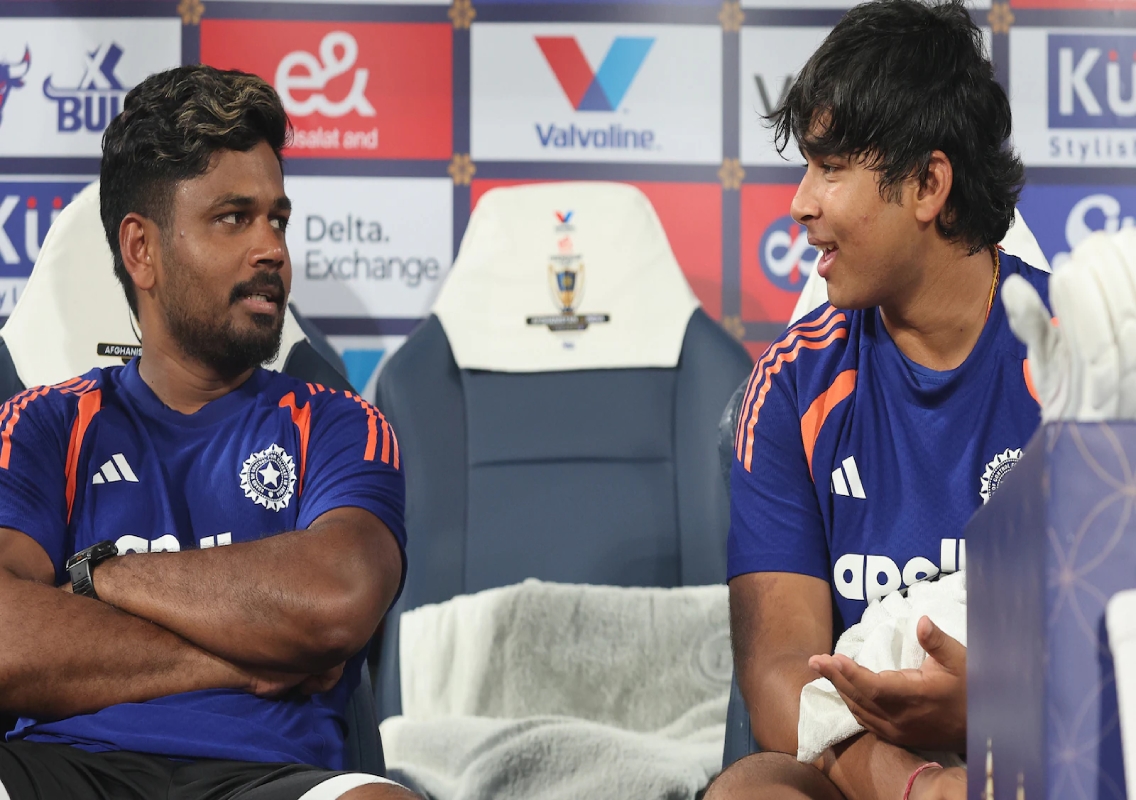


New Delhi: Former India captain Anjum Chopra has cautioned the Indian team management against treating the emergence of 15-year-old Vaibhav Sooryavanshi as a reason to immediately replace established opener Sanju Samson.
The debate over India’s opening combination intensified during the recently concluded three-match T20I series against Afghanistan. Vaibhav, who has attracted significant attention for his aggressive batting, was part of India’s squad but did not feature in the playing XI in any of the three matches. India instead continued with Sanju Samson and Abhishek Sharma at the top of the order.
Samson had a disappointing outing in the opening match but responded with consecutive half-centuries in the next two games as India completed a 3-0 series sweep in Delhi. The performances have added another dimension to the discussion over where Vaibhav fits into India’s T20I plans.
Anjum Chopra asks India to give Samson space
Speaking exclusively to NDTV, Anjum Chopra said Sanju Samson should be allowed to perform without constantly feeling that his position is under threat from an emerging player.
“I think we should let Sanju Samson be,” Chopra said, adding that playing for India already comes with pressure and competition.
She stressed that the arrival of a talented youngster should not automatically mean an established player loses his place. According to Chopra, players who have already earned opportunities in the Indian team should be given the space to perform rather than being placed under a constant question mark.
Chopra also pointed to India’s considerable depth in batting. She said players such as Samson, Abhishek Sharma, Ruturaj Gaikwad and Rinku Singh have all worked hard and earned their opportunities at international level.
Her comments come amid growing discussion about whether Vaibhav should be introduced into India’s regular T20I opening combination after making a rapid rise through domestic cricket and franchise cricket.
Vaibhav Sooryavanshi remains in contention
Vaibhav’s omission from India’s playing XI against Afghanistan did not diminish the attention surrounding the teenager.
The 15-year-old has emerged as one of the most talked-about young batters in Indian cricket because of his fearless approach and ability to score quickly. His inclusion in the senior India setup itself marked another major step in his development.
However, Chopra believes his arrival should be viewed as an addition to India’s options rather than as a direct contest with an established player.
She described Vaibhav as a “great talent” and noted that he has already made it into the Indian setup and will remain in contention. At the same time, she emphasised that India’s existing players should not suddenly lose their value simply because a new prospect has arrived.
The issue is particularly relevant for India because the team has several players capable of opening in T20 cricket. Abhishek Sharma has established himself as an attacking opener, while Samson has experience at the top of the order and has also played several important international innings.
Samson answers critics with back-to-back fifties
Samson’s response during the Afghanistan series has strengthened the case for allowing him an extended run.
After managing only 10 runs in the opening T20I, Samson produced two successive half-centuries in the remaining matches. India won all three games, including a 127-run victory in the final T20I in Delhi.
The series therefore ended with India having both a successful team result and a more positive individual run for Samson.
His performances also came at a time when there was considerable attention on Vaibhav’s absence from the XI. The teenager remained on the bench throughout the series, while the management continued with Samson and Abhishek as the opening combination.
India head coach Gautam Gambhir subsequently explained that Vaibhav would have to wait for his opportunity. Gambhir said players who had performed consistently for two or three years would remain ahead of someone who had only recently entered the senior setup. He also indicated that when Vaibhav’s opportunity arrives, the youngster would be given a longer run.
Gambhir has already explained the decision
Gambhir’s comments provide the team management’s stated reasoning behind Vaibhav’s omission.
The India head coach said the conversation with Vaibhav had been clear: he would have to wait for his opportunity. Gambhir acknowledged the youngster’s talent but stressed that established performers would remain ahead of newcomers who had only recently entered the senior team.
The approach means the current debate is not necessarily about choosing between Samson and Vaibhav immediately.
Instead, India has the option of allowing the teenager to develop within the international setup while continuing to assess the performances of the established players.
That approach also gives the management greater flexibility when future opportunities arise.
The competition for India’s opening spots
India’s T20I batting group has considerable competition for places.
Abhishek Sharma has become an important part of the team’s aggressive approach at the top of the order. Samson brings experience and wicketkeeping ability in addition to his batting. Ruturaj Gaikwad and Rinku Singh have also been part of India’s wider T20 plans.
Vaibhav’s emergence adds another name to that group.
For India, the challenge will be managing the transition between established international players and younger prospects without making selection decisions solely on the basis of age or recent hype.
Chopra’s comments underline that distinction. A young player’s emergence can increase competition without necessarily requiring the immediate removal of an established player.
Chopra’s message on player pressure
The former India opener also highlighted an often-overlooked aspect of international selection: the psychological pressure created when a player’s place is repeatedly questioned.
According to Chopra, every player understands that performance matters when representing India. Competition for places is part of professional cricket. But she argued that players should still be allowed sufficient space to perform rather than feeling that every new talent represents an immediate threat to their position.
That argument is particularly relevant for Samson, whose international career has frequently been accompanied by discussions about consistency and selection.
His recent performances against Afghanistan, however, provided a timely response after the initial setback in the opening match.
Vaibhav’s development remains a separate story
While the Samson-Vaibhav debate has attracted considerable attention, the two players’ careers need not be viewed as mutually exclusive.
Vaibhav is still only 15 and is at the beginning of his senior international journey. His inclusion in India’s setup gives him exposure to experienced international players and the team’s environment even when he is not selected in the XI.
For Samson, the immediate task is to continue converting opportunities into performances.
For the team management, the larger challenge is to ensure that India’s deep pool of batting talent is developed without unnecessarily creating a situation in which one player’s emergence is treated as the automatic end of another player’s opportunity.
India head into Asian Games campaign
India’s dominant 3-0 T20I series victory over Afghanistan came just before the team’s Asian Games campaign.
The men’s cricket team is scheduled to begin its Asian Games campaign on September 28 in Nisshin, Japan, entering the competition at the quarter-final stage.
The tournament will provide another opportunity for India’s T20 talent pool to gain experience, although the current Samson-Vaibhav debate is centred on the senior international team’s longer-term opening combination.
For now, the message from Chopra is clear: the emergence of Vaibhav Sooryavanshi should not automatically be interpreted as a reason to remove Sanju Samson.
India’s depth means there can be room for multiple talented players, while selection can continue to be determined by performance, team requirements and opportunities as they arise.