







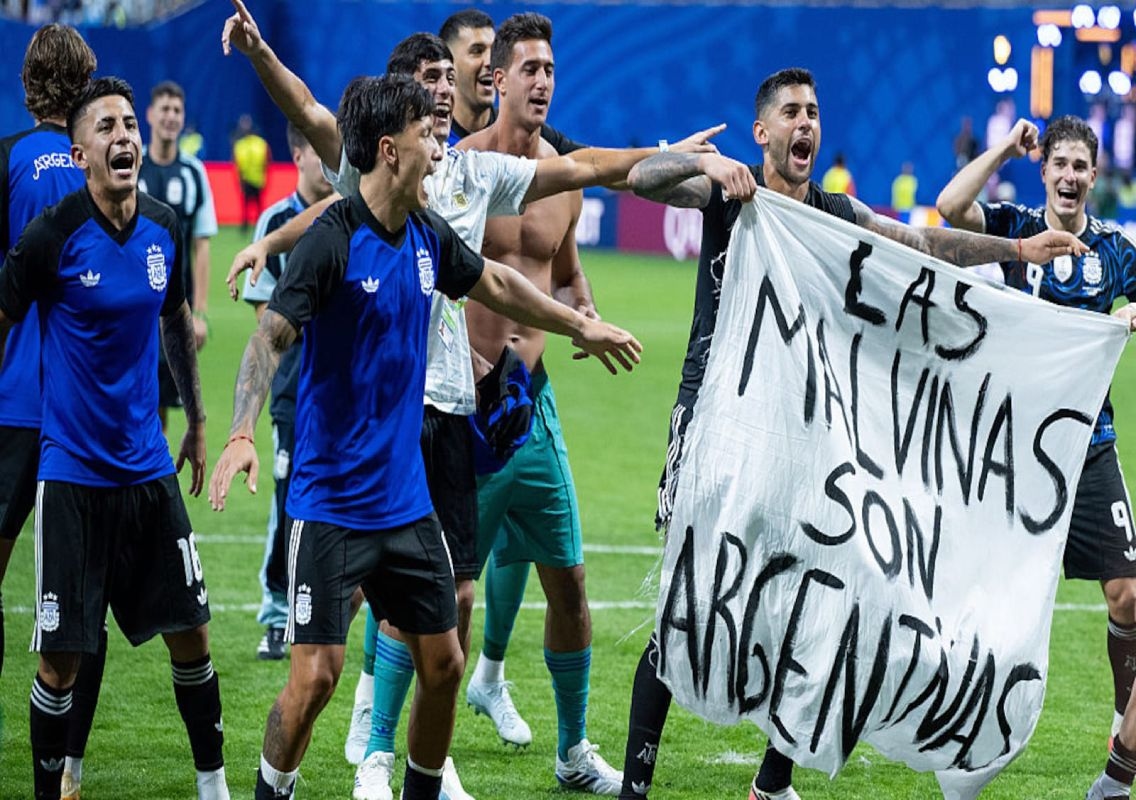


ATLANTA: Argentina’s dramatic FIFA World Cup 2026 semi-final victory over England has been followed by a potential disciplinary controversy after players displayed a politically sensitive banner during their celebrations. The defending champions defeated England 2-1 in Atlanta to reach the final, but the post-match celebrations involving the phrase “Las Malvinas son Argentinas” could now attract scrutiny from FIFA.
Midfielder Giovani Lo Celso and defender Nicolas Otamendi were seen holding the banner after Argentina completed a late comeback against England. The message translates to “The Malvinas are Argentine” and refers to Argentina’s long-standing claim over the Falkland Islands, a British Overseas Territory in the South Atlantic.
The timing of the display has increased attention because England were Argentina’s opponents in the semi-final. The Falkland Islands dispute remains a sensitive political issue between the two nations, with historical tensions extending beyond football.
FIFA rules prohibit political messages
Football authorities have strict regulations regarding political expressions during matches and official tournament events. FIFA and the International Football Association Board (IFAB) prohibit players from displaying political slogans, symbols or messages through their clothing, equipment or celebrations.
According to IFAB’s Laws of the Game, players and teams can face sanctions if they display political, religious or personal messages during football activities. The rules are designed to maintain neutrality and prevent international sporting events from becoming platforms for political statements.
The regulations state that equipment must not contain political, religious or personal slogans, statements or images. Any violation can lead to disciplinary measures from FIFA, national football associations or tournament organisers.
In this case, FIFA will likely examine whether the banner display falls under the category of a political message and whether further action is required.
Possible punishments could include financial penalties, official warnings or disciplinary action against individuals involved. However, the final decision will depend on FIFA’s assessment of the incident and the circumstances surrounding the celebration.
Players involved in controversial celebration
The banner appeared to have been brought from the stands by supporters before being displayed by Argentina players during their celebrations.
Giovani Lo Celso, who previously played for English Premier League club Tottenham Hotspur, and Nicolas Otamendi, a former Manchester City defender, were among the players seen with the banner.
The involvement of players with links to English football has added another dimension to the controversy. Both players have experienced English football culture, making their participation in the display a talking point among supporters.
Argentina players were celebrating an emotional victory after overcoming England in a dramatic semi-final. England had taken the lead through Anthony Gordon, but Argentina responded late through Enzo Fernandez and Lautaro Martinez to secure a 2-1 win.
The victory sent Argentina into the World Cup final, where they will face Spain.
Historical background of the Malvinas dispute
The Falkland Islands dispute has been one of the longest-running territorial disagreements involving Argentina and the United Kingdom.
Argentina refers to the islands as Las Malvinas and claims sovereignty over them, while the United Kingdom administers them as the Falkland Islands.
The disagreement has roots dating back to the 19th century. Britain established control over the islands in the early 1800s, while Argentina has continued to maintain its claim.
The dispute reached its most serious point in 1982 when Argentina’s military government launched an invasion of the islands, leading to the Falklands War.
The conflict lasted from April 2 to June 14, 1982, and ended with Argentina’s surrender. The war resulted in the deaths of 649 Argentine soldiers, 255 British servicemen and three civilians.
The issue remains deeply emotional in Argentina, where the islands are considered a symbol of national identity. References to Las Malvinas are common in Argentine public life, including in sports.
Political reaction adds further attention
The controversy gained more attention after Argentina Vice-President Victoria Villarruel reacted to the incident.
Villarruel expressed support for the message on social media, stating that the Falklands were Argentine and suggesting that while restrictions may prevent certain displays inside stadiums, the issue remains part of Argentina’s national sentiment.
Her comments added a political dimension to an already sensitive sporting moment.
However, FIFA’s focus is expected to remain on whether tournament regulations were breached rather than the wider political debate surrounding the islands.
Argentina prepare for World Cup final
Despite the controversy, Argentina’s attention will now turn towards the World Cup final against Spain. Lionel Messi and his teammates are one victory away from defending their world title and creating more football history.
The semi-final win over England was celebrated widely across Argentina, with supporters praising the team’s resilience and ability to perform under pressure.
However, the banner incident could create an unwanted distraction before the final. FIFA’s decision will determine whether the celebrations result in official consequences.
For Argentina, the challenge now is to maintain focus on the biggest match of the tournament while awaiting FIFA’s response. The incident highlights the ongoing difficulty of balancing football celebrations with rules designed to keep international sport separate from political disputes.