







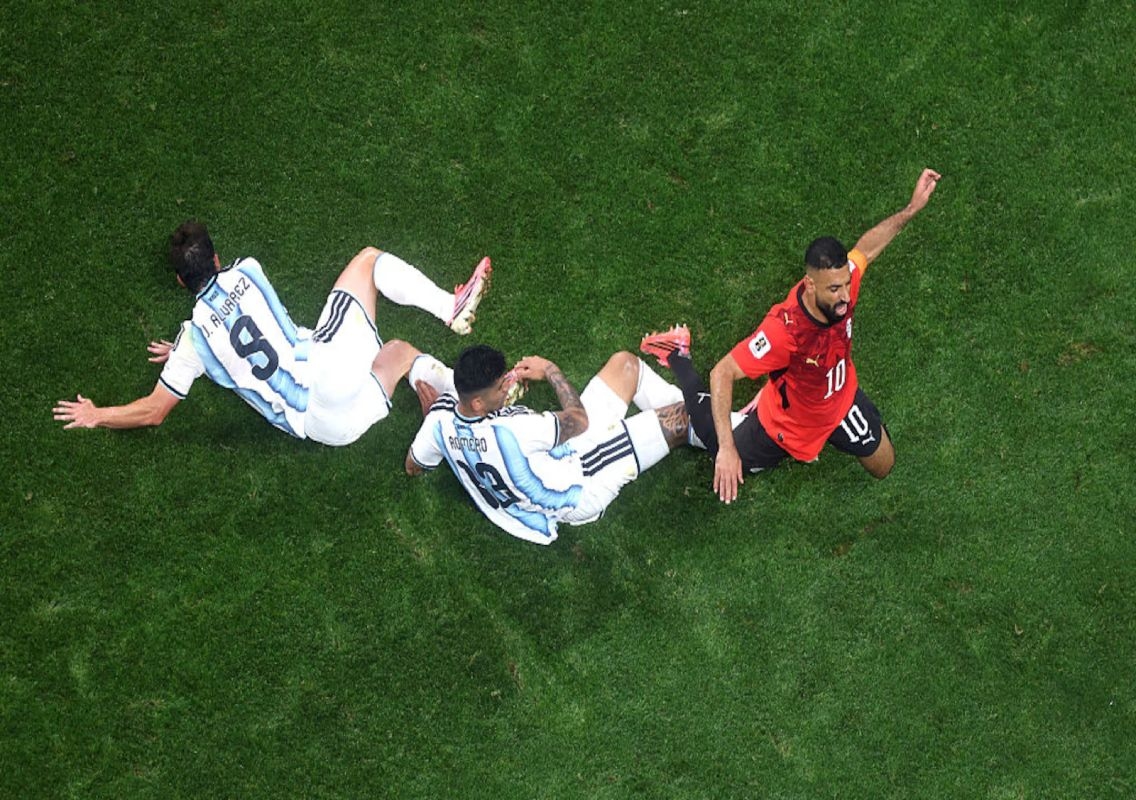


Philadelphia: Argentina’s dramatic 3-2 comeback win over Egypt in the FIFA World Cup 2026 Round of 16 has sparked a major debate over VAR decisions, with critics questioning whether key refereeing calls influenced the outcome of the match.
Egypt appeared to be heading towards one of the biggest shocks of the tournament after taking a 2-0 lead against the defending champions. However, Argentina produced a stunning late comeback, scoring three goals after the 78th minute, with Enzo Fernandez netting the decisive winner in stoppage time.
While Argentina celebrated a place in the quarter-finals, Egypt’s players and coaching staff expressed frustration over several controversial moments, with head coach Hossam Hassan openly criticising the officiating after the match.
Egypt’s disallowed goal becomes major talking point
The biggest controversy of the match came when Egypt’s Mostafa Ziko had a goal ruled out during the first half.
Egypt were already leading 1-0 when Ziko completed a brilliant counter-attacking move to seemingly double their advantage. The goal appeared to be a crucial moment that could have changed the direction of the match.
However, the VAR officials asked referee Francois Letexier to review the incident on the pitch-side monitor. After watching the replay, the referee ruled that Egyptian midfielder Marwan Attia had committed a foul on Argentina defender Lisandro Martinez during the build-up.
The decision immediately attracted criticism from fans and former players. The main argument was that the incident occurred deep inside Egypt’s own half, almost 100 yards away from where the goal was scored. Egypt regained possession after the challenge and launched a quick counter-attack that ended with Ziko finding the net.
Critics questioned whether the foul had a direct enough connection to the goal to justify a VAR intervention. They argued that the review went too far back in the attacking sequence and that the decision went against the spirit of allowing attacking moves to continue.
Although Ziko eventually scored another goal shortly afterwards, supporters claimed the earlier decision could have significantly changed the match. A 3-0 advantage would have made Argentina’s comeback much more difficult.
Salah penalty appeal adds to frustration
The second major controversy occurred late in the game when Egypt appealed for a penalty inside Argentina’s penalty area.
With Egypt searching for a possible equaliser, Mohamed Salah went down after contact involving Julian Alvarez. Egypt players claimed there was both a shirt pull and possible foot contact from the Argentine forward.
However, referee Letexier decided not to award a penalty and allowed play to continue. The VAR team also chose not to intervene, a decision that caused anger among the Egyptian players and coaching staff.
The incident became even more significant because Argentina scored their winning goal soon afterwards.
Critics pointed out the apparent contrast between the two decisions. They argued that VAR officials reviewed an earlier incident far away from goal but did not intervene for a potential penalty involving Salah inside the box.
For Egypt supporters, the issue was not only the individual decisions but the perceived inconsistency in how VAR was applied during the match.
Hossam Hassan questions officiating
Egypt coach Hossam Hassan expressed his disappointment after the final whistle, claiming that several decisions went against his team.
The Egyptian camp believed that Argentina benefited from a number of borderline calls throughout the contest, including moments where Argentine players avoided possible bookings for physical challenges.
While many decisions in football remain subjective, the combination of the disallowed goal and the penalty appeal created a feeling of injustice among Egypt’s players and fans.
The controversy also reignited wider discussions about VAR and whether the technology is being applied consistently across major tournaments.
Argentina complete remarkable comeback
Despite the controversy, Argentina showed their championship experience by fighting back from a difficult position.
Egypt had controlled large portions of the match and looked capable of securing a historic victory. However, Argentina’s attacking quality eventually made the difference as they increased pressure during the closing stages.
The comeback demonstrated the resilience of Lionel Messi’s side, who refused to give up even when facing elimination.
Enzo Fernandez’s stoppage-time goal completed a dramatic turnaround and sent Argentina into the quarter-finals, while Egypt were left reflecting on what could have been.
Conclusion
The Argentina-Egypt clash will be remembered not only for a thrilling comeback but also for the VAR debate that followed. While the technology is designed to improve decision-making, the match highlighted ongoing concerns about consistency and interpretation.
Argentina advanced to the next stage of the FIFA World Cup 2026, but Egypt’s complaints over officiating decisions ensured that the debate surrounding the game continued long after the final whistle.