







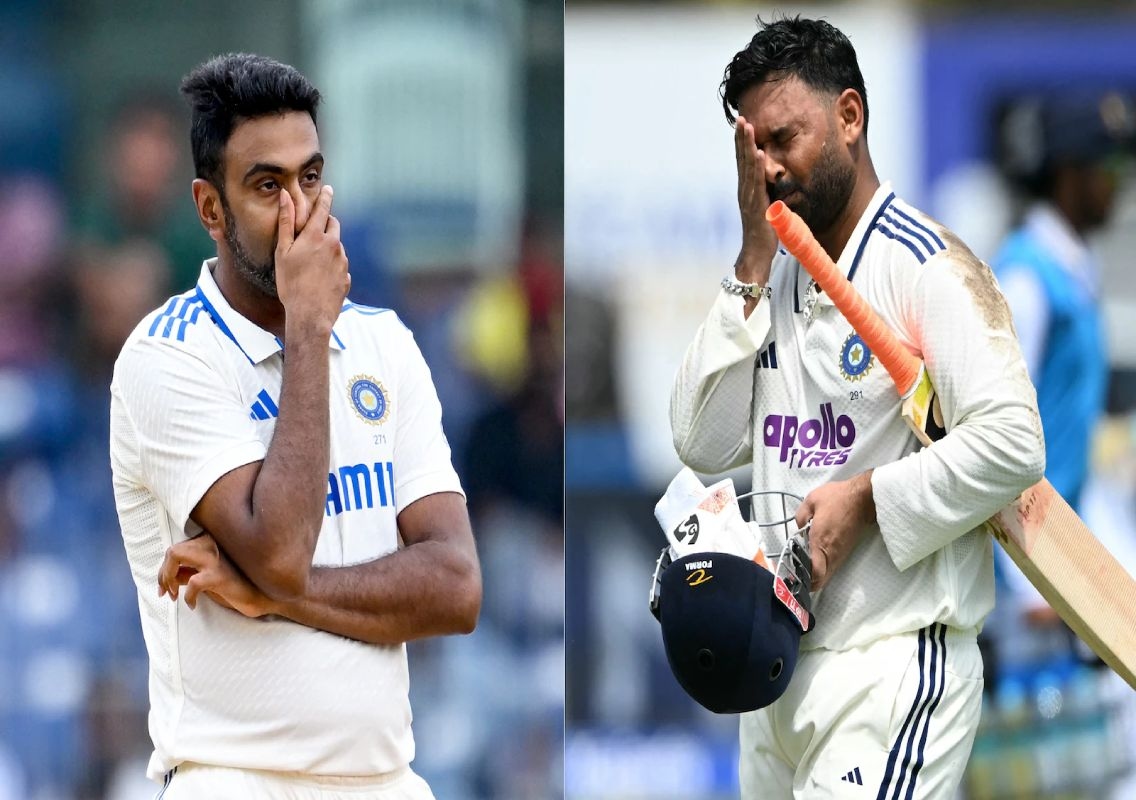


Chennai: Former India spinner Ravichandran Ashwin has raised strong questions about Rishabh Pant’s approach to Test cricket, arguing that the wicketkeeper-batter must take greater responsibility despite his reputation and the backing he has received from the Indian team management.
Ashwin’s comments came after Pant scored 168 runs in the two-Test series against Sri Lanka. The India wicketkeeper registered two half-centuries during the assignment, producing respectable numbers on paper. However, Ashwin said Pant’s performances did not meet the expectations he had set for the experienced batter.
Speaking on his YouTube channel in a discussion on the Sri Lanka series, Ashwin said he expected more from Pant and questioned the justification for overlooking risky decisions simply because of the player’s established reputation.
Ashwin’s comments were particularly focused on Pant’s decision-making in Test cricket, where he believes the situation of the match should determine the way a batter approaches an innings.
Ashwin says Pant’s talent is not the issue
Ashwin made it clear that his criticism was not directed at Pant’s ability as a cricketer. Instead, he questioned whether the batter is making the right decisions at crucial moments.
According to Ashwin, Pant has the ability to change matches and has already demonstrated that during his Test career. However, he believes that such attacking cricket cannot automatically justify every high-risk shot.
Ashwin pointed to Pant’s performances during India’s memorable tour of Australia in 2020-21 as examples of his ability to produce exceptional innings. Pant played crucial knocks in Sydney and Brisbane during that series and became one of the central figures in India’s historic Test campaign.
However, Ashwin stressed that those victories were not achieved by one player alone.
He specifically mentioned the contributions of Washington Sundar and Shardul Thakur, whose performances played important roles in India’s success. Ashwin argued that Test victories are collective efforts involving all 11 players and cannot simply be attributed to one star performer.
His broader point was that Pant’s reputation should not result in his mistakes being dismissed as simply being part of his natural style of play.
“It is about what your team needs”
Ashwin’s biggest concern appears to be the balance between Pant’s natural attacking instincts and the requirements of a particular Test match situation.
Pant is widely recognised for his aggressive approach. He regularly looks to attack bowlers, use his feet and put pressure on opposition teams. That approach has produced several memorable innings during his Test career.
However, Ashwin argued that a player must adapt his approach according to the match situation.
He cited the example of high-risk cricket being acceptable in certain circumstances but potentially damaging when the team is in a difficult position.
The former spinner also compared Pant’s attacking style with that of former India opener Virender Sehwag and former Australia wicketkeeper Adam Gilchrist. Both were renowned for aggressive batting, but Ashwin argued that their attacking approach should not be used as an excuse for poor decision-making.
His argument is that even aggressive batters have to recognise the context of a match.
A batter chasing quick runs while the team is comfortably placed is in a different situation from one taking the same risks when the team is struggling or trying to save a Test.
Ashwin rejects the “once-in-a-generation” argument
One of the strongest parts of Ashwin’s criticism was directed towards the way Pant is described and backed by the team management.
Ashwin questioned the argument that Pant is a “once-in-a-generation” player and therefore deserves continued backing regardless of his inconsistencies.
He said that if such special treatment is being given to one player, then other young and talented players should receive similar backing as well.
Ashwin specifically mentioned Yashasvi Jaiswal, another important member of India’s current Test batting group.
His argument was not that Pant lacks talent. Instead, Ashwin believes that India’s management should maintain consistent standards for all players rather than making exceptions because of a player’s reputation.
The former India spinner also pointed out that Pant is no longer a young, inexperienced cricketer. Having played around 50 Tests, Pant has accumulated considerable experience at the highest level.
Ashwin therefore believes that the expectations from Pant should be higher.
Pant has played 50 Tests and must take responsibility
Pant’s experience was central to Ashwin’s criticism.
The wicketkeeper-batter has already established himself as one of India’s most influential Test players. His career includes match-winning performances both at home and overseas, including against some of the strongest bowling attacks in world cricket.
Because of that experience, Ashwin believes Pant should take greater responsibility for his decisions.
The former spinner argued that the issue is not whether Pant should stop being aggressive. Rather, the batter needs to understand when aggression is appropriate and when the situation demands restraint.
That distinction is especially important in Test cricket, where a single poor shot can change the course of a match.
Ashwin suggested that Pant’s decision-making is also one of the reasons why he has not been able to establish himself as an all-format player for India.
Pant has already been an important part of India’s Test side, but his position in the other formats has been more complicated because of competition and consistency.
Ashwin believes that if Pant can improve his decision-making and understand situations better, he could become an all-format player for India.
Sri Lanka series produces mixed review for Pant
Pant finished the two-Test Sri Lanka assignment with 168 runs, including two half-centuries.
From a statistical perspective, that is a useful contribution, particularly considering the relatively small number of matches in the series.
However, Ashwin believes statistics alone do not tell the complete story.
The former spinner’s assessment focuses on how and when Pant scored his runs, along with the decisions he made during important phases of the matches.
For a player of Pant’s ability, expectations are naturally higher.
The Indian team management has continued to back Pant as its preferred wicketkeeper in Test cricket, and that confidence reflects the importance of his previous performances.
Pant’s ability to score quickly and change the momentum of a match makes him a unique asset. His presence can force opposition captains to alter their field settings and bowling plans.
At the same time, the aggressive approach carries an inherent risk, particularly in Test cricket.
Why Pant remains an important player for India
Despite his criticism, Ashwin’s comments do not diminish Pant’s importance to the Indian team.
Pant remains one of India’s most dangerous middle-order batters in Test cricket. His ability to counterattack can change the direction of a match within a short period.
His performances in Australia remain particularly significant. Pant played important roles in India’s successful campaign during the 2020-21 Border-Gavaskar Trophy, including memorable performances at Sydney and Brisbane.
Those innings helped establish his reputation as a player capable of delivering under pressure overseas.
However, Ashwin’s argument is that past achievements should not permanently shield a player from criticism.
A player can be exceptional and still be expected to improve.
That appears to be the central message behind Ashwin’s comments.
Ashwin’s criticism comes from a team-first perspective
Ashwin’s remarks can also be viewed through the broader demands of Test cricket.
Unlike limited-overs cricket, Test cricket requires players to constantly assess the state of the match. A batter may need to defend for long periods in one session and then accelerate in another.
The ability to shift gears is therefore an important part of succeeding in the format.
Ashwin believes Pant has enough experience to understand these requirements.
The former spinner said he loves Pant as a player, making it clear that his criticism comes from wanting the wicketkeeper-batter to fulfil his potential.
Rather than asking Pant to completely change his natural game, Ashwin appears to be calling for better judgement about when to attack and when to play according to the team’s needs.
What this means for Pant going forward
Ashwin’s comments could add another layer to the discussion surrounding Pant’s role in India’s Test team.
The wicketkeeper-batter has already earned considerable trust from the management because of his past performances. But with a large number of Tests behind him, the expectations will inevitably increase.
Pant’s next challenge will be to combine his natural attacking instincts with greater situational awareness.
If he can do that consistently, his value to India could become even greater.
For the Indian team, having a player who can both attack aggressively and adapt according to match conditions would provide another major advantage in Test cricket.
Conclusion
Ravichandran Ashwin’s criticism of Rishabh Pant is less about questioning the batter’s talent and more about demanding greater responsibility from an experienced player.
Pant scored 168 runs in India’s two-Test series against Sri Lanka, but Ashwin believes his performances still fell short of expectations. He has also rejected the idea that Pant should receive special treatment simply because he is considered a “once-in-a-generation” player.
Ashwin’s message is clear: talent and past achievements cannot replace sound decision-making.
Pant has already shown that he can win Test matches for India. The next step, according to Ashwin, is for him to understand when his aggressive style serves the team and when it puts the team’s position at unnecessary risk.
If Pant can strike that balance, he could strengthen his position as one of India’s most important all-format cricketers.