







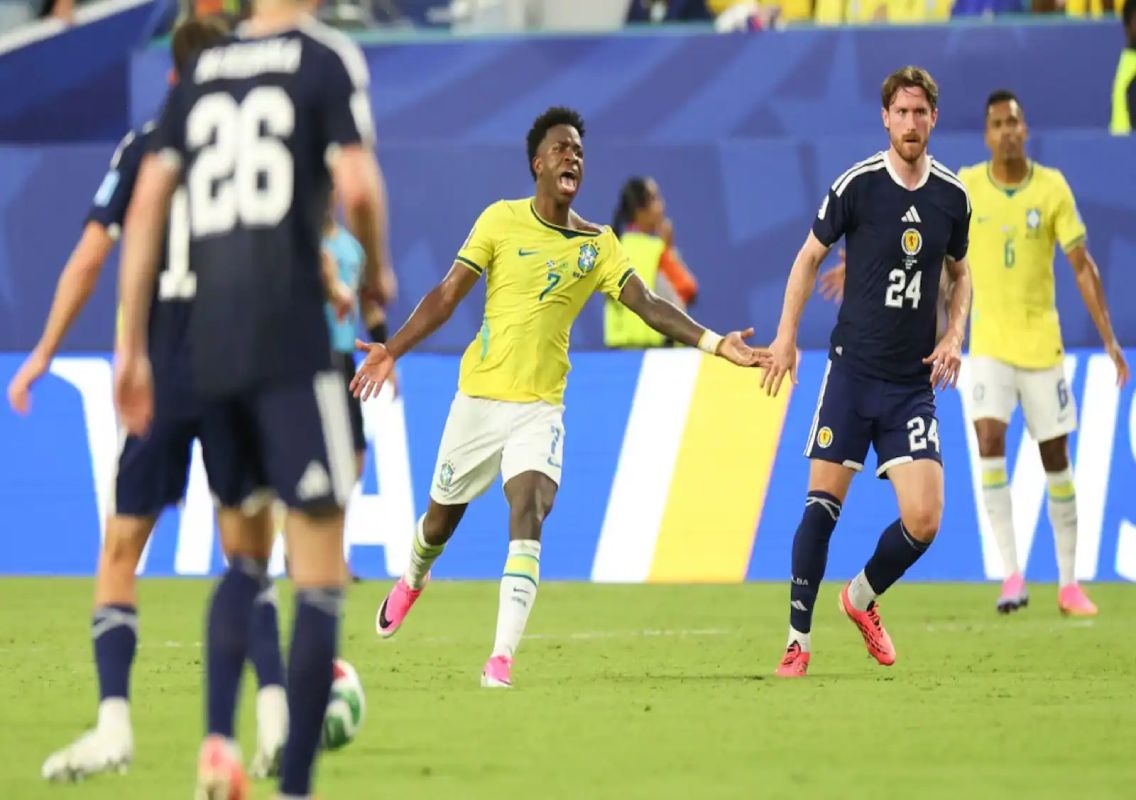


Houston: Brazil have formally requested FIFA to remove referee Cesar Ramos from officiating their matches in the FIFA World Cup 2026, following a controversial VAR decision involving Vinicius Jr during their clash against Scotland.
The Brazilian Football Confederation (CBF) lodged an official complaint after a goal scored by Vinicius Jr was disallowed in their 3-0 Group C victory. The federation has questioned the consistency of refereeing decisions and raised concerns over the use of VAR in the tournament.
Controversy over disallowed goal
The incident took place in the 21st minute of Brazil’s final group-stage match. Vinicius Jr appeared to have doubled Brazil’s lead after winning possession from Scotland defender Jack Hendry and finishing calmly past goalkeeper Angus Gunn.
Although referee Cesar Ramos initially awarded the goal, it was later overturned following a VAR review. The decision was based on a perceived foul in the build-up, a call that did not sit well with the Brazilian team and officials.
The CBF argued that the situation did not meet the “clear and obvious error” threshold required for VAR intervention, making the reversal questionable.
Formal complaint to FIFA
Following the incident, the CBF wrote to FIFA president Gianni Infantino, expressing dissatisfaction with the officiating standards. The federation also requested that Ramos should not be assigned to Brazil’s future matches in the tournament.
In its complaint, the CBF highlighted what it described as a “negative history” with the Mexican referee. The federation referred to a previous incident during the 2018 World Cup match against Switzerland, where Brazil felt key decisions went against them.
The letter reportedly questioned why Ramos was appointed for the match, given the past tensions between the referee and the Brazilian team.
Comparison with other matches
Brazil also cited inconsistency in officiating by comparing the disallowed goal with a similar situation involving Lionel Messi earlier in the tournament. In that instance, a goal was allowed to stand despite a comparable physical challenge in the build-up.
According to the CBF, even the Scottish players appeared surprised by the VAR intervention, suggesting that the decision was unexpected on the field.
“The decision seemed unexpected not only for the Brazilian team, but also for the Scottish players,” the federation noted in its submission.
Brazil progress despite controversy
Despite the controversy, Brazil secured a comfortable 3-0 victory over Scotland. Vinicius Jr later found the net again, while Matheus Cunha added another goal to seal the win.
The result ensured that Brazil finished at the top of Group C and progressed to the Round of 32. They are set to face Japan in the knockout stage in Houston.
Focus shifts to knockout stage
Head coach Carlo Ancelotti chose to downplay the refereeing controversy after the match, instead focusing on his team’s overall improvement.
“Now we are playing as a team; that is the goal. We are not perfect, but we are improving,” Ancelotti said. He emphasised the importance of maintaining solidity and reducing mistakes as the tournament enters the knockout phase.
The Italian manager expressed satisfaction with the team’s progress, noting better rhythm and increased efficiency in attack compared to earlier matches.
Conclusion
Brazil’s complaint highlights ongoing concerns around VAR consistency and refereeing decisions in the FIFA World Cup 2026. While the team has successfully advanced to the next stage, the controversy underscores the importance of clear and fair officiating in high-stakes matches.
As Brazil prepare for the knockout rounds, their focus will remain on maintaining form, even as debates around refereeing decisions continue in the background.