







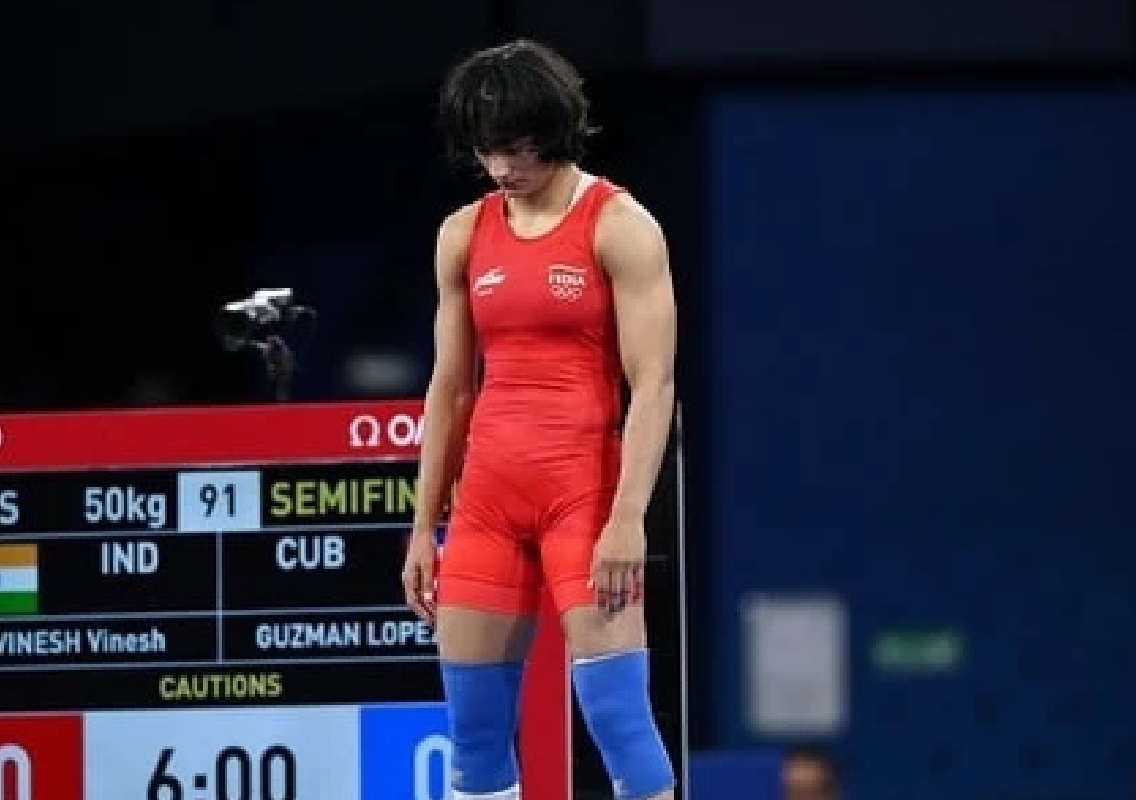


The Court of Arbitration for Sport (CAS) has delivered a conclusive judgment on the appeal filed by Indian wrestler Vinesh Phogat, who sought a joint silver medal following her disqualification from the women’s 50kg freestyle final at the Paris Olympics 2024. The detailed report released by CAS on Monday clarified the reasons behind the court’s decision to reject Phogat’s plea.
Vinesh Phogat, at 29 years old, made history as the first Indian woman wrestler to reach an Olympic final. However, her aspirations were dashed when, during the routine weigh-in the morning after the final, she was found to be 100 grams overweight. This disqualification prevented her from competing in the final and effectively denied her a medal.
Phogat’s subsequent appeal to CAS sought to overturn this decision and request a joint silver medal, based on arguments that included factors like her menstrual cycle, water retention, and the impact of travel on her weight. Despite these arguments, the appeal was dismissed, and CAS ruled in favour of the International Olympic Committee and United World Wrestling.
The 24-page report issued by CAS outlines several critical aspects of the case:
- Weight Limit Adherence: The ruling emphasized that wrestlers must adhere strictly to the weight limits set by the rules, with no exceptions permitted. CAS stated that the weight limit is a clear upper boundary with no tolerance, even for minor excesses or personal circumstances.
- Lack of Discretion: CAS noted that the rules governing weight limits are strict and do not allow for personal discretion or accommodation. The arbitrator highlighted that Phogat’s appeal sought a variation of the weight limit to account for her specific situation, which was not permissible under the established rules.
- Application of Article 11: Article 11 of the rules dictates that any failure to meet the weight requirement results in disqualification from the entire competition, not just the subsequent event. As such, Phogat’s disqualification from the final was valid, and she was ranked last without eligibility for a medal.
- No Basis for Awarding a Medal: The CAS ruling clarified that while Phogat’s performance in earlier rounds of the competition was commendable, her failure to meet the weight requirement on the final day meant that she could not be awarded a medal. The appeal for a joint silver medal was therefore not supported by the rules.
The ruling marks a significant setback for Phogat, who had hoped to secure a medal despite the disqualification. Following the verdict, she has returned to India and has announced her retirement from wrestling, leaving her future in the sport uncertain.
Phogat’s disqualification and subsequent appeal highlight the rigid nature of Olympic and wrestling regulations regarding weight limits. The CAS decision underscores the importance of adhering to these regulations throughout the entirety of a competition.
The CAS ruling reaffirms the importance of strict compliance with weight limits in wrestling competitions. While Phogat’s disqualification was a deeply disappointing outcome, the ruling reflects the unwavering adherence to established rules and procedures in international sports. The decision also reinforces the notion that eligibility must be maintained throughout all phases of a competition.