







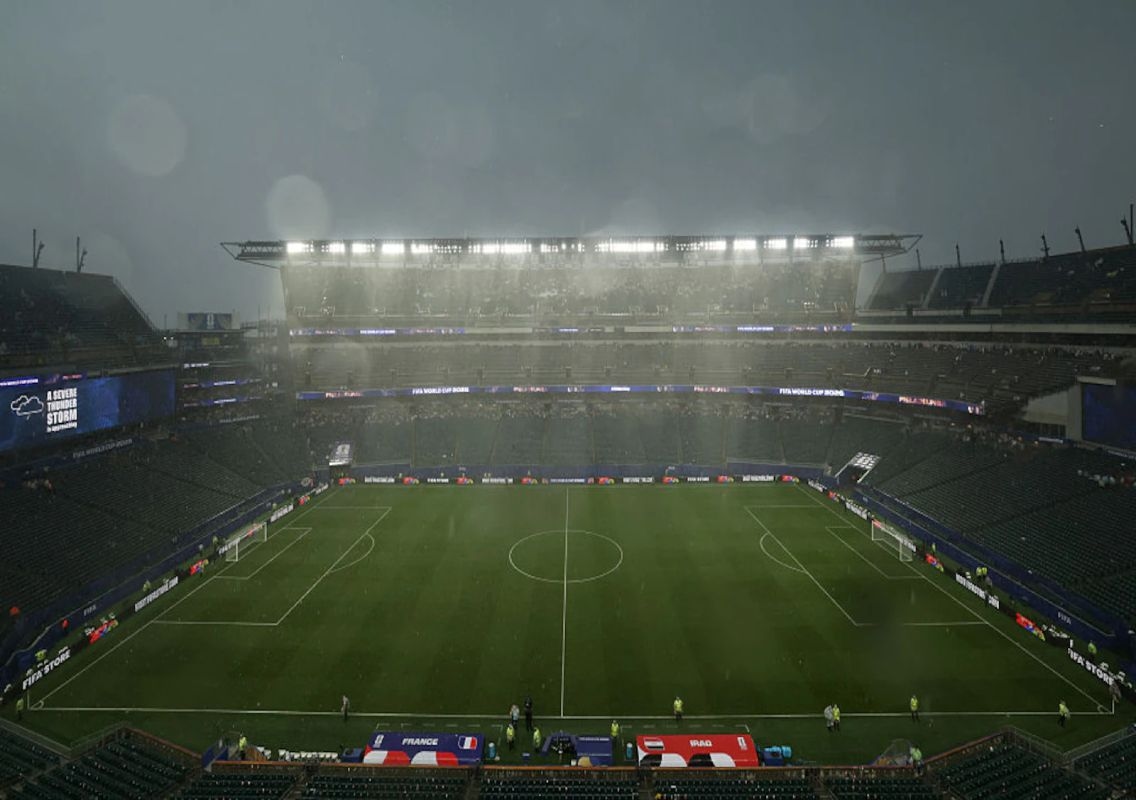


Philadelphia: The FIFA World Cup 2026 clash between France national football team and Iraq national football team in Philadelphia turned into a marathon encounter after severe weather conditions forced a dramatic suspension lasting 131 minutes. The Group I match, held at Lincoln Financial Field, ultimately stretched to nearly four hours, making it the longest game in World Cup history.
The interruption was triggered by thunderstorms and lightning in the vicinity of the stadium, activating strict safety protocols followed in the United States. While France went on to secure a comfortable 3-0 victory, the match will be remembered as much for the unprecedented delay as for the on-field action.
Match disrupted at half-time
France had taken a 1-0 lead before the half-time whistle, putting them in control of proceedings. However, what was expected to be a routine 15-minute interval quickly escalated into a prolonged suspension.
At approximately 5.49 pm local time, players left the pitch for the break. Soon after, authorities issued warnings of an approaching severe thunderstorm. Spectators were instructed to vacate their seats and move to sheltered areas within the stadium, prioritising safety amid the threat of lightning strikes.
The initial expectation was for play to resume by 7.00 pm, but worsening weather conditions forced organisers to extend the delay. Heavy rain, gusty winds and repeated lightning activity meant the match could not restart until 8.00 pm, resulting in a total delay of 131 minutes.
US safety protocol explained
The lengthy interruption was not arbitrary but the result of well-defined safety measures enforced across sporting events in the United States. According to local regulations, any detection of thunder or lightning within an eight-mile radius of the venue mandates an immediate suspension of play.
Furthermore, a minimum 30-minute window without any lightning activity is required before the match can resume. If lightning is detected again within the restricted zone, the countdown resets, prolonging the delay.
These rules are designed to ensure the safety of players, officials and fans, particularly in regions prone to sudden and intense thunderstorms. While such measures can disrupt the flow of matches, they are considered essential in preventing potential hazards.
France dominate after restart
Once the weather cleared and the match resumed, France quickly reasserted their dominance. Kylian Mbappe scored twice to extend the lead, showcasing his clinical finishing and pace.
Ousmane Dembele added a third goal to seal a convincing win for the French side. Despite the unusual break, France maintained composure and rhythm, demonstrating their depth and adaptability under challenging conditions.
The result strengthened France’s position in the group and reinforced their status as one of the tournament favourites.
Weather concerns anticipated before tournament
Weather-related disruptions had been a topic of discussion even before the tournament began. Similar interruptions were witnessed during last year’s Club World Cup held in the same region, raising concerns about scheduling and infrastructure.
Although many venues feature advanced facilities, not all stadiums are fully covered, leaving matches vulnerable to environmental factors. Organisers had largely avoided such disruptions in the early stages of the tournament, making this the first major weather-related delay.
The incident has reignited debates about contingency planning, including the possibility of more covered stadiums or flexible scheduling to mitigate the impact of extreme weather.
Impact on players and fans
The extended delay posed challenges for both teams and supporters. Players had to manage physical and mental readiness during the long break, while fans endured uncertainty and discomfort as they waited for the match to resume.
Maintaining focus after such interruptions can be difficult, but France handled the situation effectively, returning with intensity and discipline. Iraq, on the other hand, struggled to regain momentum and could not mount a comeback.
Conclusion
The France vs Iraq match will go down in World Cup history not just for the result but for the extraordinary circumstances surrounding it. The 131-minute delay highlighted the importance of stringent safety protocols while also exposing the logistical challenges of hosting matches in unpredictable weather conditions.
As the tournament progresses, organisers may need to reassess strategies to balance safety with continuity. For now, France move forward with confidence, while the match serves as a reminder that in football, external factors can sometimes take centre stage.