







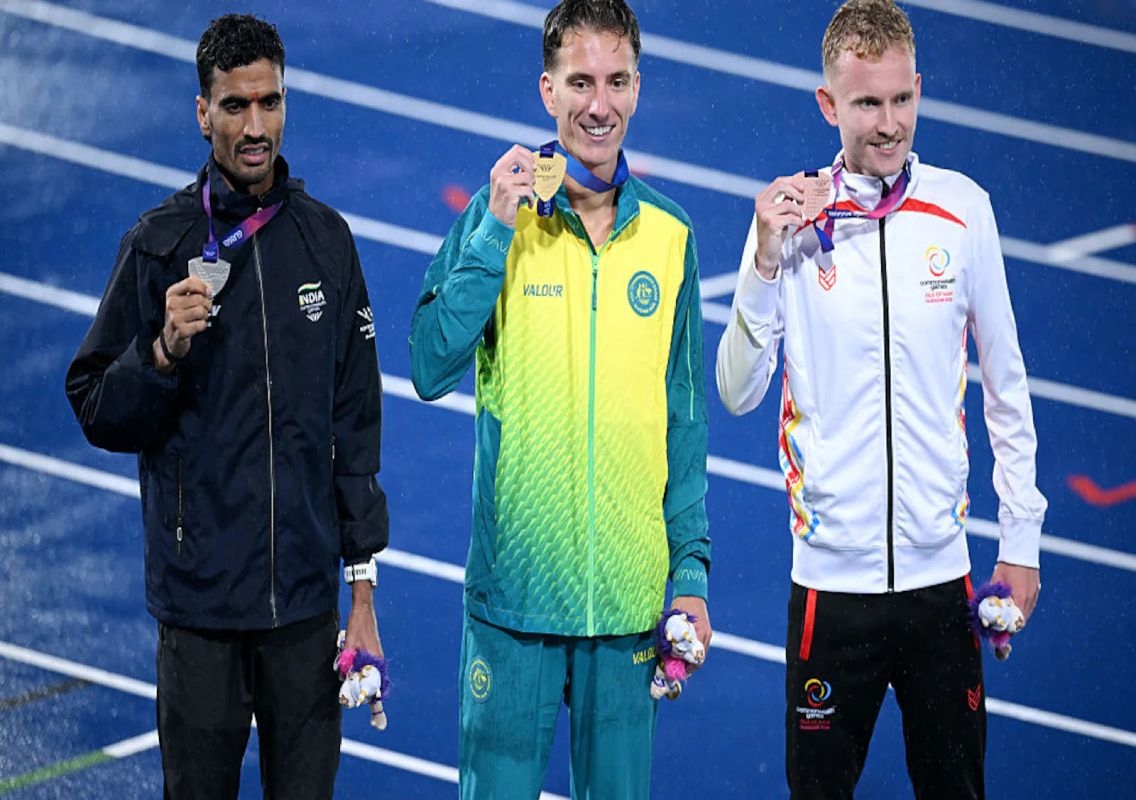


Glasgow: India’s Gulveer Singh etched his name in the record books with a historic silver medal in the men’s 10,000m at the Commonwealth Games 2026, becoming the first Indian ever to secure a podium finish in the event. The achievement marks a significant milestone for Indian athletics, particularly in long-distance track events traditionally dominated by African nations.
Competing under challenging weather conditions at the Scotstoun Stadium, Gulveer delivered a tactically astute and resilient performance. Battling heavy rain and a slippery track, he clocked an impressive 27:49.78 seconds to clinch the silver medal, narrowly missing out on gold.
Race defined by grit and strategy
The race saw intense competition from a high-quality field, including athletes from traditional long-distance powerhouses. Australia’s Ky Robinson secured gold with a timing of 27:48.93 seconds, just fractions ahead of Gulveer. Isle of Man’s David Mullarkey took bronze in 27:50.28 seconds.
Gulveer stayed with the leading pack for most of the race, conserving energy and maintaining pace despite the adverse conditions. In the final laps, he made a decisive move, showcasing a powerful finishing kick that helped him surge ahead of his competitors and secure second place.
His performance was particularly remarkable given the presence of elite runners like Daniel Ebenyo, a World Championships medallist with a personal best significantly faster than the winning time. Gulveer’s ability to hold his own against such competition underlined his growing stature in international athletics.
Breaking long-standing barriers
Gulveer’s silver medal is historic not just because it is India’s first in the men’s 10,000m at the Commonwealth Games, but also because it disrupted a long-standing trend. For the first time since the 1986 edition, no African athlete finished on the podium in this event — a testament to the changing dynamics of global distance running.
His feat adds to India’s growing success in athletics at the Games and follows the silver medal won by Sarvesh Kushare in the men’s high jump, making it India’s second silver in athletics at the 2026 edition.
Training and preparation pay off
Gulveer’s achievement is also a reflection of his rigorous training regime under coach Scott Simmons in the United States. The exposure to high-level competition and structured training methods has clearly enhanced his performance and race strategy.
Already an Asian Games bronze medallist, Gulveer has steadily progressed in his career, and this silver medal signals his arrival on the global stage. His ability to execute a near-perfect race plan in difficult conditions highlights both physical endurance and mental toughness.
Inspiration from past milestones
The achievement draws comparisons with Avinash Sable’s historic silver in the 3000m steeplechase at the 2022 Commonwealth Games, where Kenyan dominance was broken. Gulveer’s performance continues this trend of Indian athletes challenging established hierarchies in track events.
Such breakthroughs are crucial for inspiring the next generation of Indian athletes to pursue excellence in disciplines where the country has traditionally struggled.
Mixed day for India
While Gulveer’s success brought joy, there was disappointment in the women’s high jump event. Young athlete Pooja Singh, making her Commonwealth Games debut, bowed out after failing to clear 1.82m.
The 19-year-old’s event was also affected by rain interruptions, which made conditions difficult for competitors. Despite her early exit, Pooja’s participation at this level is seen as a valuable learning experience for future competitions.
Conclusion
Gulveer Singh’s silver medal in the 10,000m is a landmark achievement for Indian athletics. It not only breaks new ground for the country in long-distance running but also signals a shift in the global competitive landscape. His performance, marked by determination, strategy, and resilience, will be remembered as a defining moment in India’s sporting history and a source of inspiration for aspiring athletes.