







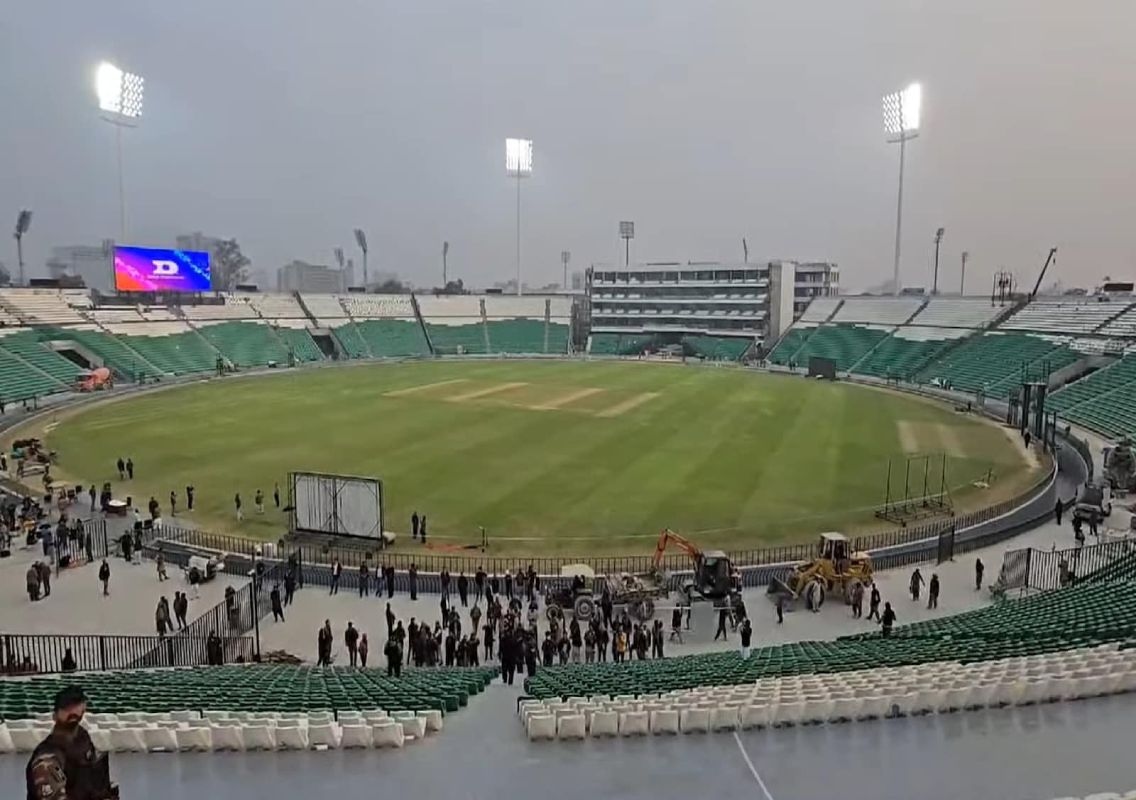


Lahore: The International Cricket Council (ICC) Appeals Panel has rescinded the demerit point imposed on Lahore’s Gaddafi Stadium after reviewing an appeal against the venue’s original ‘Unsatisfactory’ pitch rating during the third ODI between Pakistan and Australia in June.
The decision provides relief to the Pakistan Cricket Board (PCB), with Gaddafi Stadium now carrying zero demerit points on its record. The Appeals Panel reviewed match footage, the match referee’s report and comments from the captains before concluding that the pitch did not meet the criteria for an ‘Unsatisfactory’ rating.
The ICC’s decision also addressed two appeals concerning the Maple Leaf Cricket Ground in King City, Toronto. While one demerit point was withdrawn following a review of a United States-Netherlands fixture, three demerit points imposed after a later Canada-Netherlands match remain in place.
Gaddafi Stadium’s demerit point withdrawn
The original demerit point was imposed after the pitch used for the third ODI between Pakistan and Australia on June 4 was rated ‘Unsatisfactory’ under the ICC Pitch and Outfield Monitoring Process.
The rating meant the venue was penalised with one demerit point.
The PCB subsequently appealed the decision, asking the ICC to reconsider the assessment of the playing surface.
The Appeals Panel examined the evidence connected to the match before reaching its conclusion.
After reviewing the match footage, the match referee’s report and official comments from the captains, the panel determined that the pitch did not display the characteristics necessary for an ‘Unsatisfactory’ rating.
As a result, the demerit point has been removed.
ICC says pitch did not show excessive unevenness
The Appeals Panel’s assessment focused on the characteristics of the playing surface during the ODI.
According to the decision, the pitch did not demonstrate excessive unevenness or excessive spin.
Those factors were important to determining whether the original rating should stand.
The panel also acknowledged that the match referee had correctly followed the applicable guidelines when making the initial assessment.
However, following its own review, the Appeals Panel reached a different conclusion on the actual characteristics of the surface.
This distinction allowed the ICC to maintain that the match referee had followed the correct process while simultaneously overturning the demerit point.
Gaddafi Stadium now has zero demerit points
The outcome means Gaddafi Stadium’s record has been cleared of the demerit point associated with the Pakistan-Australia ODI.
The venue now has zero demerit points.
That is significant for the PCB because venues accumulate demerit points when pitches or outfields fail to meet the ICC’s standards.
Having no points on its record gives Gaddafi Stadium a clean position following the latest review.
The decision will also be welcomed by Pakistan cricket officials, who had challenged the original rating through the formal appeals process.
What are ICC demerit points?
The ICC uses its Pitch and Outfield Monitoring Process to assess the quality of playing surfaces and outfields at international venues.
Match referees evaluate conditions and assign ratings based on established criteria.
A venue can receive demerit points when its pitch or outfield is judged to fall below the required standards.
The system is designed to encourage host boards and venue authorities to maintain surfaces that provide suitable and safe conditions for international cricket.
The Gaddafi Stadium decision shows that a rating can be challenged when a cricket board believes the assessment does not accurately reflect the condition of the pitch.
Match referee’s decision was not criticised
One of the notable aspects of the ICC decision is that the Appeals Panel did not suggest that the match referee had failed to follow the relevant process.
Instead, it concluded that the referee had correctly applied the applicable guidelines.
The disagreement was over whether the pitch actually possessed the characteristics required for an ‘Unsatisfactory’ classification.
After reviewing the evidence, the Appeals Panel concluded that it did not.
This resulted in the demerit point being rescinded without questioning the procedure followed by the match referee.
PCB’s appeal proves successful
The Pakistan Cricket Board’s appeal therefore achieved its objective.
The board had challenged the ‘Unsatisfactory’ rating assigned to the Gaddafi Stadium pitch and sought a review.
The Appeals Panel considered the available evidence before deciding that the pitch did not warrant the penalty.
For the PCB, the decision represents a positive outcome in its efforts to ensure that Pakistan’s international venues are assessed fairly under the ICC framework.
Maple Leaf Cricket Ground also reviewed
The ICC Appeals Panel dealt with another set of appeals involving the Maple Leaf Cricket Ground in King City, Toronto.
Cricket Canada had submitted two appeals concerning separate matches played at the venue.
The first involved an ICC Men’s Cricket World Cup League 2 fixture between the United States and the Netherlands on June 8.
That pitch had originally received an ‘Unsatisfactory’ rating and resulted in one demerit point being imposed on the venue.
The Appeals Panel reviewed the evidence and came to a similar conclusion to its assessment of Gaddafi Stadium.
One Maple Leaf demerit point withdrawn
After reviewing the June 8 match, the panel determined that the Maple Leaf Cricket Ground surface was consistent with a satisfactory pitch.
The panel found that it did not display excessive unevenness, seam movement or spin.
Consequently, the demerit point associated with that fixture has been withdrawn.
The decision reduces the penalty burden on the Canadian venue, but it does not completely clear its record.
A separate and more serious pitch assessment remains in place.
Three demerit points remain in Canada
The Appeals Panel also reviewed the pitch used for the Canada-Netherlands match on June 16.
Unlike the June 8 fixture, the panel upheld the three demerit points imposed following an ‘Unfit’ rating.
The panel concluded that the condition of the pitch during that match was dangerous and therefore consistent with an ‘Unfit’ classification.
The three demerit points will consequently remain on the Maple Leaf Cricket Ground’s record.
This creates a clear distinction between the two assessments involving the same venue.
The June 8 demerit point was withdrawn, while the three points linked to the June 16 fixture were upheld.
Difference between ‘Unsatisfactory’ and ‘Unfit’
The ICC’s decisions also highlight the difference between pitch classifications.
An ‘Unsatisfactory’ rating indicates that a playing surface does not meet the required standards in terms of its characteristics and performance.
An ‘Unfit’ rating represents a more serious concern, particularly where the condition of a pitch creates a safety risk for players.
The Appeals Panel’s decision regarding the June 16 Canada-Netherlands fixture specifically found that the surface was dangerous.
That is why the three demerit points remain in place despite the separate withdrawal of one point from the same venue.
Relief for Pakistan cricket
For Pakistan, the Gaddafi Stadium decision is particularly significant because the venue is one of the country’s major international cricket grounds.
A clean demerit record ensures that the stadium does not carry forward the penalty associated with the Australia ODI.
The decision also demonstrates that the ICC’s appeals mechanism can provide a formal route for boards to challenge pitch assessments when they believe the evidence warrants reconsideration.
The PCB’s successful appeal could therefore provide reassurance ahead of future international matches at the venue.
Venue standards remain important
The ICC’s pitch monitoring system is designed to ensure that international matches are played on surfaces that are fair, consistent and safe.
Pitch quality can have a major influence on the balance between bat and ball.
A surface that offers excessive assistance to one discipline can significantly affect the nature of a match, while dangerous conditions can pose a direct risk to players.
The Appeals Panel’s decisions show why detailed reviews are important.
In both Gaddafi Stadium and the Maple Leaf Cricket Ground’s June 8 match, the panel determined that the surfaces did not warrant the original demerit points.
However, it also upheld the penalty for the June 16 Canada-Netherlands match because the pitch was considered dangerous.
Final position after the appeals
Following the latest decisions, the status of the two venues is clear.
Gaddafi Stadium: Zero demerit points after the penalty from the Pakistan-Australia ODI was rescinded.
Maple Leaf Cricket Ground: Three demerit points remain after the panel withdrew one point from the June 8 match but upheld three points from the June 16 fixture.
The decisions provide different outcomes for the two cricket boards but underline the same principle: pitch ratings can be reviewed when an appeal is submitted and the evidence supports reconsideration.
Conclusion
The ICC Appeals Panel has delivered a major relief for Pakistan cricket by rescinding the demerit point imposed on Lahore’s Gaddafi Stadium following its ‘Unsatisfactory’ rating during the third ODI between Pakistan and Australia.
After examining match footage, the match referee’s report and comments from the captains, the panel concluded that the surface did not show excessive unevenness or excessive spin and therefore did not meet the criteria for an ‘Unsatisfactory’ rating.
Gaddafi Stadium now has zero demerit points.
The Appeals Panel also withdrew one demerit point from Toronto’s Maple Leaf Cricket Ground after finding that the June 8 pitch was satisfactory. However, three demerit points linked to the June 16 Canada-Netherlands match remain because the surface was deemed dangerous and correctly classified as ‘Unfit’.
The decisions underline the importance of the ICC’s pitch-monitoring system while also showing that venue ratings can be successfully challenged through the appeals process when further evidence supports a different assessment.