







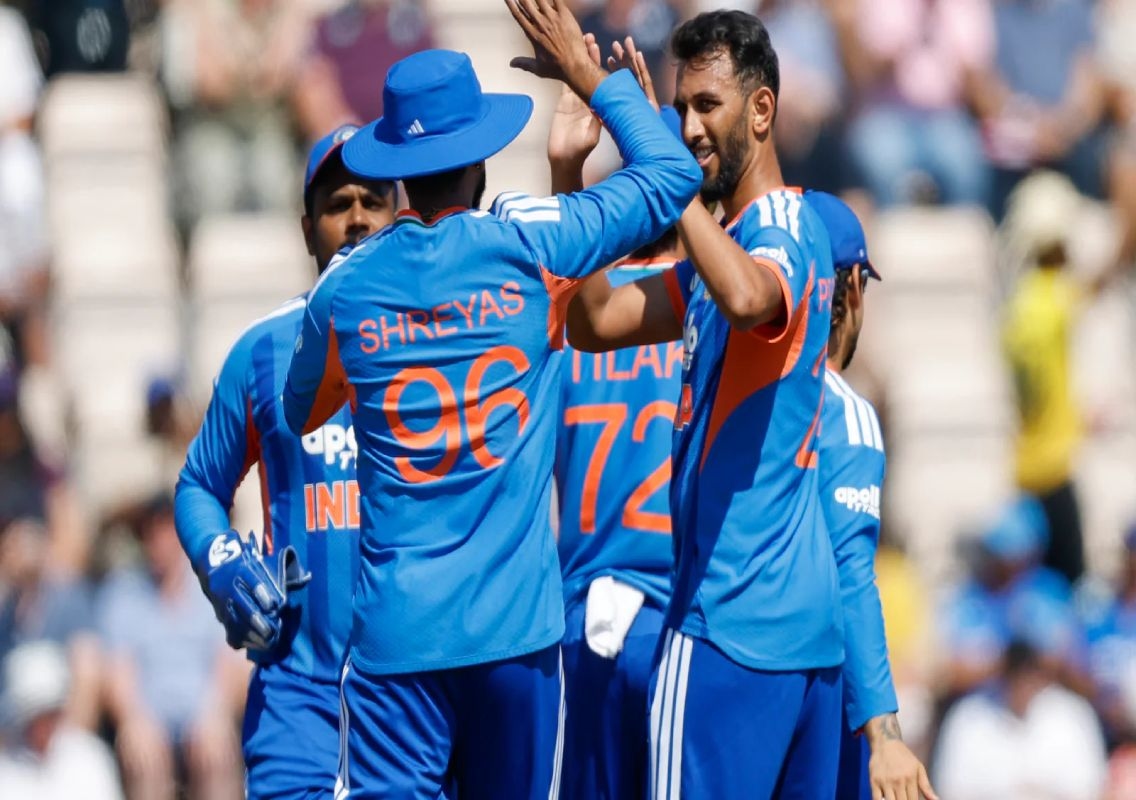


Southampton: India’s struggles in the T20 format continued as they slumped to a heavy 56-run defeat against England, marking their sixth loss in seven matches under new captain Shreyas Iyer. The defeat not only sealed a 4-0 series whitewash but also raised serious concerns over team strategy, leadership, and consistency in overseas conditions.
England dominate with record-breaking partnership
England produced a batting masterclass, powered by a sensational century from Jos Buttler and an explosive innings by skipper Harry Brook.
Buttler smashed a remarkable 131 off 64 balls, registering his career-best T20I score, while Brook remained unbeaten on 95 off 45 deliveries. The duo stitched together a monumental 233-run partnership for the second wicket, the highest for any wicket in T20 International history.
After an early breakthrough by Prasidh Krishna, who dismissed Phil Salt, India’s bowling unit lost control completely. Buttler and Brook capitalised on loose deliveries, combining elegance with brute power to dismantle the attack. Their innings featured a staggering 16 sixes, exposing India’s inability to contain aggressive batting.
Buttler’s innings stood out for its acceleration — his first fifty came off 34 balls, but he needed only 17 more deliveries to reach his century. His knock included 12 boundaries and eight sixes, underlining his dominance at the crease. Brook, on the other hand, displayed exceptional footwork and composure, particularly against spin, as he targeted Axar Patel with ease.
India’s chase never gains momentum
Chasing a daunting target of 258, India never looked in contention. Despite posting their best batting performance of the series, they managed only 201 for 8, falling well short.
Ishan Kishan scored a brisk 56 off 35 balls, while Tilak Varma contributed 53 off 25 deliveries. However, both innings came with minimal pressure, as the required run rate remained out of reach throughout the chase.
India’s batting lacked the firepower displayed by England. Notably, the entire Indian team hit just eight sixes — the same number struck individually by both Buttler and Brook — highlighting the gulf in approach and execution.
Bowling woes and tactical setbacks
India’s bowling performance was a major concern. Axar Patel endured a difficult outing, conceding 63 runs in four overs, while Prince Yadav leaked 60 runs in his spell.
The absence of injured pacer Harshit Rana further weakened the attack, forcing the inclusion of inexperienced Suryansh Shedge, who struggled to maintain consistency. His third over proved particularly costly, conceding 24 runs and effectively ending any hopes of restricting England.
The lack of discipline in line and length, coupled with poor field placements, allowed England’s batters to dictate terms. The aggressive “attack-at-all-costs” strategy, which worked on Indian pitches, appeared ineffective on English conditions.
Leadership under scrutiny amid dressing room concerns
The defeat extended India’s poor run under Iyer, with six losses in seven matches, prompting the Board of Control for Cricket in India to reportedly initiate a review.
Questions are also being raised about the team environment under head coach Gautam Gambhir. Frequent changes in the playing XI have reportedly led to uncertainty among players, affecting team cohesion and confidence.
Comparisons with the stability during Rahul Dravid’s tenure have intensified criticism. Observers point to a lack of clarity in roles and inconsistent selection policies as key issues behind India’s struggles.
On the field, Iyer’s body language during the latter stages of the match reflected the team’s situation, as he appeared visibly frustrated and short of answers while England’s dominance continued.
Conclusion: Urgent need for course correction
India’s heavy defeat in Southampton underscores deeper structural and tactical issues within the team. While individual performances have shown promise, the lack of collective execution remains a major concern.
With crucial international fixtures ahead, India must reassess its approach, particularly in adapting strategies to overseas conditions and ensuring stability in team selection. The ongoing review by the BCCI could prove pivotal in shaping the team’s future direction.
Unless swift corrective measures are implemented, India’s T20 ambitions risk further setbacks under the current leadership setup.