







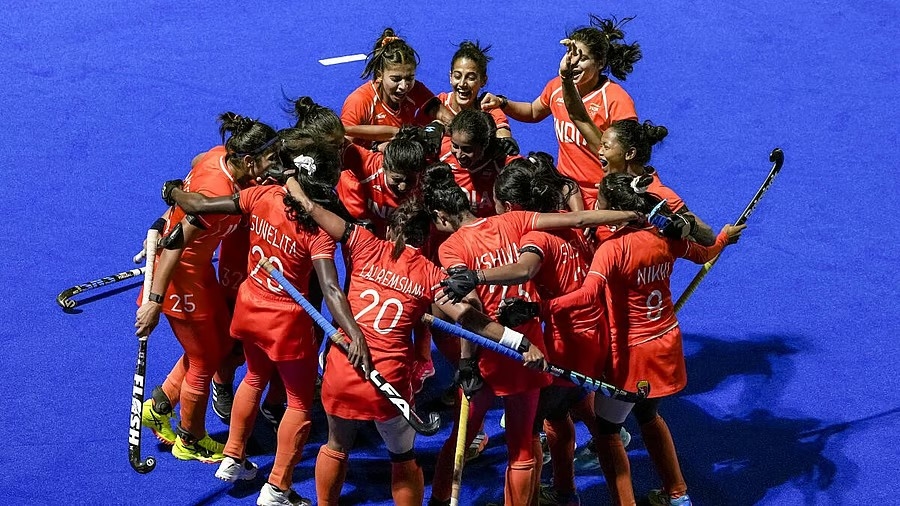


Aichi-Nagoya: India’s women’s hockey team ended a 44-year wait for Asian Games gold by defeating defending champions China 1-0 in a tense final on Saturday, securing the continental title and a direct berth at the 2028 Los Angeles Olympics.
Lalremsiami scored the decisive goal in the 10th minute with a superb reverse-stick strike, but it was India’s resolute defensive effort and goalkeeper Bichu Devi’s saves that ultimately secured the victory.
The triumph ended India’s long wait for a second women’s hockey gold at the Asian Games. The team had last won the continental title at the 1982 Asian Games in New Delhi.
India had twice reached the Asian Games final since then, in 1998 and 2018, but finished with silver on both occasions. They lost the 1998 final to South Korea and the 2018 title clash to Japan.
Lalremsiami delivers early breakthrough
India started the final with attacking intent and found the breakthrough in the 10th minute.
Sakshi Rana created the opening by threading a pass into the circle towards Lalremsiami near the goal.
The forward reacted quickly and produced a powerful reverse-stick hit while on the move. The shot flew into the upper part of the net, leaving the Chinese goalkeeper with little chance of stopping it.
The goal gave India an early advantage against a China side that had entered the final as defending Asian Games champions.
Lalremsiami’s strike also provided India with the platform they needed to control the remainder of the contest.
Rather than chasing a second goal at all costs, India increasingly focused on maintaining their advantage as China raised the pressure.
Bichu Devi and defence hold firm
China responded strongly after conceding and spent long periods pressing for an equaliser.
India’s defence, however, refused to surrender the lead.
Bichu Devi played a crucial role in protecting the 1-0 advantage, making important interventions as China repeatedly threatened the Indian circle.
The Indian defenders also put their bodies on the line to block attacks and prevent China from finding the decisive final pass or shot.
With only one goal separating the teams, every defensive intervention became important.
India absorbed wave after wave of Chinese pressure and maintained their organisation instead of allowing the defending champions to dictate the final stages.
The result was a clean sheet that proved as important as Lalremsiami’s goal.
India end 44-year Asian Games wait
The victory brings India their first women’s hockey gold at the Asian Games since 1982.
The 1982 Games were held in New Delhi, where the Indian women won the title on home soil.
Since then, India had come close on several occasions but had been unable to reclaim the championship.
The 1998 final ended in defeat against South Korea, while Japan beat India in the 2018 final.
India’s latest title therefore marks the end of a 44-year wait and restores the team to the top of the Asian Games podium.
The victory is also significant because the Asian Games title carries an Olympic qualification place. By winning the gold medal, India secured direct qualification for the women’s hockey competition at the 2028 Los Angeles Olympics.
China unable to find an equaliser
China entered the final as the defending Asian Games champions and had the quality to put India under sustained pressure.
The Chinese side also had experience of competing at the highest international level, having won silver at the Paris Olympics.
But despite their pressure, China could not find a way past India’s defence and Bichu Devi.
India’s ability to protect a narrow lead became the defining feature of the final.
The team maintained its shape and resisted the temptation to make unnecessary attacking moves when China increased the intensity.
Every clearance and defensive block helped India move closer to ending their long wait for the Asian Games title.
When the final whistle arrived, Lalremsiami’s 10th-minute strike remained the difference between the two teams.
Final delayed by 45 minutes
The final did not begin at its scheduled time after the teams’ buses were caught in a traffic jam while travelling to the venue.
The match was originally scheduled to start at 7 pm local time but began 45 minutes later at 7.45 pm.
The delay did not affect the intensity of the contest once the match got under way, with both teams immediately involved in a closely fought battle.
India’s early goal ultimately proved decisive in a match where neither side was able to add to the scoreline.
Direct route to Los Angeles Olympics
India’s Asian Games triumph also provides certainty over qualification for the 2028 Los Angeles Olympics.
The Olympic berth gives the Indian women’s team an opportunity to begin preparations for another major international campaign without having to navigate a separate qualification tournament for the Games.
For a team that has endured a lengthy wait for Asian Games gold, the result provides both a continental title and an Olympic opportunity.
The combination of Lalremsiami’s early goal, Bichu Devi’s goalkeeping and the defensive discipline shown throughout the match proved enough to overcome China.
India eye hockey double
India’s women’s gold has also raised the prospect of a hockey double at the Asian Games.
The Indian men’s team has reached the final and will face Malaysia in the title clash on October 3.
The men’s side are the defending champions and will be seeking to add another gold medal to India’s hockey tally.
A victory for the men would give India both the men’s and women’s Asian Games hockey titles in the same edition.
For the women, however, the job is already complete.
After decades of near misses, India have finally reclaimed the Asian Games women’s hockey crown. Lalremsiami’s goal may have been the only one scored in the final, but the gold medal was secured through a collective defensive effort that withstood sustained pressure from China.
The 1-0 victory not only ends India’s 44-year wait for women’s hockey gold but also sends the team directly to the Los Angeles Olympics, giving the continental triumph added significance.