







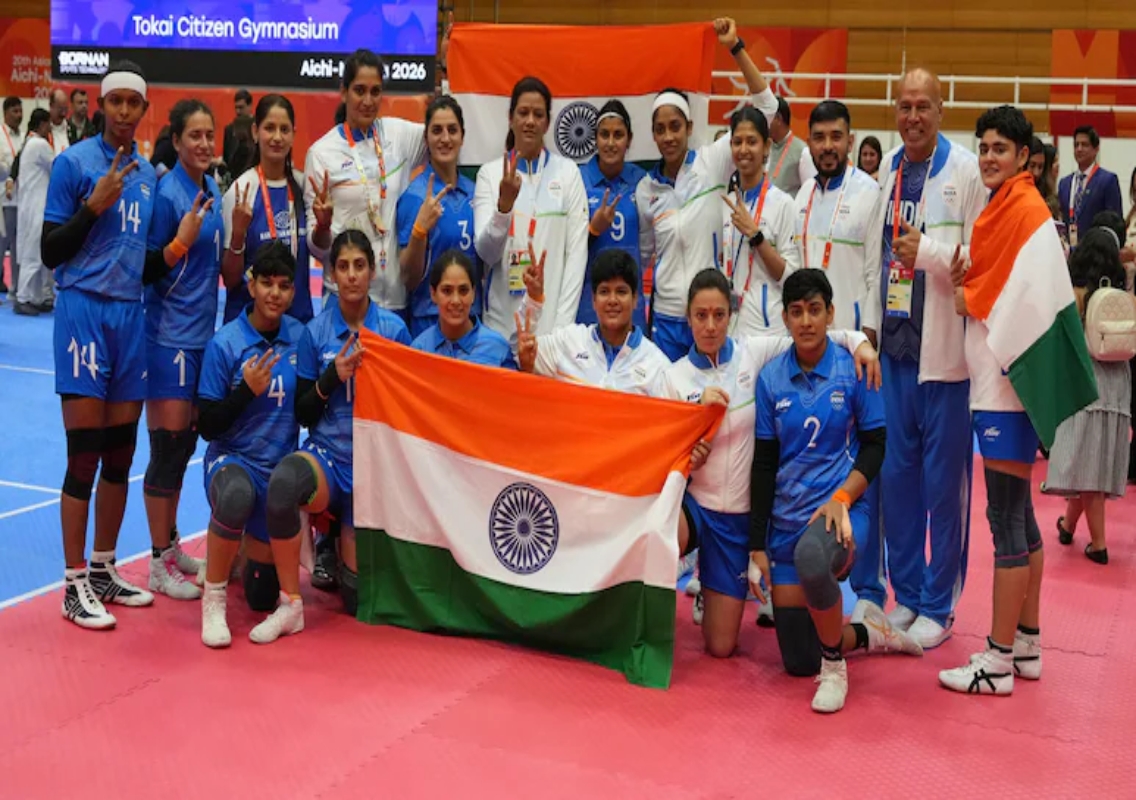


Aichi-Nagoya: India’s women’s kabaddi team clinched the gold medal at the Asian Games 2026 after defeating Iran 37-34 in a closely fought final on Saturday, September 26. The victory in Japan saw India successfully reclaim the women’s kabaddi title after missing out on gold at the 2018 Jakarta Games.
India entered the final with an unbeaten campaign and built a six-point advantage by half-time. The Indian team led Iran 22-16 at the break and managed to hold on despite a stronger second-half showing from their opponents.
Iran outscored India 18-15 after half-time, but the deficit created during the opening half proved decisive. India eventually secured a 37-34 victory to add another gold medal to its campaign at the Aichi-Nagoya Asian Games.
India takes control in the first half
The Indian women started the final strongly and established a 22-16 lead by half-time. Their early advantage gave them an important cushion against an Iranian side that had previously caused India problems at the Asian Games.
Iran responded after the interval and managed to reduce the gap during the second half. The Iranian team scored 18 points compared with India’s 15 in the final period, but India’s first-half advantage remained sufficient to secure the title.
The final score of 37-34 reflected a much tighter contest than India’s earlier knockout match against Nepal. India had defeated Nepal 48-24 in the semi-final to book its place in the gold-medal match.
India regains women’s kabaddi crown
The gold medal is significant in the history of women’s kabaddi at the Asian Games. The event made its Asian Games debut in 2010, and India has won the women’s title at every edition in which it competed except the 2018 Games in Jakarta.
At Jakarta 2018, Iran defeated India in the final, leaving the Indian team with a silver medal. India returned to the top at the subsequent edition and has now added another gold in Aichi-Nagoya.
The latest victory therefore marks a continuation of India’s strong record in women’s kabaddi at the continental multi-sport event.
Road to the final
India’s route to the gold-medal match included a dominant semi-final against Nepal. The Indian side led 31-17 at half-time and continued to control the contest after the break.
Nepal managed only seven points in the second half as India completed a 48-24 victory. The result secured India’s place in the final and set up a meeting with Iran.
India’s men’s kabaddi team also reached the final on the same day. The men defeated Thailand 66-28 in their semi-final, setting up an opportunity for India to complete a kabaddi gold-medal double in Aichi-Nagoya.
Iran provides a strong challenge
Iran proved to be a competitive opponent in the women’s final, particularly after half-time. The Iranian team improved its scoring rate in the second period and outscored India 18-15.
However, India’s six-point lead at the interval gave the defending champions enough room to withstand Iran’s comeback attempt. The Indian team maintained its advantage until the final whistle to secure the gold medal.
The result also adds another chapter to the rivalry between the two sides, following Iran’s victory over India in the 2018 women’s kabaddi final.
India celebrates Asian Games gold
After the final, the Indian players took a victory lap around the arena and celebrated their gold-medal triumph. The team also chanted ‘Vande Mataram’ during the celebrations.
The victory adds to India’s medal tally at the Aichi-Nagoya Asian Games and strengthens the country’s long-standing record in kabaddi. India’s women had entered the competition as defending champions and completed their campaign with another gold medal.
The women’s kabaddi title also came as both Indian kabaddi teams reached their respective finals. While the women have now secured gold, the men’s team is scheduled to face Iran later on Saturday with the men’s title at stake.
India’s 37-34 victory over Iran therefore not only secured another Asian Games gold but also restored the women’s team to the top of the podium after the setback at Jakarta 2018.