







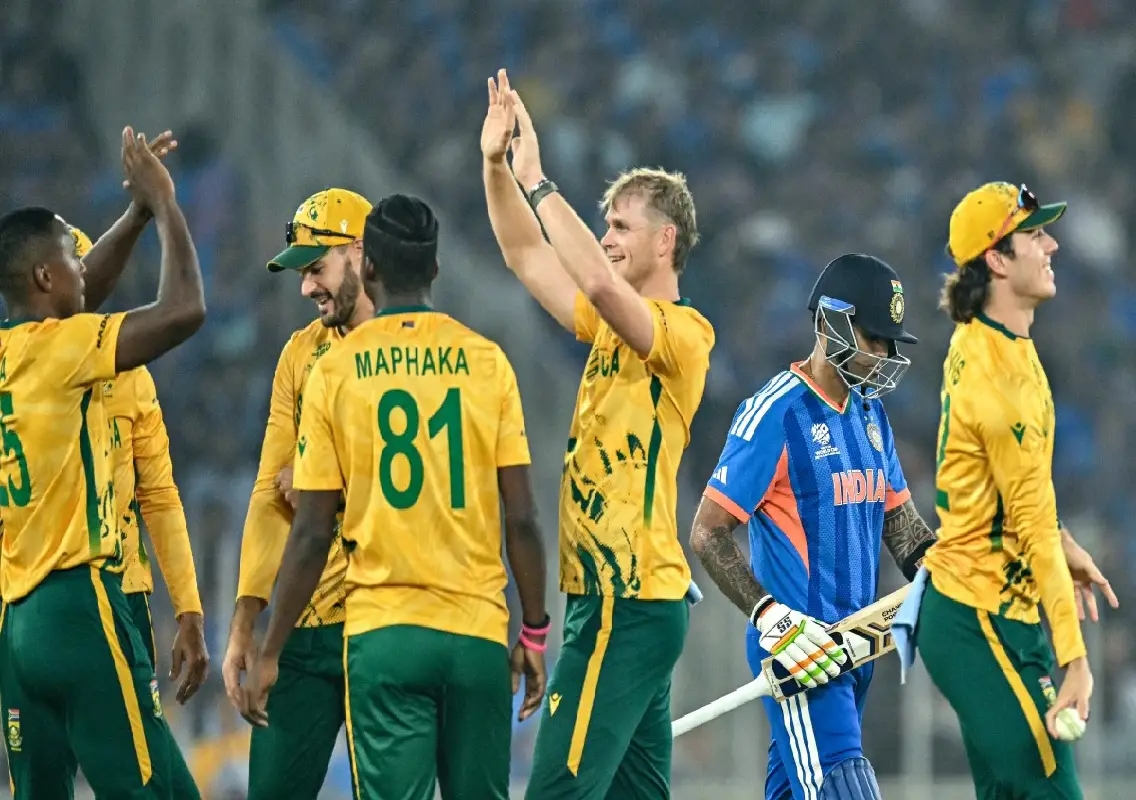


Ahmedabad: India’s one-dimensional “attack at all costs” batting approach came under severe scrutiny after a crushing 76-run defeat to South Africa national cricket team in their opening Super Eights clash of the T20 World Cup in Ahmedabad on Sunday.
The loss — India’s biggest ever in T20 World Cup history — has left the group stage wide open and turned their remaining fixtures into virtual knockouts. The 76-run margin surpassed their previous worst defeat of 49 runs against Australia in Bridgetown in 2010.
Having cruised through the group stage with four successive victories, India’s vulnerabilities were masked until they encountered a quality opponent on a slightly sluggish black-soil surface at the Narendra Modi Stadium.
Batting collapse undoes Bumrah’s brilliance
Despite a stellar bowling performance by Jasprit Bumrah, who returned exceptional figures of 3 for 15 in four overs, India were bowled out for a paltry 111 in 18.5 overs while chasing 188.
Bumrah’s incisive spells in the powerplay and death overs had initially restricted South Africa to a manageable 187 for 7. Arshdeep Singh provided able support with figures of 2 for 28, reducing the Proteas to 20 for 3 inside four overs.
However, the Indian batting unit failed to adapt to conditions where the ball was gripping and stroke-making required patience and smart rotation of strike.
South Africa’s bowlers delivered a clinical performance. Marco Jansen was the chief destroyer with 4 for 22, extracting bounce and pace variations effectively. Keshav Maharaj claimed 3 for 24 with intelligent changes in length and pace, while Corbin Bosch chipped in with 2 for 12.
Proteas recover through Miller masterclass
Earlier in the evening, David Miller rolled back the years with a commanding 63 off 35 balls. He found solid support in Dewald Brevis (45 off 29) and Tristan Stubbs (44 not out).
After the early setbacks inflicted by Bumrah and Arshdeep, the trio steadied the innings between overs seven and fifteen, a phase that ultimately proved decisive.
India’s mystery spinner Varun Chakravarthy was unable to contain the flow of runs, conceding 47 in his four overs as South Africa accelerated towards a competitive total.
Top-order falters under pressure
Chasing 188 on a tacky surface required calculated aggression. Instead, India’s top order perished attempting high-risk strokes.
Ishan Kishan fell for a duck, miscuing a delivery that held up on the pitch. Tilak Varma lasted just two balls, his attempted charge against Jansen ending in disaster. Abhishek Sharma managed 15 but looked out of rhythm before falling to a pace-off delivery.
Captain Suryakumar Yadav struggled to rotate strike and scored 18 off 22 balls, eventually flicking a leg-stump delivery to mid-wicket.
At 51 for 5, the chase was effectively over. Hardik Pandya (18 off 17) and Shivam Dube (42 off 37) stitched a 35-run partnership, but disciplined wide yorkers and slower deliveries from the South African bowlers choked any hopes of resurgence.
The decision to include Washington Sundar in place of Axar Patel also drew scrutiny, as the all-rounder failed to make a meaningful impact with either bat or ball.
Once Pandya and Rinku Singh departed, the sizeable crowd began heading for the exits, disappointed by another high-profile World Cup defeat at the venue.
Must-win games ahead
The defeat, India’s first since their semi-final loss to England in the 2022 edition, has significantly complicated their qualification scenario.
With two Super Eights matches remaining — against Zimbabwe on February 26 in Chennai and West Indies on March 1 in Mumbai — India must win both to ensure a place in the semi-finals.
The performance exposed technical and tactical flaws in a batting line-up heavily reliant on power-hitting. On slower surfaces against disciplined bowling attacks, the absence of adaptability proved costly.
While India’s bowling unit, led by Bumrah, has shown consistency and resilience, the batting order must quickly recalibrate its approach. Smart strike rotation, situational awareness and building partnerships will be critical in the upcoming fixtures.
As the tournament intensifies, India’s aggressive template will face further examination. Whether the team can balance intent with pragmatism will determine if their World Cup campaign continues or ends prematurely.