







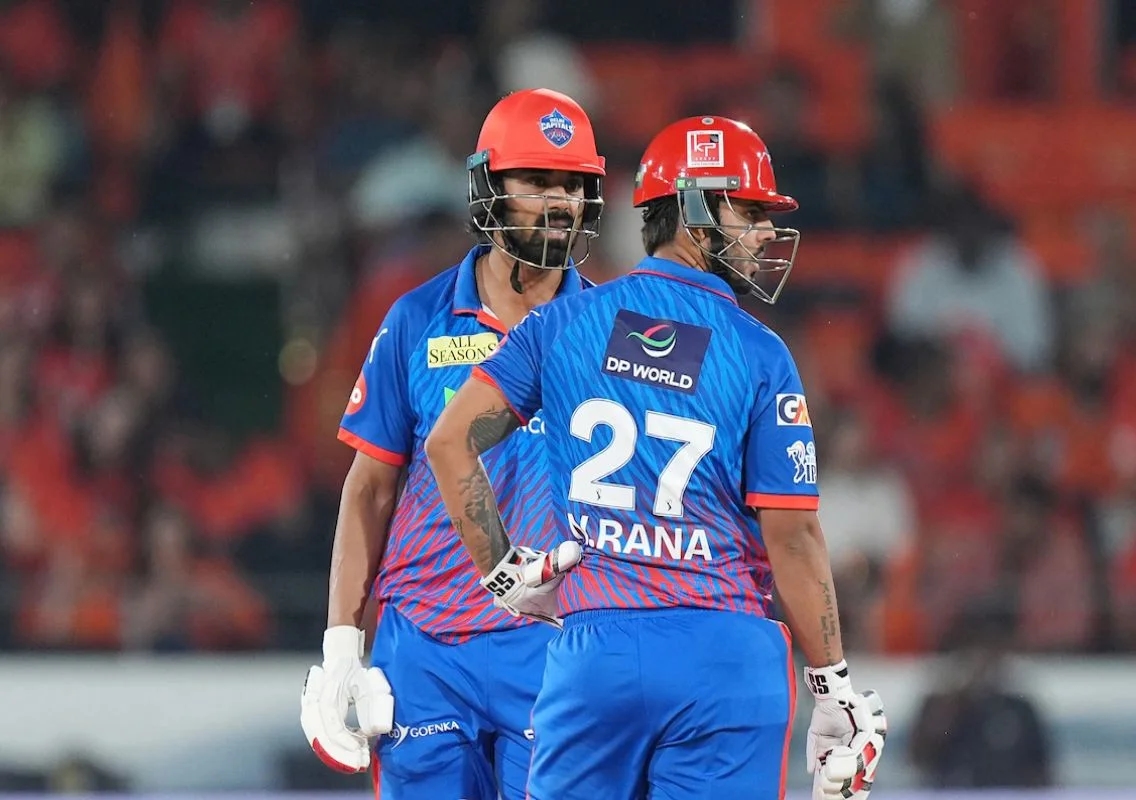


New Delhi: Delhi Capitals faced sharp criticism from within after their heavy defeat to Sunrisers Hyderabad in the Indian Premier League 2026 clash, with senior players KL Rahul and Nitish Rana coming under scrutiny for their role in a failed run chase.
Chasing a daunting target of 243 runs, Delhi Capitals never truly found momentum and eventually fell well short. Despite having a strong batting line-up, the team’s inability to capitalise on the Powerplay proved to be the turning point in the match.
Poor Powerplay start proves costly
The foundation of Delhi’s defeat was laid early in the innings. Opening alongside Pathum Nissanka, KL Rahul needed to provide a brisk start. However, Nissanka was dismissed cheaply for just 8 runs off 6 balls, putting immediate pressure on the innings.
Rahul, who has been in decent form this season, managed 37 runs from 23 deliveries but failed to anchor the chase. Meanwhile, Nitish Rana, returning to the playing XI at No. 3, scored 57 off 30 balls but struggled initially to find timing.
At the end of the first six overs, Delhi Capitals had only 59 runs on the board. According to the team management, this was significantly below the expected benchmark while chasing such a massive total.
Delhi Capitals’ Director of Cricket Venugopal Rao admitted that the team fell at least 15–20 runs short in the Powerplay.
“When chasing a 240-plus target, you ideally need 80 to 90 runs in the first six overs. With the batting depth we have, that would have kept us in the game. Finishing at 59 meant we were always playing catch-up,” Rao said in the post-match press conference.
Rahul’s lack of strike a key issue
One of the more surprising aspects of Delhi’s innings was KL Rahul’s limited involvement during the crucial early overs. After Nissanka’s dismissal, Rahul faced only a handful of deliveries, while Nitish Rana took on most of the strike.
Rahul reportedly faced just six balls during the Powerplay after the first wicket fell, compared to Rana’s 17 deliveries. This imbalance disrupted Delhi’s rhythm and prevented Rahul from building momentum.
Rao pointed out that such situations can significantly impact a batter’s ability to influence the game.
“KL Rahul didn’t get enough strike after Nissanka got out. As a batter, you need to face enough balls in the Powerplay to settle in and dominate. He hit a six and a boundary, but he couldn’t build on that because he wasn’t getting the strike regularly,” he explained.
The lack of fluidity at the top ultimately allowed Sunrisers Hyderabad to maintain control of the match.
Tactical decisions questioned
The team’s bowling strategy also came under the spotlight, particularly the decision to utilise Nitish Rana as a part-time spinner for four overs, while frontline spinner Kuldeep Yadav bowled only two.
However, Rao defended the decision, stating that such calls are made in real time based on match conditions and the captain’s judgement.
“In T20 cricket, these are instinctive decisions. If they work, they are praised; if they don’t, they are questioned. It ultimately depends on what the captain feels in that moment,” he said.
Fielding lapses prove decisive
Apart from batting and bowling concerns, Delhi Capitals were also let down by poor fielding. The team missed multiple opportunities to dismiss Abhishek Sharma, who went on to play a match-winning knock of 135 runs off 68 balls.
Sharma was handed two crucial lifelines during his innings. KL Rahul missed a run-out chance, while Pathum Nissanka dropped a straightforward catch when the batter was well set.
Rao acknowledged that such lapses can be costly, especially in high-scoring matches.
“When a player like Abhishek gives you chances, you have to take them. He offered us opportunities, but we failed to capitalise. Those moments made a huge difference in the outcome,” he said.
Delhi Capitals’ campaign so far
Following the defeat, Delhi Capitals find themselves in the middle of the points table. With three wins from six matches, the team is currently placed fifth and will need to address key issues quickly to remain in contention for the playoffs.
The loss has exposed gaps in both execution and decision-making, particularly in high-pressure chases. Going forward, the team management will expect a more cohesive performance from its experienced players.
Conclusion
Delhi Capitals’ defeat against Sunrisers Hyderabad was not the result of a single mistake but a combination of factors—an underwhelming Powerplay, lack of strike rotation, questionable tactics, and costly fielding errors.
While individual performances showed glimpses of promise, the absence of collective execution proved decisive. As the tournament progresses, Delhi will need to regroup quickly and ensure such lapses do not derail their campaign further.