







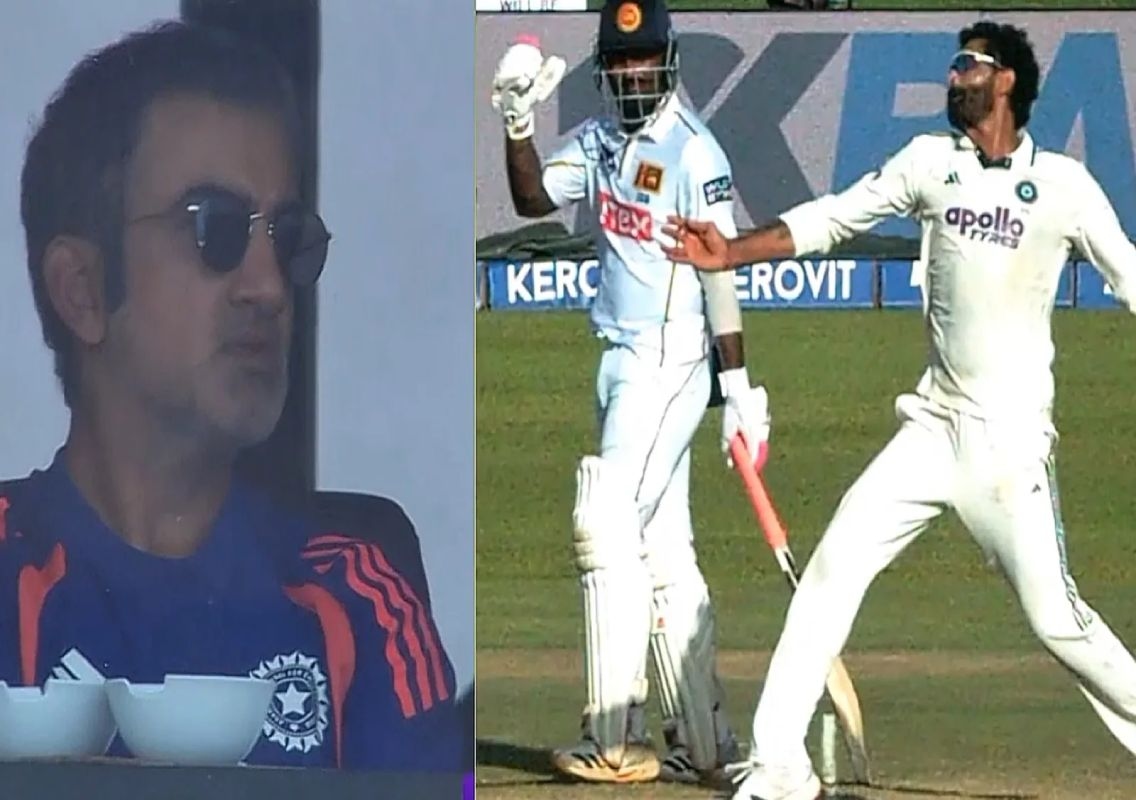


Galle: Ravindra Jadeja came agonisingly close to giving India a crucial wicket against Sri Lanka on Day 4 of the first Test, only for a no-ball to wipe out the dismissal. The moment left India head coach Gautam Gambhir visibly frustrated as the hosts fought to save the Test in Galle.
Jadeja produced a delivery that turned sharply and forced Sri Lanka captain Dhananjaya de Silva into an edge towards first slip. KL Rahul completed the catch, prompting celebrations in the Indian camp.
However, the celebrations lasted only briefly.
The umpire signalled a no-ball after Jadeja had overstepped, meaning the wicket did not count. Gambhir’s immediate reaction from the dressing-room area captured India’s disappointment at missing an important opportunity.
Jadeja’s brilliant delivery goes unrewarded
The dismissal appeared to be a major breakthrough for India.
Jadeja’s delivery turned sharply after pitching, and Dhananjaya was unable to keep his bat away from it. The resulting edge travelled towards Rahul at first slip, who took the catch cleanly.
Jadeja and the Indian team initially believed they had removed Sri Lanka’s captain.
The umpire’s no-ball call changed everything.
Because Jadeja had overstepped the bowling crease, Dhananjaya was allowed to continue his innings.
For India, it was particularly frustrating because the ball itself had done almost everything required to produce the wicket.
Gambhir’s reaction says it all
Gambhir had been visibly delighted when Rahul completed the catch.
That celebration quickly turned into frustration when the no-ball was called.
The Indian head coach’s reaction reflected how important the wicket could have been at that stage of the match. India were defending a target of 372 and had already made significant inroads into Sri Lanka’s batting line-up.
Removing Dhananjaya would have placed even more pressure on the hosts.
Instead, India had to continue searching for the breakthrough.
India had already taken four wickets
Despite the missed opportunity, India enjoyed a strong third session on Day 4.
Sri Lanka lost four wickets while chasing 372, with Manav Suthar claiming two wickets and Mohammed Siraj and Prasidh Krishna taking one each.
The hosts were therefore in a difficult position heading into the final day.
Sonal Dinusha, who had scored a century in Sri Lanka’s first innings, remained unbeaten on 25, while Dhananjaya was not out on 31.
Sri Lanka needed another 288 runs at the start of the final day to win, while India required six wickets.
India set Sri Lanka a target of 372
India began Day 4 with a lead of 178 runs and looked to extend their advantage quickly.
Yashasvi Jaiswal was dismissed for a duck in the opening over, caught behind off Asitha Fernando.
KL Rahul and Devdutt Padikkal then steadied India’s innings with a partnership worth 65 runs.
Prabath Jayasuriya broke that stand by dismissing Rahul for 35.
The Sri Lankan spinner also removed India captain Shubman Gill for eight after trapping him leg before wicket.
Rishabh Pant delivers another attacking knock
Rishabh Pant then played a key role in India’s attempt to set a substantial target.
He added 54 runs with Jadeja and completed another impressive half-century.
Pant eventually scored 66 off 69 deliveries, hitting eight fours and two sixes. His innings also saw him create a historic milestone by becoming the first Indian batter to reach 100 sixes in Test cricket.
Pant’s attacking approach helped India increase the scoring rate during an important phase of the innings.
India were eventually bowled out for 193 in 49 overs, leaving Sri Lanka with a target of 372.
Sri Lanka lose four wickets after India’s declaration-like acceleration
Sri Lanka’s chase began after the Tea break.
India’s bowlers quickly put the hosts under pressure, taking four wickets during the third session.
Suthar was particularly effective, claiming two wickets, while Siraj and Prasidh also struck.
However, Sri Lanka managed to keep the chase alive through Dinusha and Dhananjaya.
The missed opportunity created by Jadeja’s no-ball therefore became an important moment because Dhananjaya remained at the crease and continued to provide resistance.
Jadeja’s role remains crucial
Jadeja’s contribution is particularly important for India in a Test played in Galle.
The conditions traditionally bring spin into the contest, and India’s attack has relied heavily on its spinners during the match.
Jadeja provides India with both bowling control and lower-order batting depth.
His ability to extract turn and create pressure makes him a major threat to Sri Lanka’s batters.
However, the no-ball highlighted how even the smallest technical error can prove costly during a Test match.
India need six wickets on the final day
At the end of Day 4, India remained in a commanding position.
Sri Lanka needed 288 more runs to complete what would be a remarkable chase, while India required only six wickets to win the Test.
The equation left both sides with a realistic path to a result.
India would be favourites to complete the victory if their bowlers could strike early on the final morning.
Sri Lanka, meanwhile, needed Dinusha and Dhananjaya to produce a substantial partnership while surviving India’s spin and pace attack.
The no-ball could become a talking point
Had Jadeja’s delivery counted, India’s task on the final day could have been significantly easier.
Dhananjaya is an experienced batter and the Sri Lankan captain, making his wicket particularly valuable.
Instead, the no-ball allowed him to continue and potentially influence the outcome of the match.
For Jadeja, it was a reminder of the fine margins that often decide Test matches.
A brilliant delivery, an excellent catch and a potential breakthrough were all rendered irrelevant because of a small overstepping error.
Conclusion
Ravindra Jadeja’s no-ball denied India what appeared to be a crucial wicket against Sri Lanka on Day 4 of the first Test in Galle. His sharply turning delivery induced an edge from Dhananjaya de Silva, with KL Rahul completing the catch, but Jadeja had overstepped and the dismissal was ruled invalid.
Gautam Gambhir’s frustrated reaction reflected the significance of the missed chance. Nevertheless, India took four wickets during Sri Lanka’s chase and entered the final day needing six more wickets to win.
Sri Lanka required 288 runs, with Dhananjaya and Sonal Dinusha still at the crease. The no-ball could yet prove an important moment in a tightly contested Test.