







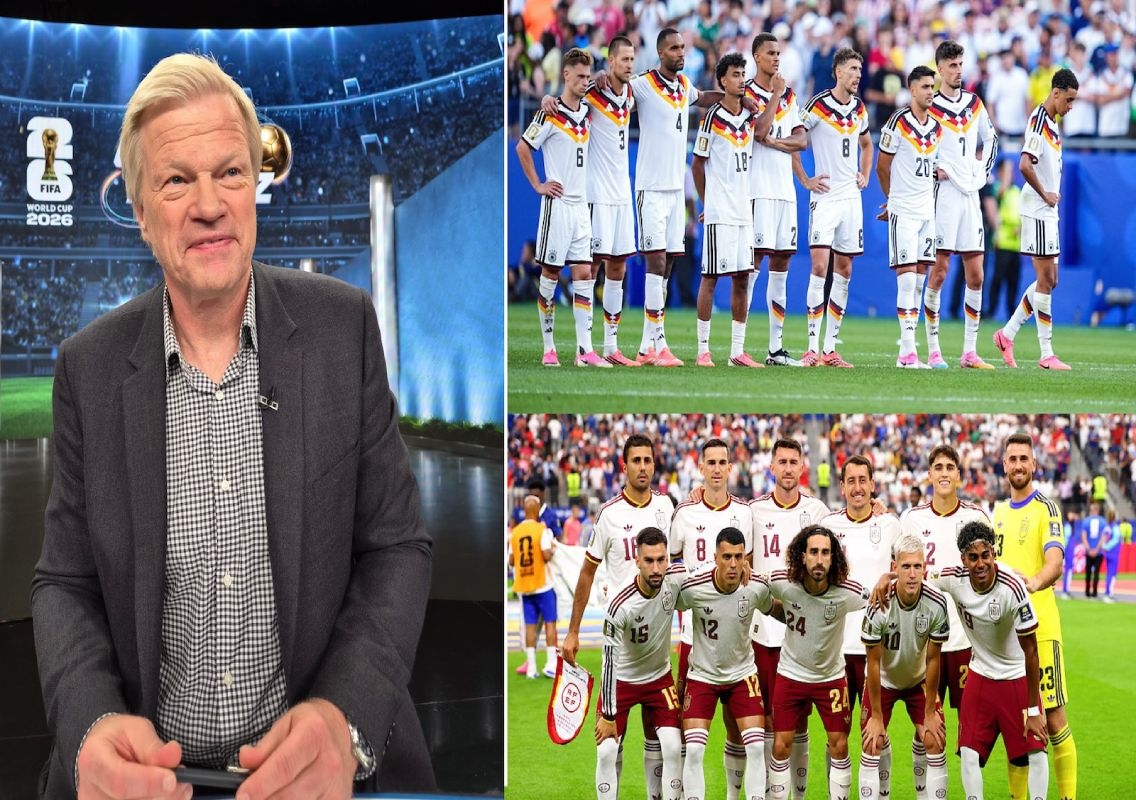


Munich: German football legend Oliver Kahn believes Germany’s path back to becoming a global football powerhouse does not depend only on appointing a new coach but on developing a clear football philosophy and long-term strategy. The former Germany captain said the national team must learn from Spain’s successful revival model after their disappointing early exit from the FIFA World Cup 2026.
Germany were eliminated in the Round of 32 at the tournament, continuing a period of inconsistency for one of football’s most successful nations. While Argentina and Spain have reached the final with clearly defined playing identities, Germany have struggled to establish a consistent approach despite possessing several talented players.
Speaking as a World Cup expert for ZEE5, Kahn highlighted Spain’s transformation as an example of how a national team can maintain its traditional identity while evolving tactically.
Spain’s evolution offers blueprint for Germany
Kahn praised Spain’s ability to retain their possession-based football philosophy while adding more attacking intensity and directness under coach Luis de la Fuente.
Spain have impressed throughout the 2026 World Cup with their defensive organisation and attacking control. They have conceded only one goal during the tournament and have displayed a balanced approach that combines technical quality with tactical discipline.
According to Kahn, Spain’s current success is built on years of maintaining a football identity rather than making frequent changes based on short-term results.
“The most important part, not only for national teams but also for club teams, is to develop your own philosophy, develop your own identity and stick to it,” Kahn said.
He pointed out that Spain’s famous tiki-taka style, which dominated world football more than a decade ago, has evolved under de la Fuente. While the foundation of ball possession remains, Spain now play with greater attacking purpose and vertical movement.
Kahn explained that Spain have not abandoned their traditional strengths but have adapted them to modern football demands. This combination of continuity and improvement has helped Spain return to the highest level.
Germany’s issue bigger than coaching change
Germany’s future has been the subject of debate following their early World Cup elimination. Several former players have questioned whether the team lacks a clear tactical direction and identity.
When asked about former Germany international Philipp Lahm’s comments regarding the absence of a tactical blueprint under coach Julian Nagelsmann, Kahn agreed that the problem extends beyond the identity of the manager.
The former Bayern Munich goalkeeper said discussions about replacing the coach, including speculation involving Jürgen Klopp, should not distract from the bigger issue.
“The big question in Germany for me is not who will be the next coach. Maybe, to a minor extent, will it be Jürgen Klopp? But for me, the most important question is what kind of football or what kind of players do we want to educate over the next 10 years?” Kahn said.
He stressed that Germany already have talented players, including Jamal Musiala, Florian Wirtz and Kai Havertz, but talent alone cannot guarantee success.
According to Kahn, mentality, responsibility and the ability to handle pressure situations are equally important in major tournaments.
Mental strength remains key in World Cups
Kahn, who won the Golden Ball at the 2002 FIFA World Cup, said Germany must focus on developing players who can perform during decisive moments.
He highlighted situations such as penalty shootouts and high-pressure knockout matches, where mental preparation often separates champions from underperforming teams.
The former goalkeeper believes Germany’s decline is not because of a lack of quality players but because the team needs stronger foundations and a clearer understanding of how they want to compete at international level.
Germany have historically built success around discipline, organisation and collective strength. Kahn believes those characteristics must be restored while adapting to modern football.
Argentina’s mentality impresses Kahn
While discussing the ongoing World Cup, Kahn also praised defending champions Argentina for their remarkable resilience and fighting spirit.
Argentina have repeatedly shown their ability to recover from difficult situations during the tournament. Their dramatic comeback victory over England in the semi-final, where they scored two late goals to win 2-1, highlighted their ability to perform under pressure.
Kahn said Argentina’s biggest strength is not just individual talent but the environment created around captain Lionel Messi.
He explained that Argentina’s players are motivated by representing their country and playing alongside Messi, creating an atmosphere where high performance becomes possible.
According to Kahn, Argentina’s success comes from a combination of tactical understanding, emotional connection and collective belief.
Lessons for Germany’s future
Germany’s next challenge will be rebuilding a national team capable of competing consistently at major tournaments. Kahn believes the solution lies in developing a long-term football structure rather than relying on a quick managerial fix.
Spain’s journey shows that maintaining a football identity while adapting to new trends can produce sustainable success. Argentina’s campaign demonstrates the importance of mentality and team spirit.
For Germany, combining these lessons could be crucial in their attempt to return to the elite level of international football.
Conclusion
Oliver Kahn’s message is clear: Germany’s revival will not come simply through changing coaches. The nation needs a defined football philosophy, stronger player development and greater mental resilience. By learning from Spain’s evolution and Argentina’s winning mentality, Germany can begin rebuilding towards future World Cups.