







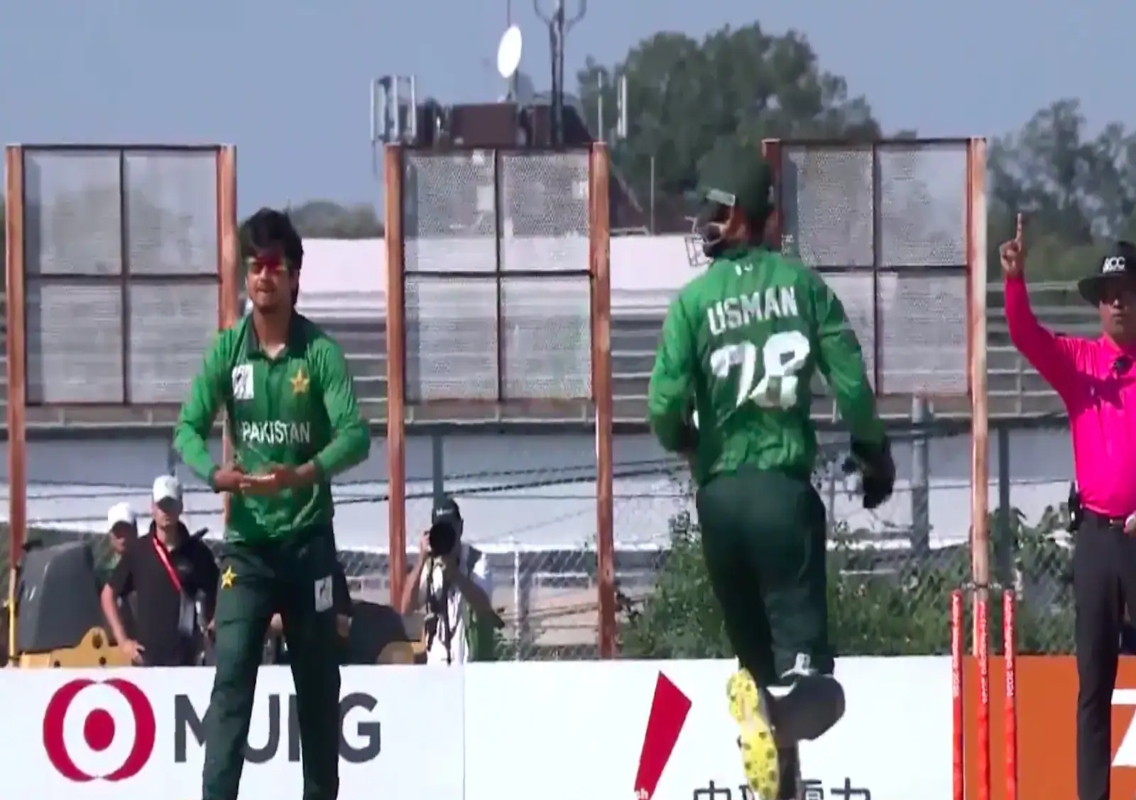


Former Pakistan wicketkeeper-batter Kamran Akmal has criticised Saim Ayub for his controversial send-off to 15-year-old Indian batter Vaibhav Sooryavanshi during the Asian Games 2026 men’s cricket final between India and Pakistan. Akmal questioned the need for such a celebration and suggested that Ayub was seeking attention on social media rather than focusing on his performance.
The incident took place during the high-profile gold-medal clash between the two teams on Saturday. Ayub dismissed Sooryavanshi for 15 runs from nine balls in the third over. Instead of limiting his celebration to a conventional reaction, Ayub performed a “baby in the cradle” gesture, apparently referring to Sooryavanshi’s young age.
The celebration quickly became a talking point among cricket fans, with the gesture attracting criticism on social media. The incident also drew a strong response from Akmal, who felt that players representing Pakistan at the international level should concentrate on their cricket rather than creating moments designed to attract online attention.
Kamran Akmal questions Saim Ayub’s celebration
Speaking on a sports discussion show, Akmal expressed disappointment over Ayub’s conduct during the final. The former Pakistan international argued that the age of an opposition player should not become a reason for an excessive celebration, particularly when the youngster is competing in international cricket.
Akmal said that such incidents had been occurring for some time and linked them to the pressure to remain relevant on social media. He also stressed that Ayub is an established international cricketer and should focus more closely on his performances.
His criticism came despite Ayub having achieved the immediate objective of dismissing one of India’s young opening batters. For Akmal, however, the manner of the celebration was unnecessary and did little to help Pakistan’s cause in the gold-medal match.
Vaibhav Sooryavanshi dismissed for 15
The incident occurred early in India’s innings. Sooryavanshi, who is only 15 years old, was dismissed after scoring 15 runs from nine deliveries.
Ayub’s dismissal of the young Indian batter could have been a significant moment for Pakistan, which was hoping to put early pressure on India’s batting line-up. Instead, the subsequent celebration became one of the most discussed moments of the match.
Sooryavanshi did not respond to the gesture and quietly walked back towards the Indian dugout after his dismissal. The teenager’s calm reaction stood in contrast to the animated celebration and further fuelled discussion surrounding the incident.
The contest between India and Pakistan was already one of the most anticipated matches of the Asian Games because of the rivalry between the two cricketing nations. With the gold medal at stake, every moment of the match attracted considerable attention.
Abhishek Sharma responds with the bat
Ayub’s celebration proved particularly costly from a psychological point of view when India’s next phase of batting produced an immediate response.
In the same over, Abhishek Sharma attacked Ayub and struck him for a six and two boundaries. The sequence shifted the momentum back towards India and turned the spotlight away from Ayub’s earlier celebration.
India eventually posted a strong total and went on to win the gold medal. The Indian side secured victory over Pakistan and successfully defended its Asian Games men’s cricket title.
The outcome meant that the send-off, which had initially attracted considerable attention, became less significant than India’s eventual performance. Pakistan’s inability to convert the early breakthrough into sustained pressure allowed India to recover and establish control over the contest.
Pakistan’s performance remains the bigger concern
Akmal’s criticism was not limited to the individual incident. His comments also reflected wider concerns about Pakistan’s performance in international cricket.
The former wicketkeeper-batter argued that players should prioritise their performances and results instead of attempting to generate viral moments. His comments suggested that the focus on social media attention could become a distraction, particularly during major international tournaments.
For Pakistan, the Asian Games final represented an opportunity to win gold against India. However, the team ultimately finished with the silver medal after falling short in the final.
For India, the victory represented another successful campaign in Asian Games cricket. The men’s team retained its title, adding to the country’s strong performance in the tournament.
The final also produced several contrasting individual narratives. Sooryavanshi’s early dismissal, Ayub’s controversial celebration and India’s eventual victory ensured that the match continued to generate discussion even after the final ball.
The incident adds another chapter to India-Pakistan rivalry
India-Pakistan cricket matches are rarely limited to the scoreboard, and the Asian Games final was no exception. The rivalry, combined with the gold medal at stake, ensured that individual moments received significant attention.
Ayub’s gesture towards Sooryavanshi became one such moment. While competitive celebrations are common in professional sport, Akmal’s comments underline the expectation that international players should maintain discipline and respect, regardless of the opponent’s age.
Sooryavanshi’s age made the incident particularly sensitive. Despite being just 15, he was competing at the highest level of the Asian Games and was part of an Indian team that eventually won the gold medal.
The episode ultimately serves as a reminder that performances tend to have greater significance than short-lived celebrations. Ayub achieved an early breakthrough, but India’s subsequent recovery and eventual gold-medal victory meant that the dismissal did not define the result.
For Pakistan, Akmal’s comments provide a strong reminder that players need to remain focused on the larger objective. For India, the final ended with another Asian Games gold medal and a memorable victory over their traditional rivals.