


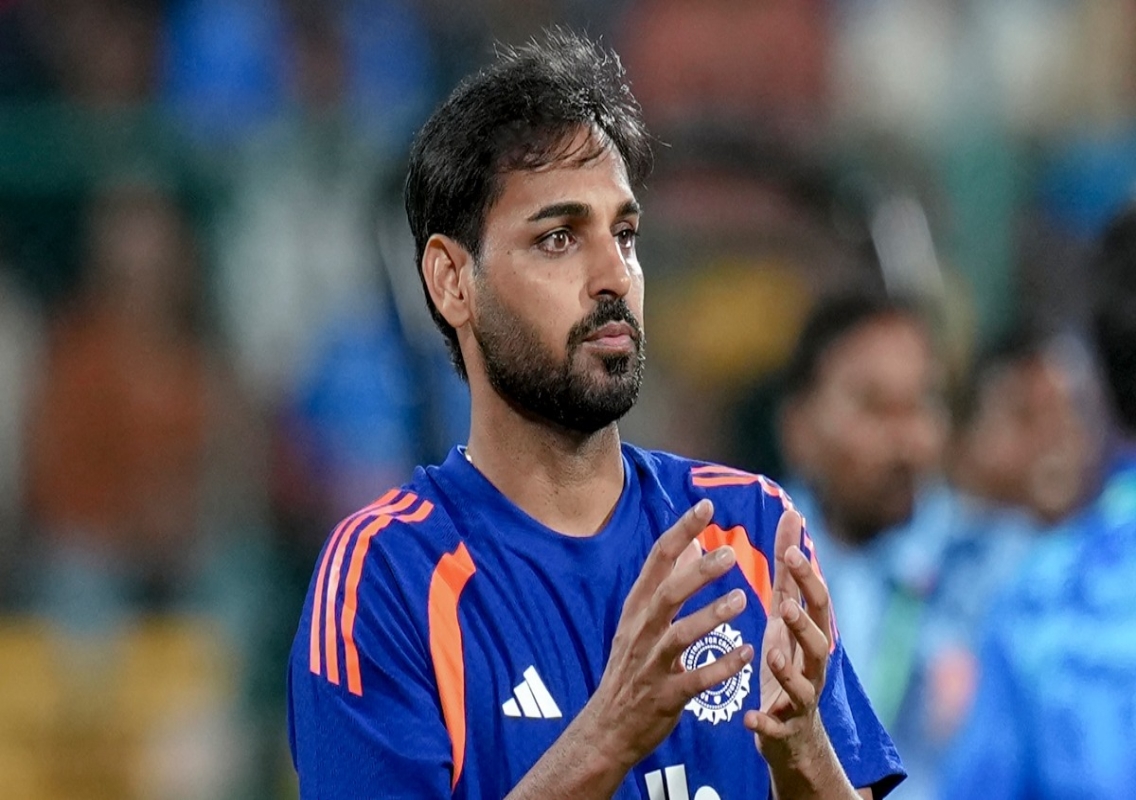


Christchurch: Former India wicketkeeper-batter Dinesh Karthik has highlighted a worrying aspect of Bhuvneshwar Kumar’s return to international cricket after the experienced pacer endured an expensive outing in the first T20I against New Zealand. While Karthik urged fans not to judge the bowler too harshly after one match, he pointed to two uncharacteristic no-balls as a concern that needs attention.
Bhuvneshwar returned to India’s T20I side in Christchurch on October 22, 2026, after a long absence from international cricket. However, the comeback did not go according to plan, as he conceded 49 runs in four overs without taking a wicket. India eventually won the high-scoring contest by four wickets, successfully chasing New Zealand’s 225/4 with two balls remaining.
Karthik points to two costly no-balls
Speaking about Bhuvneshwar’s performance, Karthik identified the two no-balls as a significant factor behind the bowler’s expensive figures. For a pacer known for his control and ability to deliver disciplined spells, conceding two no-balls in a single match was an unusual feature of the comeback.
According to Karthik’s assessment, the first and fourth overs of Bhuvneshwar’s spell were comparatively better, while the second and third overs proved more difficult. The extra deliveries and runs conceded during the middle overs contributed to the pressure on India’s bowling attack.
Karthik suggested that nerves could have played a role in the performance, while also raising the possibility that Bhuvneshwar might not yet have been fully ready for the demands of international cricket after his extended absence.
However, the observation was not a declaration that the veteran pacer had lost his ability. Rather, it highlighted the importance of regaining rhythm, control and confidence as he settles back into the international setup.
A difficult return after a long absence
Bhuvneshwar’s appearance against New Zealand marked his return to international cricket after last playing for India in 2022. His experience and reputation as a bowler capable of controlling the powerplay and delivering accurate overs made his comeback a notable development for the team.
The first T20I, however, offered a stern test. New Zealand batted aggressively throughout their innings, finishing on 225/4 in 20 overs. Glenn Phillips led the charge with an unbeaten 82 off 40 balls, while Finn Allen contributed 45 off 24 deliveries and Bevon Jacobs scored 31 off 16.
Bhuvneshwar’s figures of 0/49 reflected the pressure created by New Zealand’s attacking approach. The two no-balls added to the difficulty, as they gave the opposition additional deliveries and opportunities to score.
At the same time, India’s bowling difficulties were not limited to Bhuvneshwar. Axar Patel conceded 51 runs, Arshdeep Singh gave away 45, and Nitish Kumar Reddy went for 40 in his four overs. Mayank Yadav was comparatively economical, returning figures of 1/40.
The collective figures underline the challenge faced by India’s bowlers on a surface where the batters were able to score rapidly. Nevertheless, Bhuvneshwar’s control will remain an important point of discussion because of his experience and role in the attack.
Karthik asks for patience, but consistency matters
Karthik’s assessment carried a note of caution without dismissing Bhuvneshwar’s prospects. A single expensive spell, particularly in a high-scoring match and after a lengthy international break, is not enough to establish whether a player can still perform at the highest level.
The former India wicketkeeper’s message was that supporters should allow the bowler time to work through the challenges of his return. At the same time, the no-balls cannot become a recurring problem. For a bowler whose effectiveness depends heavily on accuracy and subtle variations, avoiding unnecessary extras is a basic requirement.
Bhuvneshwar will need to demonstrate improved discipline in subsequent matches, particularly when facing aggressive batters during the powerplay and at the death. Re-establishing a consistent run-up, release point and bowling rhythm could be important as he adjusts to international competition again.
The next outings will provide a clearer indication of whether the opening performance was an isolated setback or whether he needs more time to regain his best form. India’s team management will also have to assess how his experience fits into the balance of the bowling attack.
India’s batting rescues the opening match
Despite the concerns with the ball, India began the five-match T20I series with an important victory. Chasing 226, the visitors reached 230/6 in 19.4 overs, completing their highest successful T20I run chase at the time of the match.
Sanju Samson set the tone with 67 off 33 balls, while Abhishek Sharma made 29 off 12. Captain Shreyas Iyer contributed 42 off 28 deliveries before Naman Dhir finished strongly with an unbeaten 42 off 15 balls. Samson was named Player of the Match.
The result gave India a 1-0 lead in the series, but the bowling performance left areas for improvement ahead of the next fixture.
For Bhuvneshwar, the priority will be to turn the experience into a more controlled performance. Karthik’s comments point to a specific concern rather than a final verdict: the veteran pacer’s return will be judged not by one difficult night alone, but by how quickly he restores the accuracy and consistency associated with his bowling.