







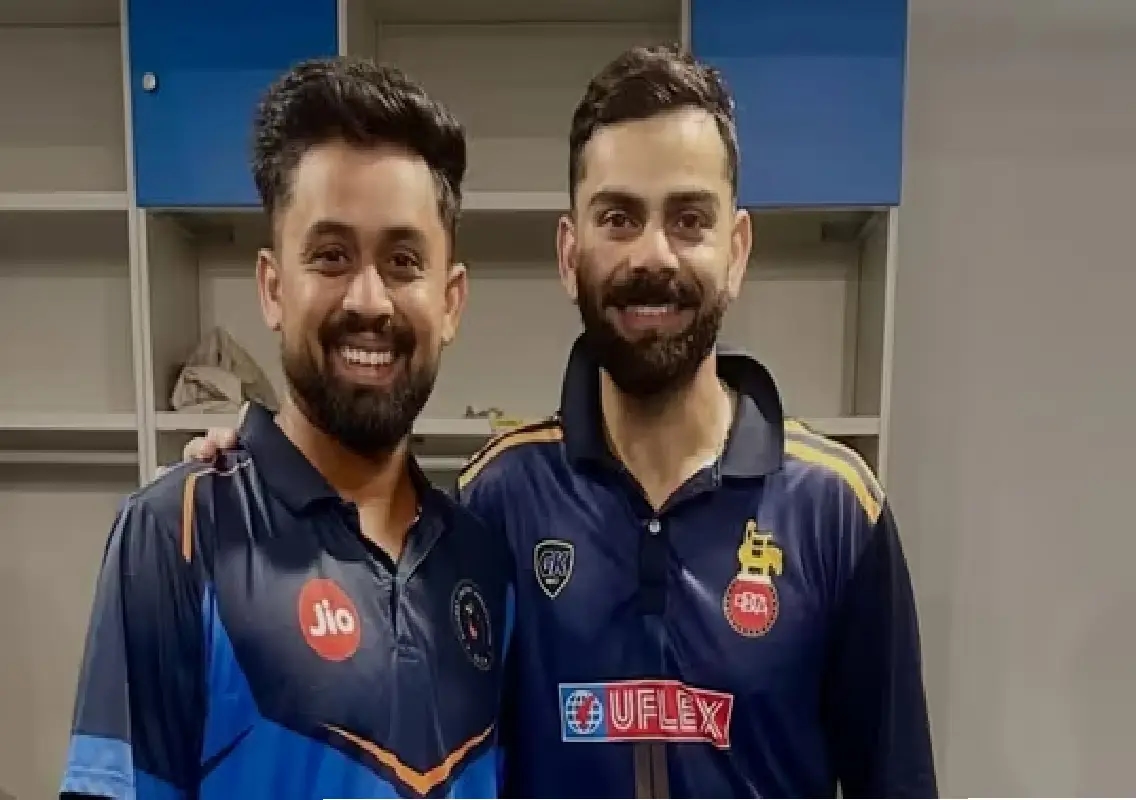


Ahmedabad: Virat Kohli’s return to the Vijay Hazare Trophy after a 15-year gap turned into a compelling statement of intent, as the former India captain showcased hunger, adaptability and authority in domestic cricket, while also producing a moment that handed Gujarat spinner Vishal Jayswal the biggest wicket of his career.
A comeback loaded with context
Kohli entered the Vijay Hazare Trophy under a cloud of scrutiny. Over the past four to five months, debate around his future, motivation and longevity has dominated cricket discourse, with questions raised about whether he has the drive to push on until the 2027 ODI World Cup. Having retired from Test cricket earlier in the year and spent months away from international action, the pressure was unmistakable.
His recent ODI tour of Australia had only added fuel to the scepticism. Back-to-back ducks in the opening two matches put Kohli firmly in the spotlight. Yet, as he has done throughout his career, the 37-year-old responded emphatically with an unbeaten 74 in Sydney. That knock proved a turning point, setting the tone for a prolific series against South Africa where he finished as Player of the Series with two centuries and an unbeaten fifty.
Dominance on domestic return
Against that backdrop, Kohli’s reappearance in India’s premier domestic 50-over competition carried significance far beyond runs alone. Representing Delhi, he made an immediate impact, compiling a combined 208 runs across two matches against Andhra and Gujarat.
In the opening fixture against Andhra, Kohli struck a commanding 131, anchoring a successful chase of 299 with remarkable ease. The innings underlined his comfort in List A cricket and suggested that the technical and mental foundations of his game remain firmly intact.
The following match against Gujarat reinforced that narrative. Walking in early after the dismissal of opener Priyansh Arya, Kohli adopted an unusually aggressive approach from the outset. He attacked pacers inside the powerplay, charged down the track, and even unveiled innovative strokes such as the reverse sweep to disrupt the spinners’ rhythm.
A rare dismissal and a career-defining wicket
By the end of the first ten overs, Kohli had already struck eight boundaries and a six. He raced to his half-century in just 29 balls, looking ominously set for another three-figure score. Gujarat’s bowlers appeared under siege until Vishal Jayswal intervened.
The left-arm orthodox spinner delivered a moment of brilliance, drawing Kohli out of his crease with sharp turn away from the outside edge. Wicketkeeper Urvil Patel completed the dismissal with a swift stumping, making him only the ninth wicketkeeper in history to effect a stumping of Kohli.
The dismissal was notable not for Kohli’s error but for the execution of Jayswal’s plan. Speaking later, the 27-year-old admitted there was no elaborate trap. “My plan was not to have Kohli come out of the crease. I just wanted to bowl stump-to-stump and not give him room,” he said, explaining that patience and discipline were central to the strategy.
Gujarat’s tactical discipline
Jayswal revealed that Gujarat’s approach revolved around containment rather than confrontation. The idea was to deny Kohli easy boundaries and force him into a mistake. “We knew if he was unable to get boundaries at will, our chances would increase,” the spinner explained.
The plan worked. Not only did Jayswal remove Kohli, he also dismissed Nitish Rana, Rishabh Pant and Arpit Rana, finishing with impressive figures of 4 for 42. Across 11 first-class matches, 13 List A games and 16 T20s, Jayswal has now taken a combined 64 wickets, while also proving his all-round credentials with a first-class century to his name.
Mutual respect and learning
Despite the intensity of the contest, the post-match exchange between the two players reflected mutual respect. Jayswal revealed that Kohli congratulated him with a simple “well bowled” and encouraged him to keep performing. Kohli also signed the match ball, a souvenir that the spinner later shared on social media along with the video of the stumping, which crossed 2.5 lakh likes on Instagram.
For Jayswal, the opportunity to bowl to Kohli was invaluable. “When you play against such big players, you learn a lot about their mindset and approach,” he said, describing the experience as memorable and instructive.
A narrow finish and lessons learned
While Jayswal’s personal success stood out, Gujarat ultimately fell short in the match. Chasing a modest target, they were well placed at 213 for 6 in the 42nd over, needing just 42 runs. However, Delhi staged a late comeback, claiming the final four wickets for 27 runs to seal a dramatic seven-run victory.
Reflecting on the defeat, Jayswal admitted the loss was painful but educational. “We should have won the contest, but it wasn’t meant to be. We learned how important it is to finish games,” he said.
Bigger picture for Indian cricket
Kohli’s Vijay Hazare performances have reaffirmed his appetite for competition and his ability to adapt, even as domestic bowlers continue to challenge him. With the BCCI mandating participation of centrally contracted players in domestic tournaments, his presence — along with Rohit Sharma turning out for Mumbai — has added depth, visibility and competitiveness to the competition.
As the tournament progresses, Kohli’s return stands as both a personal statement and a reminder of the enduring value of domestic cricket in shaping narratives at the highest level.