







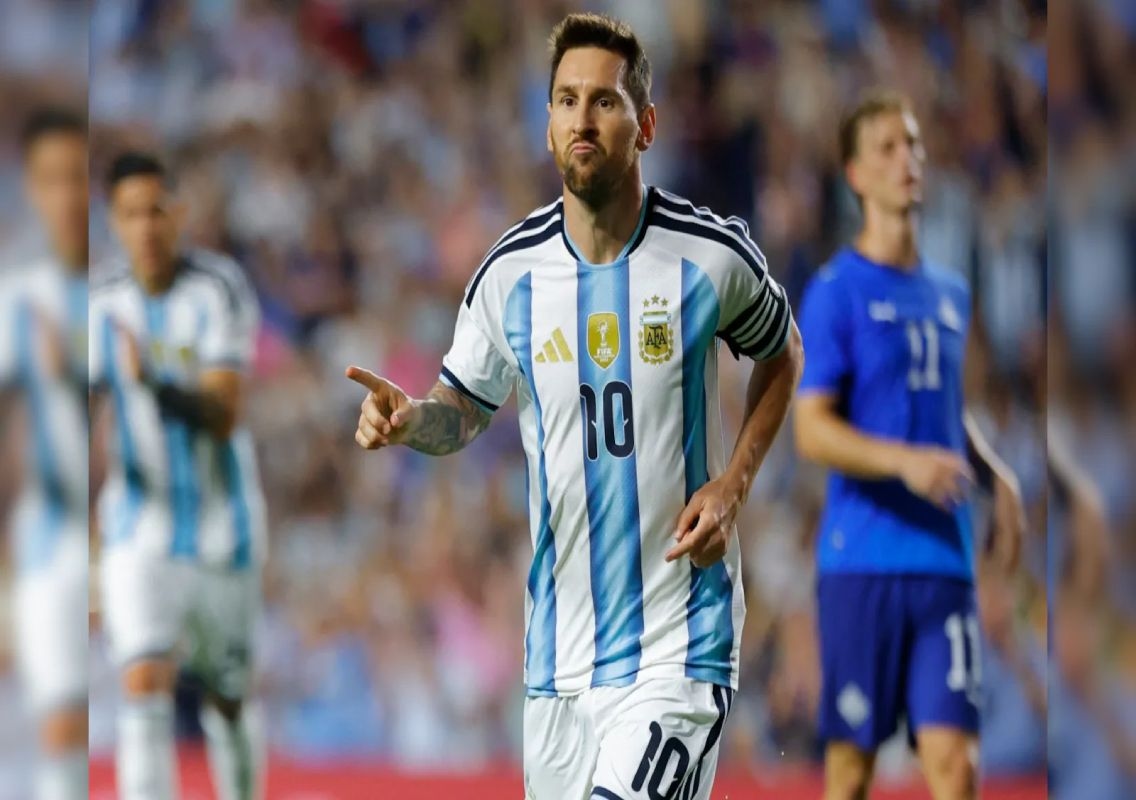


Alabama: A fresh controversy has emerged at the FIFA World Cup 2026 after sensitive passport details of Lionel Messi and his Argentina teammates were accidentally leaked ahead of a warm-up match, raising serious concerns over data security protocols at the global tournament.
According to a report by Reuters, the passport numbers of all Argentina players listed for their pre-World Cup friendly against Iceland were published without redaction on the official team sheet. The incident occurred at the Jordan-Hare Stadium in Alabama, where the document was circulated to media and the public without masking confidential information.
Major security lapse raises questions
The breach has sparked widespread criticism, as passport numbers are considered highly sensitive personal data. Standard practice requires such information to be blurred or removed before documents are made public.
However, in this case, the Argentina squad’s passport details, including that of captain Lionel Messi, were visible in the released material. The oversight has raised questions about the adequacy of FIFA’s data handling and security measures during one of the world’s most high-profile sporting events.
Interestingly, Iceland’s players were not affected by the breach, as they did not include passport numbers in their submitted team sheet. This contrast has further highlighted inconsistencies in documentation protocols between teams.
Reuters has reportedly reached out to both FIFA and the Argentine Football Association for comments, but official responses are awaited.
Series of controversies hit tournament
The data leak is the latest in a string of controversies surrounding the FIFA World Cup 2026, which is being co-hosted by the United States, Canada, and Mexico.
Earlier, a video showing Senegal’s national team undergoing extensive security checks at a United States airport sparked outrage on social media. The players, including stars like Sadio Mane and Kalidou Koulibaly, were reportedly screened with metal detectors on the tarmac in San Antonio after disembarking from their flight.
Several users questioned whether other teams were subjected to similar procedures, with some alleging unequal treatment. Reports also suggested that Uzbekistan’s team may have faced comparable checks in New York, though no official confirmation has been provided.
Referee denied entry adds to concerns
In another incident, Somali referee Omar Artan was denied entry into the United States despite being selected for officiating duties at the World Cup. Artan, one of Africa’s top referees and the continent’s best male referee in 2025, was set to become the first official from Somalia to referee at the tournament.
He was stopped at Miami International Airport due to unspecified “vetting concerns” cited by U.S. Customs and Border Protection. Following the incident, FIFA removed him from the list of match officials.
Artan had been issued a visa shortly before travel, according to the Somalia Embassy in Kenya, making the development even more controversial. Upon returning to Mogadishu, he expressed disappointment but remained hopeful of participating in future World Cups.
Argentina shine on the pitch
Amid the off-field controversy, Argentina delivered a commanding performance on the field, defeating Iceland 3-0 in front of more than 88,000 spectators.
Lionel Messi, returning from a hamstring injury, made an immediate impact after coming on as a substitute in the second half. He scored within two minutes, converting a penalty after Lautaro Martinez was fouled in the box.
The goal also saw Messi become Argentina’s oldest goalscorer, at 38 years and 11 months, surpassing a record held since 1957.
Argentina will begin their title defence in Group J against Algeria, carrying strong momentum despite the off-field distractions.
Conclusion
The passport data leak involving Argentina’s squad has once again brought the spotlight on organisational lapses at the FIFA World Cup 2026. While the tournament continues to deliver thrilling action on the pitch, repeated controversies risk overshadowing the sporting spectacle.
As FIFA faces growing scrutiny, ensuring stronger security measures and consistent protocols will be crucial to maintaining the credibility and integrity of the event.