







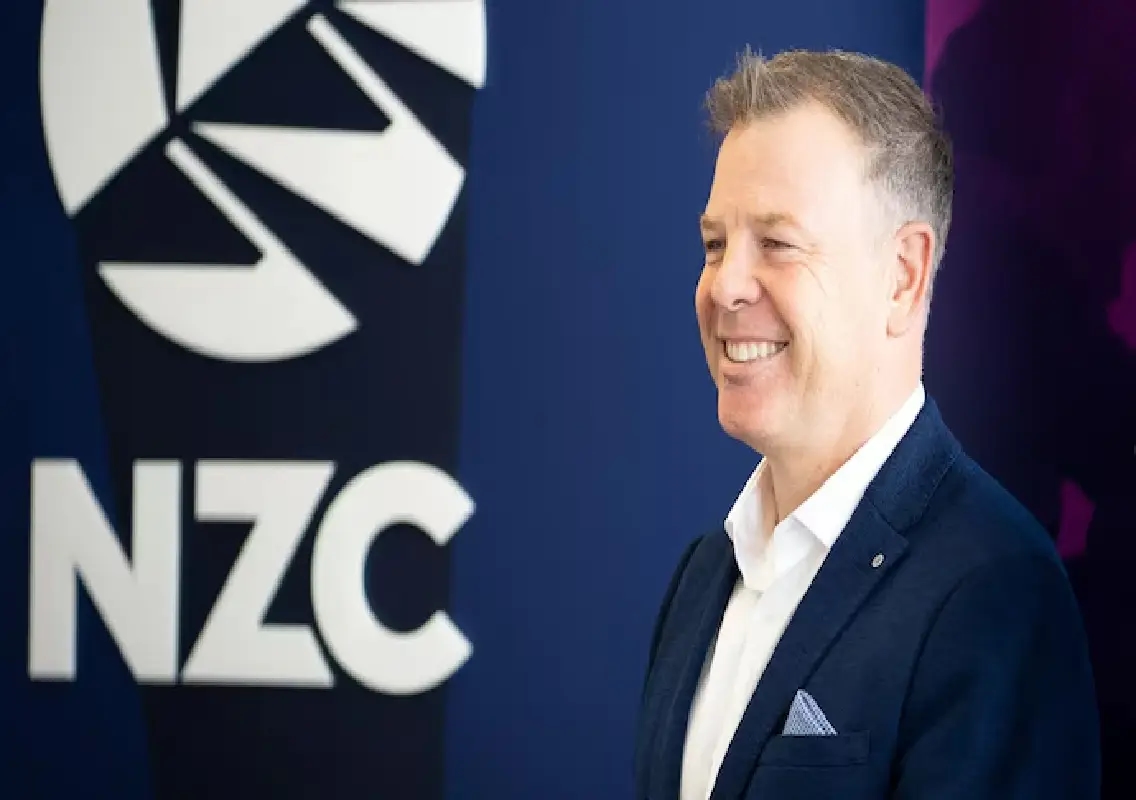


New Zealand Cricket (NZC) is set for a leadership transition after chief executive Scott Weenink announced that he will step down from his position on January 30, 2026, citing irreconcilable differences over the future direction of the game in the country.
Announcement marks end of two-and-a-half-year tenure
Scott Weenink’s decision brings to a close a two-and-a-half-year tenure that, while marked by notable on-field success for New Zealand teams, was increasingly characterised by disagreements behind the scenes. In a media statement issued on Friday, Weenink acknowledged that alignment between himself, several of New Zealand’s six major member associations, and the New Zealand Cricket Players’ Association (NZCPA) had broken down.
“After careful consideration, it has become clear that I hold a different view from several member associations, and the NZCPA, on the future priorities for NZC, including the long-term direction of the game and the best role for T20 cricket in New Zealand,” Weenink said. “Given these differences, I believe it is in the best interests of the organisation that new leadership takes NZC forward from here.”
The statement underlined that the decision was not sudden, but the result of months of internal discussions and mounting tension over strategic priorities.
Strategic disagreements over T20 cricket
At the heart of the split were differing views on the role of Twenty20 cricket within New Zealand’s domestic structure. Over recent years, T20 leagues around the world have become major commercial drivers, attracting global audiences, private investment, and elite players. Several NZC member associations and the players’ body have pushed for a stronger embrace of franchise-based T20 cricket to ensure the country remains competitive in the global market.
Weenink, however, is understood to have favoured alternative approaches. These reportedly included exploring the possibility of a New Zealand-based franchise entering Australia’s Big Bash League, rather than creating a standalone domestic franchise tournament that could replace existing competitions.
These strategic differences widened over time, ultimately making it difficult for the organisation to move forward with a unified vision.
On-field success during Weenink’s leadership
Despite the off-field disagreements, Weenink’s tenure coincided with a productive period for New Zealand cricket. Appointed as NZC chief executive in August 2023, he oversaw several historic achievements across formats and genders.
During this period, the White Ferns won the Women’s T20 World Cup, a landmark achievement that reinforced New Zealand’s standing in women’s cricket. The men’s team also enjoyed success, securing a rare and celebrated Test series win in India in 2024, one of the toughest assignments in world cricket. In addition, New Zealand reached the final of the Champions Trophy in 2025, further highlighting the strength of the national setup.
Reflecting on his time in office, Weenink said he was proud of what had been achieved. “While I am saddened to leave after such a successful period, I do not wish to create ongoing instability by continuing without the support of some key stakeholders,” he said. “I depart with pride in the excellent progress made by NZC during my time as CEO, and confidence in the people in NZC who will carry the game forward.”
NZ20 league plans add urgency to leadership change
Weenink’s resignation comes at a critical juncture for New Zealand cricket, with momentum building behind the launch of a new franchise-based T20 league, provisionally titled NZ20. The competition is tentatively scheduled to begin by January 2027 and would operate under a licensing model similar to the Caribbean Premier League.
Under current proposals, NZ20 would feature independent management, foreign investment, and privately owned teams, replacing the existing Super Smash tournaments for both men and women. Supporters of the idea argue that New Zealand has fallen behind other cricketing nations by lacking a major franchise league, limiting commercial growth and player earning opportunities.
Players and member associations have largely backed the NZ20 concept, seeing it as a way to retain talent and attract international attention. With Weenink stepping aside, the responsibility for finalising and implementing the league’s structure will now fall to incoming leadership.
Transition period and next steps
NZC has not yet announced an interim or permanent replacement for Weenink, but it is expected that the board will begin the search process shortly. With key decisions around domestic competitions, commercial partnerships, and player pathways looming, the choice of the next chief executive will be closely watched.
Clarity on the future of NZ20 is expected by early 2026, shortly after Weenink’s departure. The new leadership will need to balance tradition with commercial realities, ensuring that New Zealand cricket remains competitive on the field while adapting to the rapidly evolving global landscape of the sport.
Conclusion
Scott Weenink’s exit underscores the growing pressures facing cricket administrators worldwide, as boards grapple with the balance between heritage formats and the commercial pull of T20 leagues. While his tenure delivered significant sporting success, unresolved strategic differences ultimately led to his decision to step aside. As New Zealand Cricket looks ahead, the coming months will be crucial in shaping the next phase of the game’s evolution in the country.