







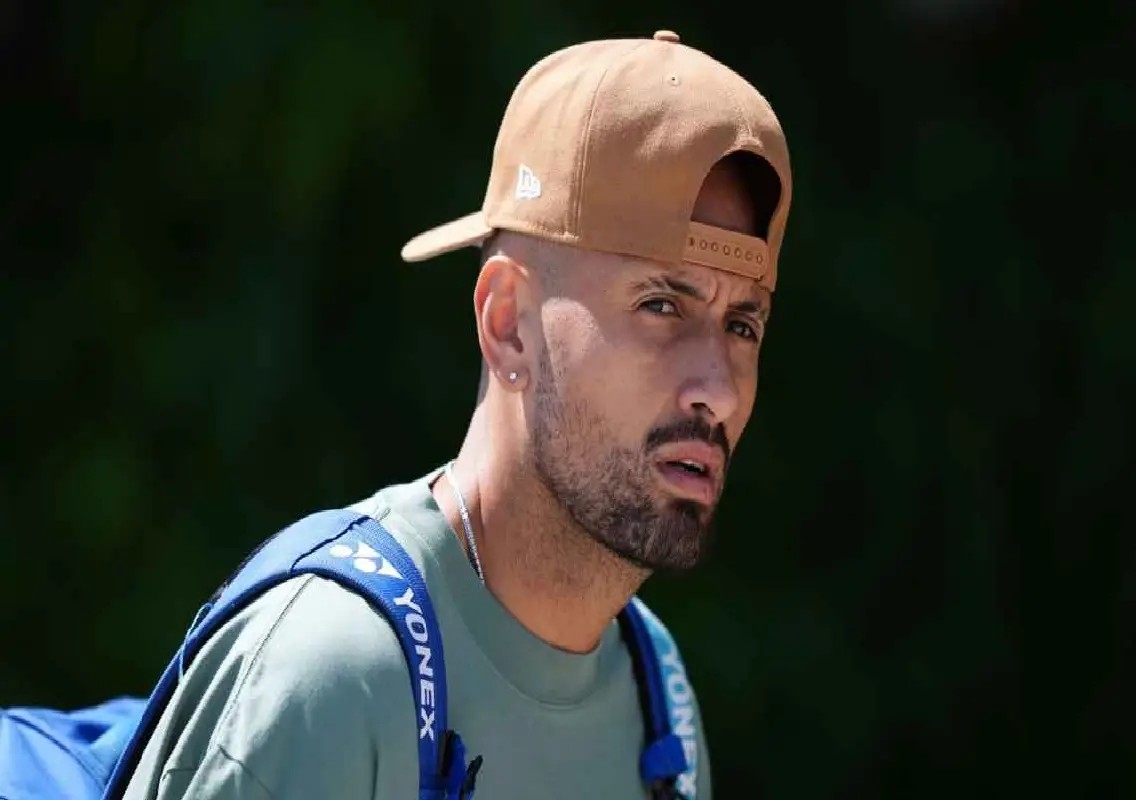


London: Former Wimbledon finalist Nick Kyrgios has been provisionally suspended from professional tennis after testing positive for cocaine during an ATP 250 tournament in Mallorca, Spain, in June. The 31-year-old Australian confirmed the failed drug test on social media, saying he had made a “huge mistake” and taking responsibility for his actions.
The International Tennis Integrity Agency (ITIA) confirmed that Kyrgios provided a sample on June 22 during the Mallorca tournament. A World Anti-Doping Agency (WADA)-accredited laboratory subsequently confirmed the presence of benzoylecgonine, a metabolite of cocaine, on July 17.
Kyrgios accepts responsibility
Kyrgios addressed the matter publicly before the ITIA announced his provisional suspension. In a statement shared on Instagram, he apologised to his fans, family, sponsors and young people who look up to him.
The Australian said he was not making excuses for the failed test, but explained that the past few years had been particularly difficult because of recurring injuries and the challenges of dealing with the possibility that his playing career could be nearing its end.
Kyrgios said the physical problems had taken a significant toll on him and that he had sometimes felt helpless and alone. However, he acknowledged that his circumstances did not justify his actions.
He described the positive test as a wake-up call and announced that he would step away from social media and public life for 28 days to focus on himself and his wellbeing. He also requested privacy for himself and his family during that period.
ITIA confirms provisional suspension
The ITIA said the provisional suspension became mandatory because cocaine is classified as a stimulant and substance of abuse on the WADA Prohibited List and is prohibited in competition under the Tennis Anti-Doping Programme.
Kyrgios has been provisionally suspended since August 4. The ITIA said he has the right to appeal the suspension, although he had not appealed it as of August 19.
The final length of any suspension will depend on whether the cocaine use is determined to have occurred in or out of competition. Under the applicable anti-doping rules, substances of abuse can attract reduced sanctions when the violation relates to out-of-competition use.
This means Kyrgios’ current provisional suspension does not, by itself, establish the final period for which he will be barred from competition.
Injury-hit career adds to setback
The doping case comes during a difficult phase of Kyrgios’ tennis career. Once regarded as one of the most naturally gifted and unpredictable players on the ATP Tour, he has struggled with injuries in recent years and has made relatively few appearances.
Kyrgios reached a career-high singles ranking of No. 13 in 2016. His biggest Grand Slam run came at Wimbledon in 2022, when he reached his first major final before losing to Novak Djokovic.
His career has since been disrupted by persistent physical problems. He has not played in a Grand Slam tournament since the 2025 Australian Open, although he returned to the spotlight last year for an exhibition-style “Battle of the Sexes” match against Aryna Sabalenka in Dubai.
The latest suspension therefore creates another significant obstacle for the Australian, who has been attempting to manage his physical condition while remaining involved in professional tennis.
What happens next?
The immediate suspension prevents Kyrgios from competing while the anti-doping process continues. The eventual sanction will depend on the circumstances surrounding the cocaine finding and the outcome of the proceedings.
The ITIA’s announcement confirms that the laboratory detected benzoylecgonine rather than simply relying on an unverified allegation. At the same time, the current action is a provisional suspension, and Kyrgios retains his right to appeal.
Kyrgios has indicated that he intends to use the next 28 days away from public life to address his situation. His decision to publicly acknowledge the failed test and accept responsibility has also placed the focus on what comes next for a player whose career has been shaped by both exceptional tennis ability and repeated controversies.
For now, the length of his absence from competitive tennis remains undecided. The final outcome will depend on the anti-doping process and whether the violation is classified as an in-competition or out-of-competition offence.
Kyrgios’ case is another difficult chapter in a career that has already experienced considerable highs and lows. Having reached the Wimbledon final and a career-best world ranking of 13, the Australian now faces an uncertain return to the sport as he deals with the consequences of the failed test.