


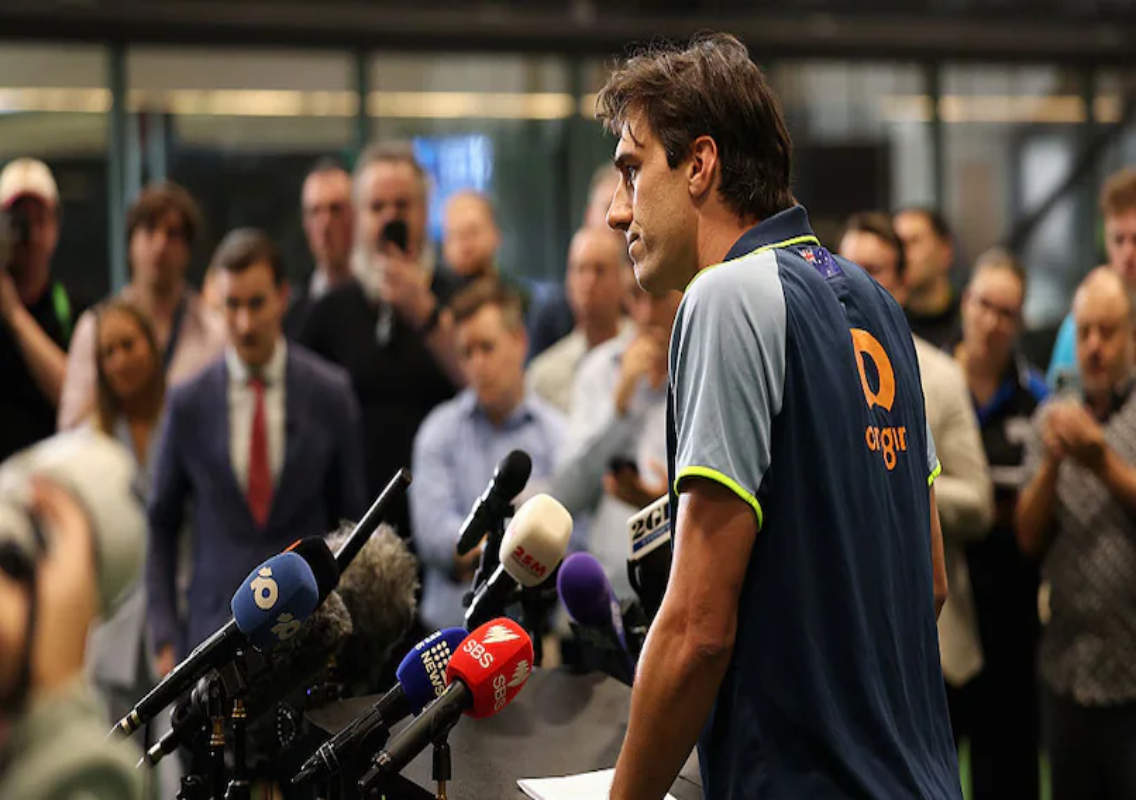


SYDNEY: Australia Test captain Pat Cummins has strongly rejected former teammate Usman Khawaja’s claims about the 2018 ball-tampering scandal, describing allegations that the entire Australian team knew about the use of sandpaper as “complete and utter nonsense”.
Cummins addressed the controversy during an extensive press conference at Cricket Central in Sydney on Friday, November 13. He denied knowing that sandpaper was being used to alter the ball during the infamous Cape Town Test against South Africa in March 2018.
The Australian captain also rejected Khawaja’s suggestion that he and other players were involved in planning the ball-tampering operation. He said the claims had caused considerable damage to the reputations of several people and Australian cricket.
Cummins firmly rejects Khawaja’s allegations
Khawaja reignited the Sandpapergate controversy through revelations in his autobiography, Sabr. The former Australia opener suggested that knowledge of the plan to use sandpaper extended beyond the three players who were punished following the incident.
Responding to the claims, Cummins said he was genuinely shocked by what had been written.
He maintained that he had consistently denied knowing that sandpaper would be taken onto the field and insisted that Khawaja’s account was incorrect.
Cummins also took particular exception to the suggestion that he and other members of the bowling group were architects of a plan to alter the ball illegally.
He described that allegation as completely false and said the details in the book had been presented too casually, without adequately considering their impact on the people involved.
Cummins questions Khawaja’s account
One of the issues that particularly surprised Cummins was Khawaja’s reported admission that he had warned Cameron Bancroft to be careful while using sandpaper.
Cummins said this was not consistent with the image he had of Khawaja, whom he considered a friend and teammate.
He questioned why Khawaja had presented the allegations in a manner that could affect the lives and reputations of several former teammates.
While acknowledging Khawaja’s right to share his experiences through his autobiography, Cummins stressed that people must also take responsibility for the claims they make.
The Australia captain said he was willing to address the matter because he believed the allegations had broader implications for the reputation of Australian cricket.
No master plan to use sandpaper, says Cummins
Cummins also rejected the suggestion that Australia’s bowling group had collectively planned to use illegal methods to generate reverse swing.
He said there was no team meeting, grand plan or agreement among the bowlers to take sandpaper onto the field.
According to Cummins, players regularly use different methods during training to prepare for reverse swing. Sandpaper can be used to roughen bats, while balls may also be deliberately scuffed during practice sessions to help batters prepare for challenging bowling conditions.
However, he said the existence of such training practices did not mean players had agreed to use sandpaper during an international match.
Cummins explained that there was a clear distinction between activities permitted during practice and taking a foreign object onto the field to alter the condition of the match ball.
He also said he had not noticed anything unusual about the ball during the Cape Town Test. Even the umpires had inspected it at the time, he pointed out.
Cummins questions claims about Australian captaincy and race
The press conference also addressed another controversial claim in Khawaja’s autobiography concerning the influence of race on leadership opportunities in Australian cricket.
Khawaja had suggested that becoming Australia’s captain required a player to belong to a particular skin colour.
Cummins strongly disagreed with that assertion and described it as a serious allegation requiring evidence.
He said he did not believe the Australian captaincy was restricted to people based on their skin colour.
The issue added another dimension to the disagreement between the two former teammates, extending the debate beyond the 2018 ball-tampering incident.
Sandpapergate: What happened in 2018?
The controversy dates back to the third Test between Australia and South Africa at Newlands in Cape Town in March 2018.
During the match, television cameras captured Australian batter Cameron Bancroft using a piece of sandpaper to tamper with the ball while the team was fielding.
An investigation by Cricket Australia resulted in lengthy suspensions for three players. Steve Smith and David Warner received 12-month bans, while Bancroft was suspended for nine months.
Smith stepped down as captain, while the incident triggered a major review of Australian cricket’s culture and leadership.
Cummins was part of the Australian team during the Cape Town Test and has repeatedly denied having prior knowledge of the plan to use sandpaper.
Debate over the original investigation returns
Khawaja’s account has reopened questions about how much the Australian dressing room knew about the incident and whether the original investigation established the full extent of the players’ involvement.
Cricket Australia has indicated that there is no compelling reason to reopen the investigation, although the latest claims have brought renewed attention to the differences between former teammates’ accounts.
Cummins maintained that the investigation was the proper process for addressing the incident at the time. He said players had been questioned and had answered questions about what happened.
The latest disagreement has once again divided opinion among former Australian players and cricket followers.
For Cummins, however, the central issue remains his denial of any knowledge of the sandpaper plan. His strong response has made clear that he does not accept Khawaja’s version of events and believes the allegations should not go unchallenged.