







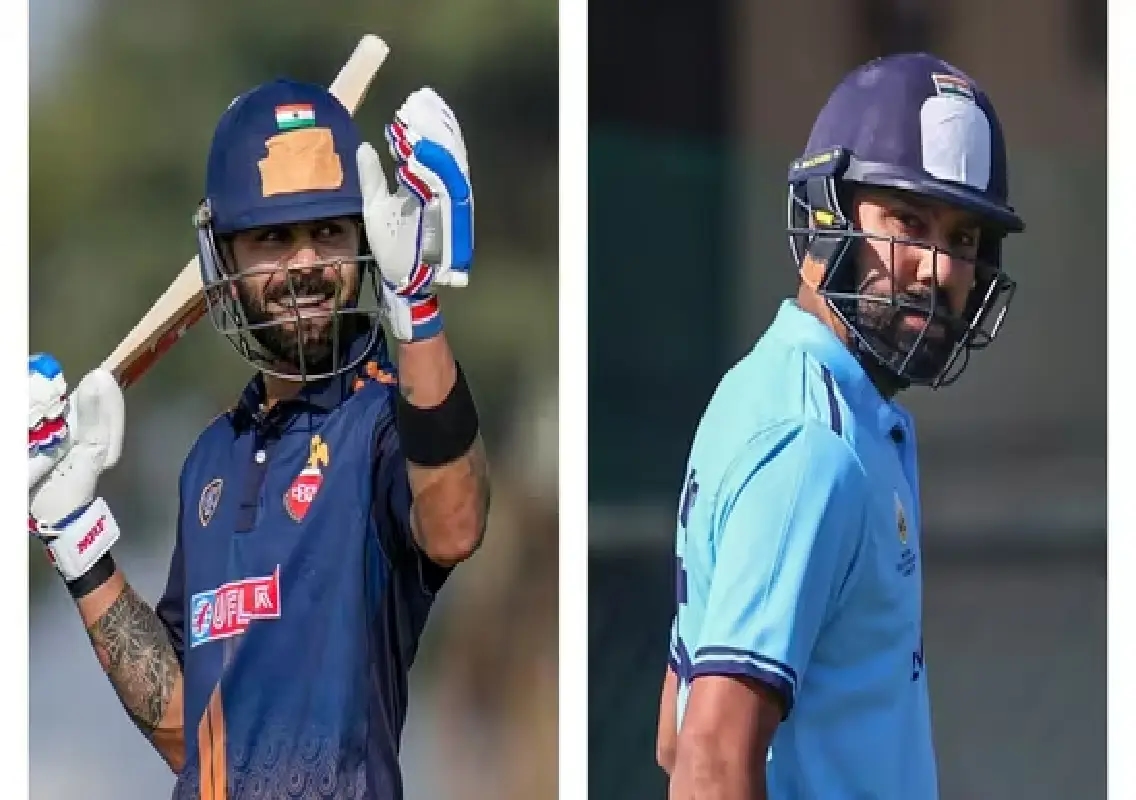


Bengaluru: The long-awaited return of Rohit Sharma and Virat Kohli to the Vijay Hazare Trophy turned into a run-fest on Wednesday, as both stalwarts smashed commanding centuries in their respective matches, underlining their enduring class while also reopening the debate on the relevance of mandatory domestic appearances for established international stars.
Centuries that came with ease
Rohit Sharma needed just 62 deliveries to bring up his hundred, cruising with trademark authority and timing, while Virat Kohli took 84 balls to reach three figures, navigating a slightly more experienced and disciplined bowling attack. The centuries came against Sikkim and Andhra Pradesh respectively, and both knocks were marked by fluency rather than exertion.
For Rohit, it was an afternoon of dominance in Jaipur, where over 10,000 spectators packed the Sawai Man Singh Stadium to witness one of India’s finest white-ball batters ply his trade in domestic cricket. The Sikkim bowlers, many of whom were playing against an icon they had grown up watching, were largely powerless as Rohit toyed with the field, peppering the boundary at will.
Kohli’s return, meanwhile, was quieter in terms of atmosphere but no less emphatic in cricketing terms. Playing at the Centre of Excellence ground on the outskirts of the city after matches were shifted from the M Chinnaswamy Stadium, Kohli methodically dismantled Andhra’s bowling. Though the stands were largely empty, the innings served as a reminder of his unmatched hunger for runs whenever he steps into a competitive arena.
A day of records and reminders
The day belonged not just to the senior superstars. It also witnessed history being created by 14-year-old Vaibhav Suryavanshi, who became the youngest centurion in List A cricket. Already the owner of three T20 hundreds, Suryavanshi’s achievement reinforced the depth and promise of India’s domestic structure.
Yet, as Suryavanshi symbolised the future, Rohit and Kohli emphatically rejected any notion that they represent the past. Their centuries were statements of relevance, fitness and desire, achieved with minimal fuss and maximum control.
Star power and domestic cricket’s visibility
Rohit’s presence alone was enough to draw a five-figure crowd in Jaipur, highlighting a stark reality: domestic cricket in India still depends heavily on star power to attract eyeballs. While the Vijay Hazare Trophy remains a vital cog in the country’s cricketing ecosystem, many matches are played in near anonymity, watched only by selectors, support staff and a handful of dedicated followers.
Kohli’s match, held away from the city centre, might have drawn a very different response had it been staged at an accessible venue. The contrast between packed stands for Rohit and empty seats for Kohli was less about popularity and more about logistics, but it underlined how much domestic tournaments benefit from marquee names.
BCCI mandate under scrutiny
Rohit and Kohli’s participation was not entirely voluntary. The Board of Control for Cricket in India has mandated that all available internationals, barring Jasprit Bumrah, must play at least two Vijay Hazare Trophy matches ahead of the limited-overs series against New Zealand in January.
On paper, the policy makes sense. It discourages senior players from opting out of domestic commitments and reinforces the importance of representing one’s state. Indian cricket has, in the past, seen several stars invent reasons to skip domestic tournaments, weakening their stature and competitive value.
However, the performances on Wednesday also raised a pertinent question: what do Rohit and Kohli truly gain from facing bowling attacks that are far removed from the quality they encounter at the international level?
Motivation versus match practice
One undeniable benefit is match practice. Competitive cricket, even at a lower intensity, is often more valuable than endless hours in the nets. Kohli’s struggles during the early stages of the Australia tour in October, after not playing competitively since June, were a stark reminder of how rust can creep in.
That said, motivation remains a key challenge. Kohli is known for bringing 100 per cent intensity to every contest, which is precisely why warm-up matches have rarely appealed to him. Rohit, too, thrives when challenged, not when coasting through one-sided contests on flat tracks.
At this stage of their careers, both batters would arguably benefit more from situations that test their technique, temperament and adaptability rather than from piling on runs against modest attacks.
The larger picture
Rohit and Kohli are coming off stellar ODI performances. Rohit was Player of the Series in India’s 1-2 loss in Australia, while Kohli earned the same honour in the 2-1 series win over South Africa, scoring two centuries and an unbeaten fifty. With the next 50-over World Cup still around 23 months away, their immediate focus is likely on maintaining form rather than chasing domestic milestones.
If the end goal is to keep them battle-ready for international cricket, there is a case to be made for allowing seasoned players to seek competitive opportunities overseas during gaps, rather than enforcing token domestic appearances.
Conclusion
Rohit Sharma and Virat Kohli’s centuries on their Vijay Hazare Trophy return were a celebration of enduring excellence and a boost for domestic cricket’s visibility. At the same time, their effortless dominance reignited a legitimate debate on whether a one-size-fits-all policy truly serves India’s most accomplished cricketers. Balancing fairness, motivation and meaningful preparation will be the challenge for Indian cricket’s policymakers going forward.