







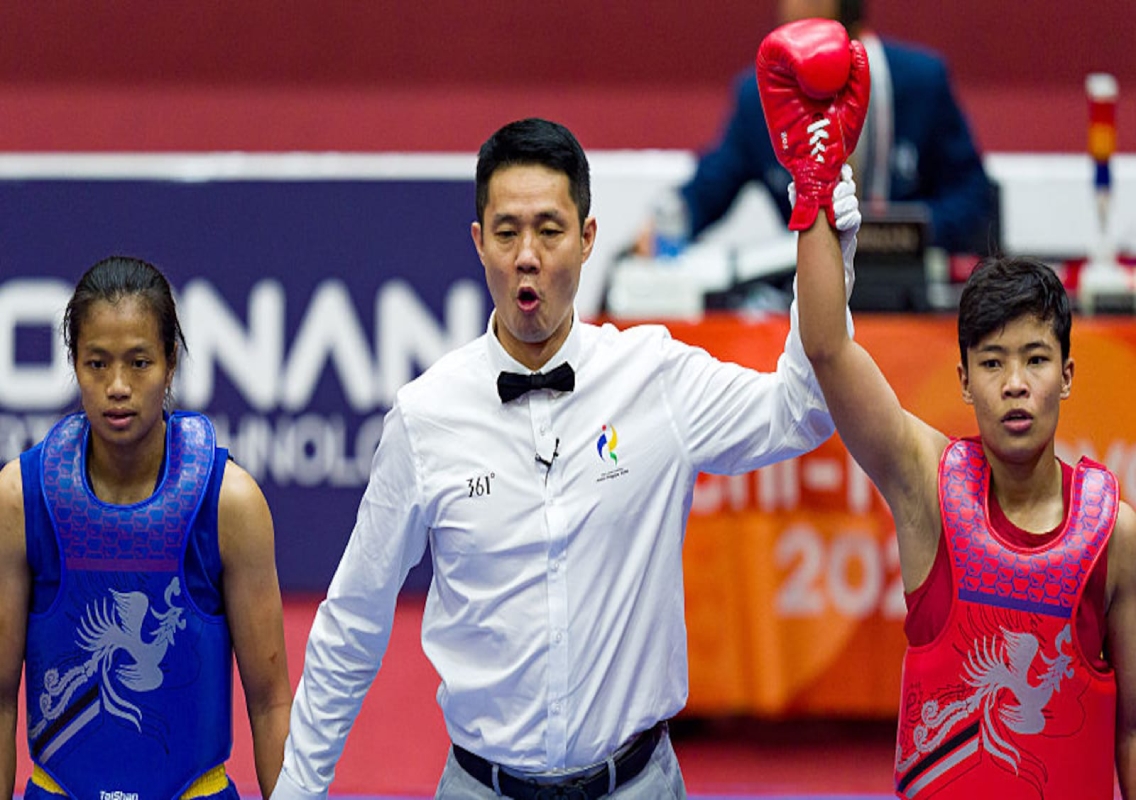


Nagoya: Indian wushu star Roshibina Devi Naorem secured a silver medal in the women’s 60kg Sanda event at the Asian Games 2026 on Thursday, adding another major medal to India’s campaign at the Aichi-Nagoya Games. Roshibina went down to China’s Zhang Xiaoyu in the gold-medal bout but extended her remarkable record at the continental event with a medal at her third successive Asian Games.
The 25-year-old Indian lost the final 0-2, with Zhang winning both rounds by a 5-0 margin. Despite missing out on the gold medal, Roshibina’s silver represents another significant achievement in her Asian Games career and adds to India’s medal tally in wushu.
Roshibina completes Asian Games medal hat-trick
Roshibina’s latest medal is her third consecutive Asian Games podium finish. She won bronze in the women’s 60kg Sanda category at the 2018 Jakarta-Palembang Games and followed it with a silver medal at the 2022 Hangzhou Asian Games.
Her performance in Nagoya means she has now collected medals at three successive editions of the Asian Games, underlining her consistency at the continental level. She has also become the first Indian wushu athlete to win medals at three consecutive editions of the Asian Games.
Her journey to the medal in Nagoya was particularly notable because she was not initially part of India’s Asian Games squad.
From selection setback to Asian Games silver
Roshibina initially lost the national selection trial to young wushu player Divyanshi Choudhary. Divyanshi was subsequently ruled out because of an injury, opening the way for Roshibina to join the Indian contingent.
The circumstances surrounding her inclusion had attracted attention before the Games. Divyanshi had also made allegations against Roshibina following her removal from the squad. Those allegations were part of the wider controversy surrounding the selection process, while Roshibina’s eventual performance on the mat provided a sporting response to the difficult build-up.
Once she received the opportunity, Roshibina made the most of it.
Strong run through the tournament
Roshibina began her campaign by defeating Bangladesh’s Most Khatun before progressing to the quarter-finals. In the last-eight stage, she overcame Macau’s Chu Man Sin to move into the semi-finals and guarantee India a medal.
The Indian then produced another strong performance in the semi-final against Indonesia’s Thania Kusumaningtyas. Roshibina won the bout 2-0, securing her place in the final and guaranteeing at least a silver medal for India.
Her route to the final also included a notable victory over Vietnam’s Nguyen Thi Thu Thuy, the 2023 world champion. That win further underlined Roshibina’s ability to compete against leading athletes in the women’s 60kg category.
Zhang Xiaoyu claims gold
In the final, however, Roshibina faced a strong challenge from China’s Zhang Xiaoyu. Zhang controlled both rounds and won each by 5-0 to secure the gold medal.
Roshibina was unable to find a way back into the contest and eventually had to settle for silver. Nevertheless, reaching the final meant she matched the silver-medal finish she achieved at the previous Asian Games.
The result also gave India an important medal from the wushu competition after several other Indian competitors failed to reach the podium.
India’s wushu campaign
Roshibina was the standout performer for India in the Sanda events at the Aichi-Nagoya Games. Among the other Indian Sanda competitors, Aryan lost his men’s 56kg quarter-final, while Aparna was eliminated in the women’s 52kg round of 16. Vikrant Baliyan also exited after losing his opening-round contest in the men’s 75kg category.
India’s Taolu competitors also missed out on podium finishes. Hanjabam Langlentombi Devi finished ninth in the women’s Nanquan and Nandao events, while Nyeman Wangsu was 15th in the women’s Changquan final. Suraj Singh Mayanglambam finished 11th in the men’s Changquan final.
Roshibina’s silver therefore became the major highlight of India’s wushu campaign at the Games.
A significant medal for India
Roshibina’s achievement is particularly notable because it combines consistency with resilience. From winning bronze in Jakarta in 2018 to taking silver in Hangzhou and now securing another silver in Aichi-Nagoya, she has remained a constant presence on the Asian Games podium.
Her latest medal also adds to India’s overall medal tally at the 2026 Asian Games. Following Roshibina’s silver, India’s tally stood at 14 medals — one gold, six silver and seven bronze, according to the latest reports.
While the gold medal remained out of reach against Zhang, Roshibina leaves Nagoya with another landmark achievement. Her third successive Asian Games medal places her among India’s most consistent performers in wushu and gives the country another podium finish in a discipline that has steadily contributed to India’s medal haul at the continental Games.
Conclusion
Roshibina Devi’s silver medal is a significant addition to India’s Asian Games campaign. After entering the squad as an injury replacement and overcoming a challenging build-up, the Manipuri athlete progressed all the way to the women’s 60kg Sanda final. Although China’s Zhang Xiaoyu stopped her from winning gold, Roshibina’s third consecutive Asian Games medal has strengthened her place in Indian wushu history.