







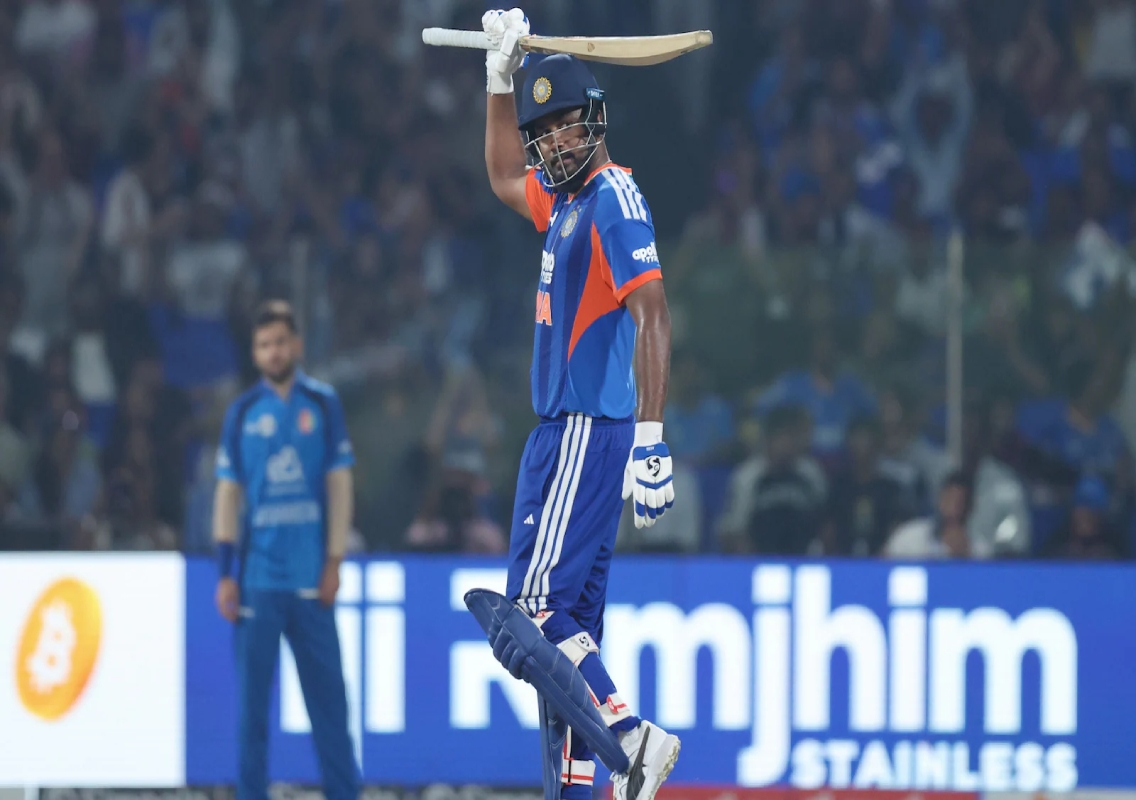


New Delhi: Sanju Samson answered questions over his place in India’s T20I side with a stunning 22-ball 57, helping India defeat Afghanistan by seven wickets in the second T20I at the Arun Jaitley Stadium on Tuesday, September 15.
The victory gave India an unassailable 2-0 lead in the three-match series, with the final match still to be played. Samson’s explosive innings came at a time when his position had attracted scrutiny following a modest contribution in the opening T20I and the presence of teenage batter Vaibhav Sooryavanshi in the squad.
India’s victory was built around a blistering opening partnership between Samson and Abhishek Sharma, while Nitish Kumar Reddy produced an impressive spell with the ball to restrict Afghanistan to 159/8.
Afghanistan post 159 after India opt to bowl
India captain Shreyas Iyer won the toss and elected to bowl first.
Afghanistan suffered an early setback when Arshdeep Singh dismissed Rahmanullah Gurbaz for a duck in the second over. Sediqullah Atal and Afghanistan captain Ibrahim Zadran then attempted to rebuild the innings.
The pair took Afghanistan to 41/1 at the end of the powerplay, but India’s bowlers continued to apply pressure.
Nitish Kumar Reddy made an immediate impact, dismissing Ibrahim Zadran with his first delivery of the match. The Afghanistan captain had scored 37 runs.
Ravi Bishnoi then removed Sediqullah Atal for 12, leaving Afghanistan at 67/3. Reddy struck again in his next over, dismissing Gulbadin Naib and further restricting the visitors.
Afghanistan struggled to build a substantial partnership through the middle overs. Darwish Rasooli briefly provided momentum with two sixes, but Axar Patel dismissed Azmatullah Omarzai before Arshdeep removed Rasooli.
At 105/6 after 15 overs, Afghanistan were in danger of finishing with a modest total.
Rashid Khan and Mohammad Nabi provide late boost
Afghanistan eventually recovered through a late attacking partnership between Mohammad Nabi and Rashid Khan.
The pair added 48 runs from just 28 deliveries, giving Afghanistan a chance to reach a competitive total.
Nabi scored 20 from 14 balls, while Rashid Khan struck 28 off 16 deliveries.
Jasprit Bumrah ended Nabi’s stay at the crease in the penultimate over, while Nitish Reddy dismissed Rashid to complete his three-wicket haul.
Afghanistan finished their 20 overs at 159/8.
Reddy was India’s leading bowler with figures of 3/24 from three overs, while Arshdeep Singh claimed two wickets. Bumrah, Axar Patel and Ravi Bishnoi took one wicket each.
Samson and Abhishek launch stunning chase
India’s response was emphatic from the opening over.
Sanju Samson and Abhishek Sharma attacked the Afghanistan bowling from the beginning, putting together 82 runs during the six-over powerplay.
Samson was particularly aggressive against Azmatullah Omarzai in the fifth over, smashing three fours and a six as India collected 20 runs.
The following over was even more expensive for Afghanistan. India scored 27 runs, with Samson hitting two sixes and two fours while Abhishek also cleared the boundary.
India reached 82/0 after six overs, putting the chase firmly under their control.
The opening partnership eventually ended in the seventh over when Rashid Khan dismissed both batters.
By then, however, the damage had already been done.
Samson departed after scoring a breathtaking 57 from 22 balls, while Abhishek contributed a rapid 39 off 19 deliveries. Their partnership provided India with the platform needed to complete the chase comfortably.
Samson produces timely response
Samson’s innings was particularly significant given the attention surrounding India’s opening combination.
He had scored only 10 runs in the first T20I against Afghanistan, while Abhishek had produced an outstanding 82 off 32 balls.
The emergence of 15-year-old Vaibhav Sooryavanshi had subsequently intensified discussion about India’s options at the top of the order.
Samson, however, responded with a powerful performance in the second match.
His 22-ball half-century contained aggressive strokeplay and helped India take control of the chase within the powerplay.
The innings also came after a difficult run of scores for the wicketkeeper-batter, making his contribution one of the defining moments of the second T20I.
Rashid Khan takes three wickets
Afghanistan’s main success with the ball came through captain Rashid Khan.
The leg-spinner claimed three wickets, dismissing Samson, Abhishek and Indian captain Shreyas Iyer.
His spell briefly offered Afghanistan an opportunity to put pressure on the chase.
However, India’s strong start meant the required run rate remained comfortably under control.
After Iyer was dismissed by Rashid in the 11th over, Ishan Kishan and Tilak Varma completed the job.
Kishan remained unbeaten on 38, while Tilak Varma finished unbeaten on 15.
India reached 163/3 in just 14.5 overs, securing a seven-wicket victory with plenty of deliveries remaining.
India seal series with one game remaining
The victory confirmed India’s series triumph with the final T20I still to be played.
It is also India’s first series victory on home soil under Shreyas Iyer’s T20I captaincy.
The result gives India an opportunity to experiment with the playing XI in the final match.
With the series already decided, attention is likely to turn towards players who have not yet featured, particularly Sooryavanshi.
Iyer has already indicated that India wants players on the sidelines to get match practice and become familiar with the conditions. That could potentially open the door for changes in the third T20I.
Nitish Reddy stands out with the ball
While Samson dominated the batting headlines, Nitish Kumar Reddy was India’s standout bowler.
His figures of 3/24 helped prevent Afghanistan from building a large total after the visitors threatened to recover through their middle and lower order.
His dismissal of Ibrahim Zadran with his first delivery immediately put India back in control after the Afghanistan captain had begun rebuilding the innings.
Reddy later removed Gulbadin Naib and Rashid Khan to finish with three wickets.
His contribution was important in restricting Afghanistan to a target that India’s aggressive opening pair could attack.
Afghanistan unable to contain India’s powerplay
The difference between the two innings was particularly visible during the powerplay.
Afghanistan managed 41/1 in the first six overs, while India raced to 82/0.
The 41-run difference gave India a significant advantage even before the middle overs began.
Samson and Abhishek repeatedly found the boundary, forcing Afghanistan’s bowlers onto the defensive.
The early acceleration meant India needed only 78 runs from the remaining 14 overs after the powerplay.
Although Rashid Khan briefly slowed India’s progress by removing three key batters, the target was already within comfortable reach.
Focus shifts to third T20I
With India now leading 2-0, the third T20I will provide the team management with an opportunity to assess other members of the squad.
The biggest selection question is likely to involve Vaibhav Sooryavanshi, who has yet to feature in the series.
The teenager was again left out of the second T20I, with Samson retaining his opening position alongside Abhishek.
However, Samson’s 57 has given the experienced batter a timely performance while also ensuring that the selection discussion remains an interesting one ahead of the final match.
India’s objective in the third game will therefore extend beyond the series result. It could also be about giving international exposure to players waiting for an opportunity.
Samson’s statement comes on the field
For Samson, the second T20I provided a response through performance.
After scoring 10 in the series opener, he returned with an explosive 57 that effectively powered India’s chase during the most important phase of the innings.
The victory also allowed India to complete another comfortable chase against Afghanistan and secure the series.
With the final T20I still to come, India’s attention will now turn towards squad rotation, player opportunities and preparations for future international assignments.
For Afghanistan, the challenge will be to find a way to restrict India’s powerful top order and convert competitive starts with the bat into larger totals.