







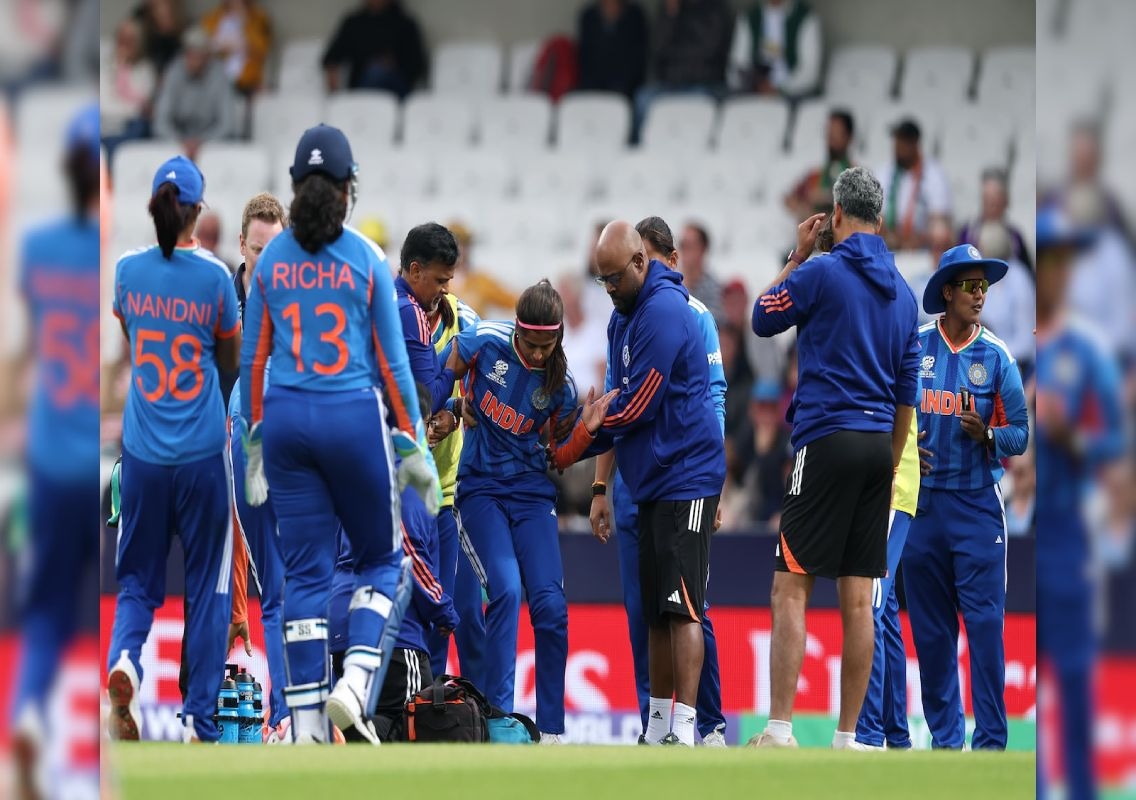


Leeds: India’s strong start at the ICC Women’s T20 World Cup 2026 has been dealt a significant blow with the injury to Shreyanka Patil, a key all-rounder whose absence could impact the team’s balance going forward. Cricket legend Mithali Raj has termed the development a “setback”, even as India continue their winning momentum in the tournament.
India have opened their campaign with two convincing victories, first against Pakistan and then a dominant performance over the Netherlands. However, Shreyanka’s ankle injury during the Netherlands clash at Headingley has raised concerns ahead of tougher fixtures against top teams.
Injury blow disrupts team combination
Shreyanka Patil suffered the injury while fielding off her own bowling, twisting her right ankle in an unfortunate incident. The injury has ruled her out of the remainder of the tournament, cutting short what was expected to be a crucial comeback phase after earlier setbacks due to shin splints and a thumb fracture.
Her absence adds to India’s growing list of injured players, including Amanjot Kaur and Kashvee Gautam, who are already sidelined with back and knee injuries respectively.
Mithali Raj highlighted the emotional and tactical impact of the injury. “It definitely will be a setback because the support staff would have had strategies built around her role. For a player coming back from injury, missing a World Cup is always tough,” she said during a media interaction.
Replacement and spin strategy
India have named Prema Rawat as Shreyanka’s replacement, but the team management now faces decisions regarding the ideal bowling combination.
Mithali believes Radha Yadav could step up as the third spinner alongside Deepti Sharma and N Sree Charani. India’s reliance on spin has been a defining feature of their white-ball success, and maintaining that strength will be key in the absence of Shreyanka.
“India’s strength has always been their spin attack. Radha Yadav has performed consistently and is well placed to fill that role,” Mithali observed.
The team may also consider flexible combinations depending on pitch conditions, especially in venues like Leeds, where surfaces can favour seamers.
Middle-order concerns persist
While India’s results have been positive, Mithali Raj pointed out underlying concerns in the batting department, particularly in the middle order. The team has struggled to build stable partnerships, often losing wickets in clusters.
Players like Richa Ghosh have been burdened with finishing responsibilities under pressure due to the lack of consolidation from the top and middle order.
In matches against Pakistan and the Netherlands, India saw quick dismissals in the middle overs, with players like Bharti Fulmali and Yastika Bhatia failing to make significant contributions.
Mithali stressed the importance of partnerships: “Even a 30-run stand in the middle overs can create a platform for someone like Richa Ghosh to accelerate later. That balance is currently missing.”
Seam attack selection dilemma
Another talking point is the role of experienced pacer Renuka Singh Thakur, who was not included in the playing XI against Pakistan. Mithali suggested that her omission could indicate concerns about rhythm and form.
“If she was not picked in the opening game, it suggests the team management might not be fully confident about her current rhythm,” Mithali said.
However, she added that India could opt for a three-seamer strategy if conditions demand, especially on greener pitches that assist pace and bounce.
Bigger tests ahead
India’s next matches against stronger opponents like South Africa and Australia will test their depth and adaptability. The absence of Shreyanka Patil will particularly be felt in high-pressure situations, where her all-round abilities could have provided balance.
Despite the setback, India’s early performances have showcased their potential as strong contenders. The team’s ability to recalibrate strategies and plug gaps will be crucial as the tournament progresses.
Conclusion
Shreyanka Patil’s injury has undoubtedly disrupted India’s plans at a crucial stage of the Women’s T20 World Cup 2026. While replacements and tactical adjustments offer solutions, the team must address middle-order inconsistencies and maintain bowling balance.
With tougher challenges ahead, India’s resilience and adaptability will determine whether they can sustain their winning run and emerge as serious title contenders.