







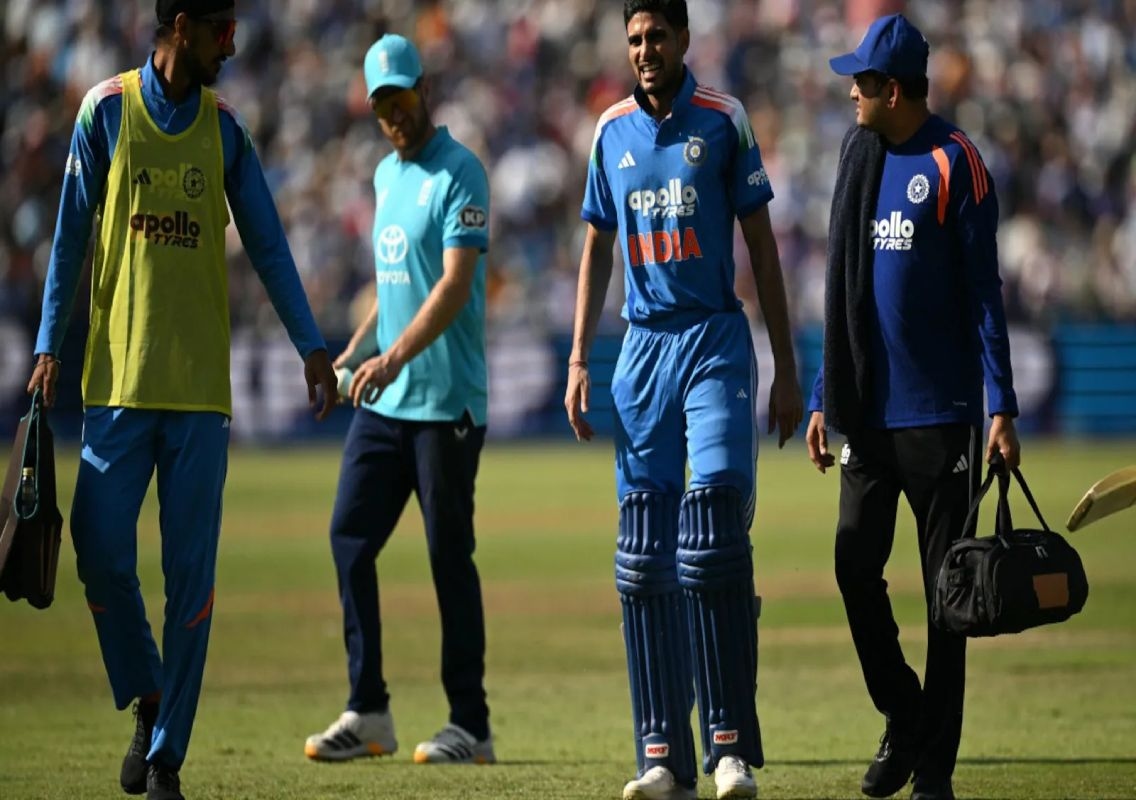


Birmingham: Shubman Gill, leading the India national cricket team, was forced to retire hurt during the first ODI against the England cricket team after suffering what appeared to be a cramp in his right leg while batting fluently.
Gill, who was in excellent touch, had scored 80 runs off 75 deliveries, striking 11 fours and one six. His innings provided India with a solid foundation in pursuit of a target of 259. However, in the 26th over of the innings, the Indian skipper suddenly showed signs of discomfort. He struggled to stand upright and was seen lying down on the pitch, clutching the back of his right leg.
Medical staff rushed onto the field to assess the situation. After a brief period of treatment, Gill attempted to regain composure but was unable to continue. He eventually walked off the field, opting to retire hurt in order to avoid aggravating the issue.
Likely cause: Muscle cramp due to exertion
While there was no immediate official confirmation about the severity of the injury, early indications suggested that Gill was dealing with a muscle cramp, a common occurrence in limited-overs cricket. Factors such as extended time at the crease, physical exertion, and match conditions can often lead to cramps, especially during long innings.
Gill’s visible discomfort and inability to stand properly pointed towards a cramp in the hamstring or calf area. Retiring hurt in such situations is considered a precautionary measure, allowing the player to recover without risking a more serious injury such as a muscle strain.
India’s strong bowling effort restricts England
Earlier in the match, India delivered a disciplined bowling performance to restrict England to 258 runs in 47.5 overs. The standout performer with the ball was Axar Patel, who claimed four crucial wickets with his accurate left-arm spin.
Pace bowlers Prasidh Krishna and Gurnoor Brar provided valuable support, picking up two wickets each. Jasprit Bumrah also made an impact, claiming one wicket and reaching the milestone of 150 ODI wickets in the process.
England had started their innings on a positive note, with Ben Duckett contributing 43 runs at the top. However, a middle-order collapse saw them lose five wickets for just 19 runs, putting them under significant pressure.
Root and Dawson steady England innings
Following the collapse, Joe Root anchored the innings with an unbeaten 76, showcasing composure and experience. He was well-supported by Liam Dawson, who scored a crucial 68 runs.
Their partnership helped England recover from a precarious position and post a competitive total. Contributions from Will Jacks and Jofra Archer further added valuable runs towards the end.
India’s bowling unit maintained control during the death overs, preventing England from accelerating beyond the 260-run mark.
Impact on India’s chase
Gill’s retirement came at a crucial juncture in the chase. With the required target at 259, his presence at the crease would have significantly boosted India’s chances of securing an early lead in the three-match series.
However, the decision to walk off ensured that the injury did not worsen. In ODI cricket, players who retire hurt are allowed to return later in the innings if they recover in time, leaving the door open for Gill’s possible comeback depending on his condition.
Conclusion
Shubman Gill’s retirement was a precautionary step prompted by physical discomfort, most likely a muscle cramp caused by exertion. While it temporarily disrupted India’s chase, the move prioritised player fitness over immediate gains. The team management will closely monitor his condition ahead of the remaining matches in the series, as his form remains vital to India’s batting lineup.