







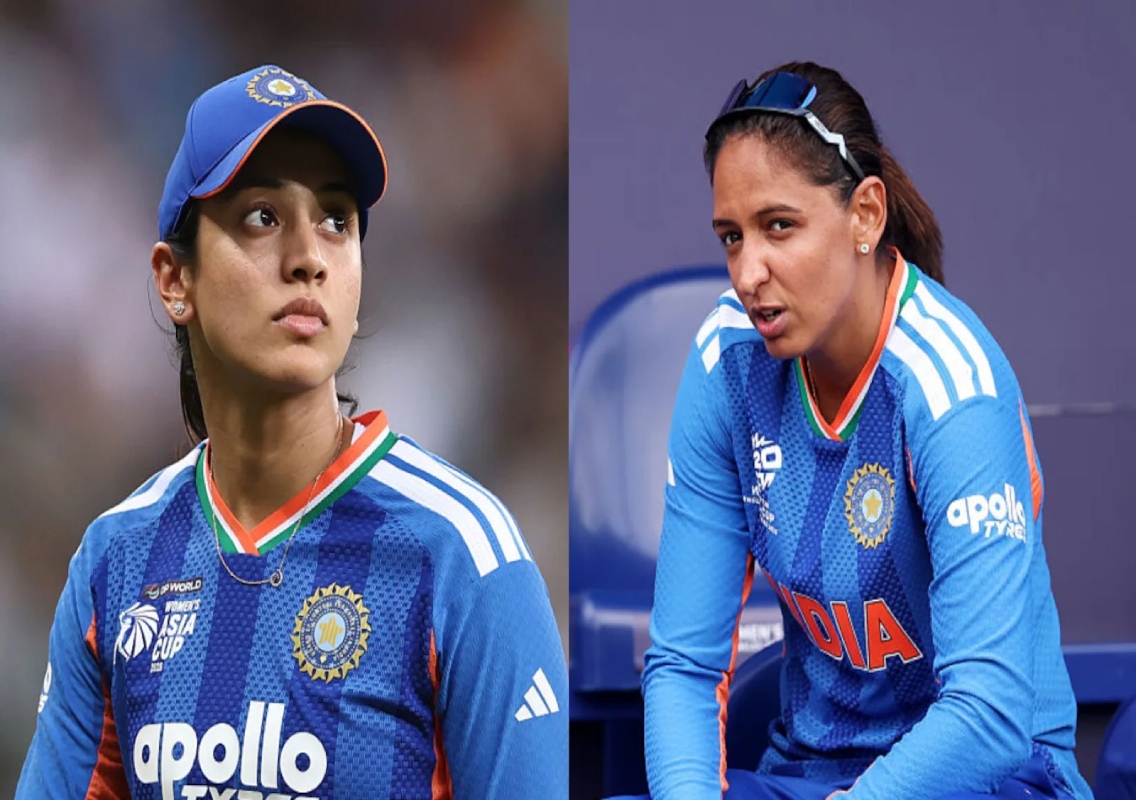


New Delhi: Smriti Mandhana has taken over as captain of the Indian women’s cricket team across all formats, marking a significant change in leadership after Harmanpreet Kaur stepped down from the position on October 6.
Mandhana’s appointment came after the Board of Control for Cricket in India (BCCI) reviewed the team’s recent performances and leadership structure. The 30-year-old opener, who had served as Harmanpreet’s deputy, is now set to lead India into a new phase. The International Cricket Council confirmed her appointment following Harmanpreet’s resignation.
The leadership change has also triggered discussion about whether Mandhana should have been handed the captaincy earlier. A Press Trust of India report carried by NDTV Sports has cited a team source claiming that tensions had developed between Mandhana and Harmanpreet, leading to unease within the dressing room. The claim has not been independently established by the BCCI.
Harmanpreet ends landmark captaincy tenure
Harmanpreet, 37, took over India’s T20I captaincy in 2016 before becoming the full-time ODI and Test captain in 2022 after Mithali Raj’s international retirement.
Her tenure included several landmark achievements. Most notably, she led India to their maiden ICC Women’s Cricket World Cup title in 2025. In September 2026, she also became the first captain to lead a side in 150 T20Is.
More recently, Harmanpreet led India to a second successive Asian Games women’s cricket gold medal in Japan. India defeated Sri Lanka in the final, with Mandhana playing a major role with a 79-run innings.
Harmanpreet has confirmed that stepping down as captain does not mean retirement. She is expected to continue playing for India, creating a new dynamic in the dressing room with Mandhana now occupying the leadership position.
Mandhana’s elevation follows years of experience
Mandhana made her international debut in 2013 and has developed into one of India’s most important batters.
She has also gained leadership experience at the franchise level with Royal Challengers Bengaluru in the Women’s Premier League. Under her captaincy, RCB won the WPL title twice, giving Mandhana valuable experience in managing a high-profile side.
At international level, she has previously captained India in 18 T20Is and four ODIs. The ICC also noted that Mandhana recently became the highest run-scorer in women’s international cricket, moving past Mithali Raj. She has 18 international centuries across formats.
Her appointment therefore represents more than a sudden change in leadership. She has already had opportunities to lead India and has been part of the team’s senior leadership group for several years.
Report raises questions over timing
The timing of Mandhana’s appointment has become one of the major talking points following the leadership change.
According to the PTI report carried by NDTV Sports, there had been questions about whether the selectors should have made the transition earlier, particularly following India’s 2025 ODI World Cup triumph.
The report also cited former India captain Mithali Raj, who had previously suggested that Mandhana could have been given the ODI captaincy two or three years earlier. Mithali had also discussed the possibility of giving T20I leadership to a younger player such as Shafali Verma.
These comments are part of the wider debate around succession planning in Indian women’s cricket. The BCCI, however, has now made its decision, with Mandhana taking charge across all three formats.
Dressing-room tension claim adds another dimension
The leadership transition has also brought reports of differences between the two senior players into focus.
The PTI report quoted an unnamed team source as saying that Mandhana and Harmanpreet had not been “seeing eye to eye” for some time and that this had contributed to unease in the dressing room.
The report also recalled the difficult transition when Harmanpreet succeeded Mithali as ODI captain in 2022, suggesting that India has previously faced challenges when changing leadership between established senior players.
However, such claims are based on an unnamed source and should be treated as reported allegations rather than confirmed facts.
With Harmanpreet remaining part of the playing group, managing the transition constructively will be important for the Indian team.
Mandhana inherits a successful team
Mandhana takes over at a time when India have enjoyed considerable success in the 50-over format and at the Asian Games.
India won the 2025 Women’s Cricket World Cup on home soil and followed it with another strong campaign in 2026. The team won the Women’s Asia Cup in September, completing an unbeaten campaign and claiming a record-extending eighth title. Mandhana scored 59 in the final against Sri Lanka, while Shafali Verma made 68.
India subsequently won the women’s cricket gold medal at the 2026 Asian Games, again defeating Sri Lanka. Mandhana’s 79 off 45 balls was one of the defining performances of the final.
The transition therefore comes despite strong results in major tournaments. The challenge for Mandhana will be to build on those achievements while addressing the areas where the team has struggled.
T20 cricket remains a major challenge
One of the concerns surrounding the previous leadership structure was India’s performance in T20 World Cups.
The PTI report noted that India had suffered early exits from consecutive T20 World Cups, leading to questions over leadership and the team’s approach in the shortest format.
Mandhana now has the opportunity to shape India’s T20 cricket alongside her ODI and Test responsibilities.
Her first assignment as full-time captain will be the home series against Zimbabwe. India will play three T20Is from October 16, followed by three ODIs beginning October 23.
Harmanpreet’s role will remain important
Although Harmanpreet has surrendered the captaincy, her experience remains an important asset for the Indian side.
She has led India in 211 international matches across formats and was at the centre of several historic moments in women’s cricket. Her continued presence means Mandhana will have a senior player with extensive leadership experience within the squad.
The next phase will therefore involve not only Mandhana taking responsibility but also the wider team adapting to a new leadership structure.
For Indian women’s cricket, the change represents the beginning of a new chapter. Mandhana now has the opportunity to establish her own leadership style, while Harmanpreet will look to contribute as a senior player.
Whether the transition came earlier than it should have is now a matter for debate. What is certain is that the leadership baton has changed hands, and Mandhana’s tenure begins with a team carrying both the weight of recent success and expectations for even greater achievements.