







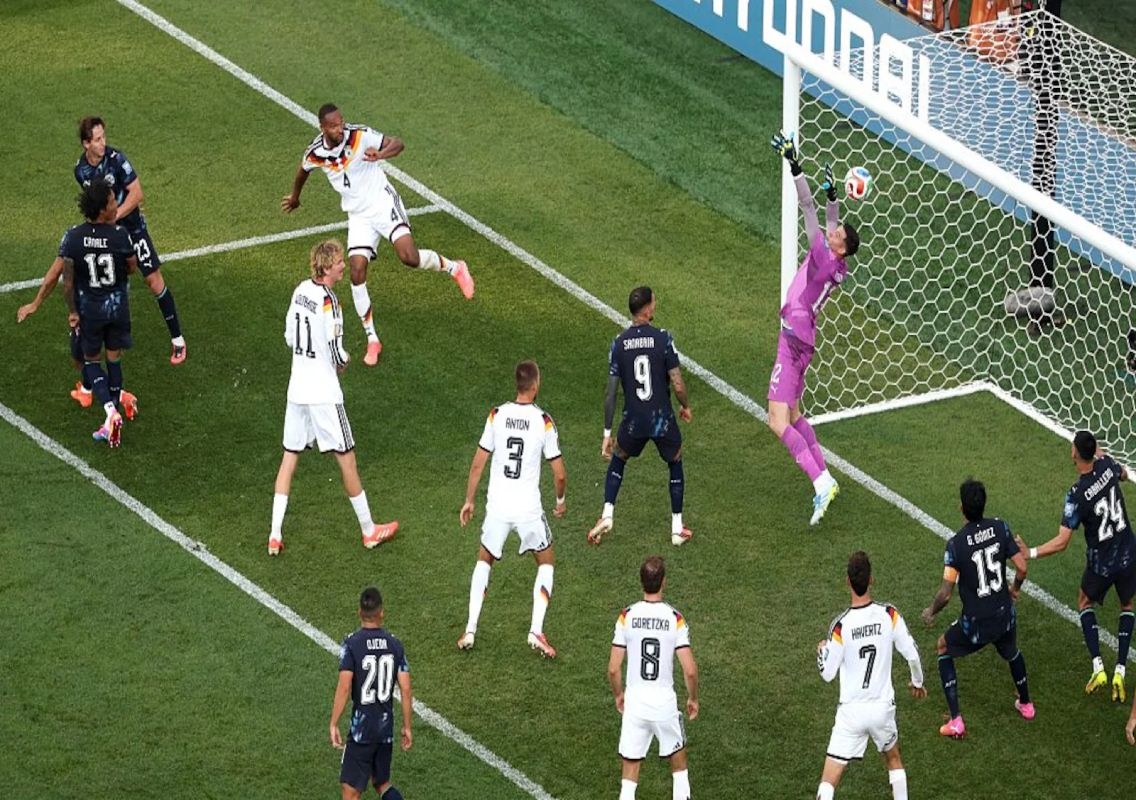


Foxborough: Germany’s shock elimination from the FIFA World Cup 2026 Round of 32 against Paraguay has been overshadowed by a heated VAR controversy, after Jonathan Tah’s extra-time header was disallowed following a referee review for an alleged foul on the goalkeeper. The decision proved pivotal as Paraguay eventually progressed 4-3 on penalties after a 1-1 draw across 120 minutes.
The incident has triggered debate across the football world, with pundits and former officials divided over whether the intervention was justified or overly harsh, especially given the physical nature of the challenge inside a crowded penalty area.
Tah’s disallowed goal changes the match momentum
The decisive moment came in extra time when Germany believed they had taken a crucial 2-1 lead. A set-piece delivery into the box found centre-back Jonathan Tah, who powered a header past Paraguay goalkeeper Orlando Gill.
However, celebrations were cut short when the VAR room intervened. Match officials reviewed a potential infringement involving Germany defender Waldemar Anton and Gill during the build-up phase of the corner.
Moroccan referee Jalal Jayed was instructed to check the pitch-side monitor, where he concluded that Anton had committed a foul on Gill before Tah’s header. The goal was subsequently ruled out, keeping the score at 1-1 and pushing the match into a penalty shootout.
The decision immediately sparked anger from the German players, who protested strongly on the pitch, arguing that the contact was minimal and did not interfere with the goalkeeper’s ability to make a save.
Pundits divided over “soft” foul call
The ruling drew widespread criticism from analysts covering the match. Former England striker Alan Shearer, speaking on BBC commentary duties, described the decision as excessively harsh given the circumstances inside the box.
“Not for me, I don’t agree with that decision at all,” Shearer said. “He falls to the ground far too easily. Yes, there’s contact, but it’s a contact sport. There are 13 bodies in the six-yard box, not for me. I don’t agree with that. The ‘keeper buys it.”
Shearer added that while contact existed, it was not enough to justify overturning a goal in such a high-stakes knockout match.
Former World Cup assistant referee Darren Cann also described the incident as “soft”, but acknowledged that similar decisions are often given in favour of goalkeepers in modern VAR interpretations.
“This is soft but it wouldn’t surprise me if it’s ruled out,” Cann said. “This is hardly anything — a small block on the goalkeeper, I suspect it’s for a block on the goalkeeper.”
The contrasting opinions highlight a growing debate in global football about how VAR should interpret minimal contact in crowded penalty situations, particularly during knockout-stage matches.
Germany fail to recover after emotional setback
Following the disallowed goal, Germany struggled to regain momentum despite dominating possession in extra time. Paraguay defended in compact lines, forcing the match into penalties where pressure ultimately decided the outcome.
At 1-1 after 120 minutes, Germany entered the shootout as slight favourites due to their historically strong record in penalty scenarios at World Cups. However, the script flipped dramatically.
Kai Havertz, Nick Woltemade and Jonathan Tah all missed from the spot, while Paraguay also missed two attempts but held their nerve to secure a 4-3 victory. Goalkeeper Orlando Gill emerged as the decisive figure, making key saves that sent Paraguay into the Round of 16.
The result marks one of Germany’s most disappointing World Cup exits in recent memory and adds further scrutiny on their tactical execution in knockout football.
VAR again under spotlight in knockout football
The controversy has reignited concerns about consistency in VAR decision-making, particularly in situations involving goalkeeper contact. While referees are instructed to protect keepers in aerial duels, critics argue that marginal contact is increasingly leading to goals being overturned.
In this case, the match referee’s interpretation of “impeding the goalkeeper” proved decisive in a World Cup elimination match, leaving Germany frustrated and Paraguay celebrating a historic upset.
For Germany, the defeat will be remembered not only for missed penalties but also for a moment of fine margins that swung their tournament fate. For Paraguay, however, it is another chapter in their growing reputation for resilience and discipline on the world stage.