







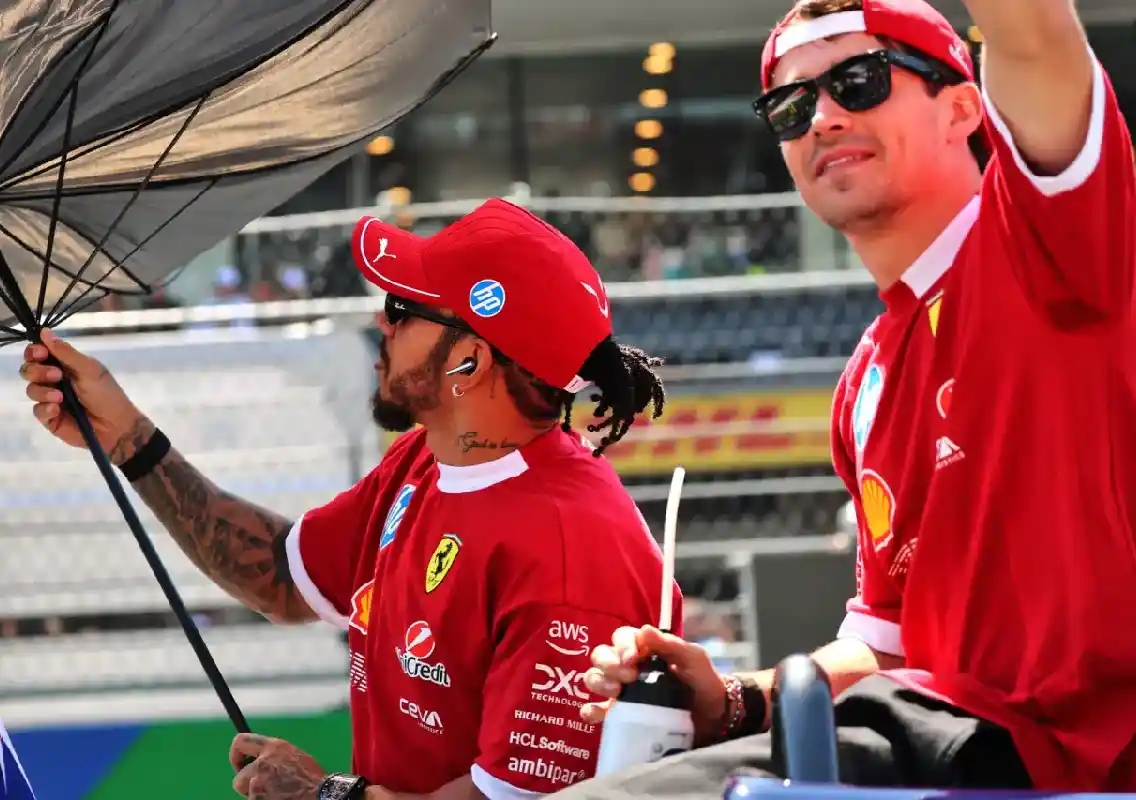


A week of heightened scrutiny at Ferrari took a new turn after team chairman John Elkann publicly urged Lewis Hamilton and Charles Leclerc to “talk less and focus on driving,” sparking widespread discussion about internal dynamics within the iconic Formula 1 outfit. The comments followed a challenging run of races, where Ferrari has struggled to find consistent performance amid fierce competition for second place in the Constructors’ Championship.
The remarks, delivered at a sponsor event, quickly drew headlines for their directness—an uncommon tone from the typically reserved Ferrari leadership. Given the global spotlight on the team’s high-profile driver line-up, the reaction was swift. Within hours, both Hamilton and Leclerc released individual statements on social media, signalling unity and commitment rather than confrontation.
Their responses, while separate, carried a shared message: the team remains together, focused and determined to finish the season strongly.
A season of pressure and expectations
Ferrari entered the current season with strong expectations, especially after signing seven-time world champion Lewis Hamilton. The pairing with Charles Leclerc was widely regarded as one of the most promising line-ups on the grid—combining experience, adaptability and raw speed. However, the campaign so far has been defined by narrow margins, strategic miscalculations, reliability setbacks and misfortune in key races.
The recent Grand Prix in São Paulo was emblematic of these struggles. Leclerc’s race ended early due to involvement in a first-lap incident triggered by another driver. Hamilton, meanwhile, endured a difficult outing involving contact and subsequent pace issues. The team left Brazil with almost no points in a race that was considered crucial to keeping their championship position secure.
It was in this backdrop that Elkann’s comments were made. The chairman stressed the need for focus and resilience, adding that while the drivers are among the best on the grid, the team as a whole must keep its attention on performance rather than external noise or narratives.
Drivers respond with calm unity
Instead of direct rebuttal, both Hamilton and Leclerc opted for tone over confrontation—carefully crafted words that underlined internal solidarity.
Hamilton’s brief but emphatic message read: “I back my team. I back myself. I will not give up. Not now, not then, not ever.” The statement, while not addressing Elkann directly, appeared designed to reinforce his personal commitment to the long-term project at Maranello.
Leclerc offered a longer reflection, acknowledging the disappointment of recent races: “A very difficult weekend in São Paulo. Disappointing to come back with nearly no points at such a critical moment. It’s uphill from here and only unity can help us turn this around. We will give it everything as always.”
Neither driver made reference to the chairman’s comments by name, but the timing and tone left little doubt that their statements were intended to cool the conversation—both inside the team and across global F1 media.
Leadership tensions or strategic messaging?
Ferrari is no stranger to scrutiny. As the oldest and most storied team in Formula 1, every comment, result and decision is magnified. However, analysts suggest that Elkann’s remarks may not signal tension, but rather a deliberate internal push to reinforce discipline during a sensitive phase of the championship.
Team Principal Frédéric Vasseur has repeatedly emphasised that Ferrari is working through a multi-season plan to return to consistent race-winning form. The transition is complex, involving car development structures, factory coordination and strategic consistency. The drivers are only one part of the system, albeit highly visible ones.
For Hamilton, who is still adapting to Ferrari’s machinery and operations, the situation underscores the scale of the challenge he accepted by joining the team. For Leclerc, who has spent years carrying Ferrari’s competitive hopes, it serves as a reminder that expectations remain exceptionally high.
Looking ahead
Only a few races remain this season, and Ferrari is locked in a tight battle for second place in the Constructors’ Championship. Every race result now carries both sporting value and symbolic weight. A strong finish would help stabilise narratives around progress, morale and development into the next season.
However, the tone set by the drivers—public composure, internal unity and a refusal to fuel speculation—may prove just as crucial as any upgrade package.
In the end, Ferrari’s campaign may come down to execution, error minimisation and collective strength. And for now, at least, the public message from Maranello is clear: the drivers stand together, and the team moves forward as one.