







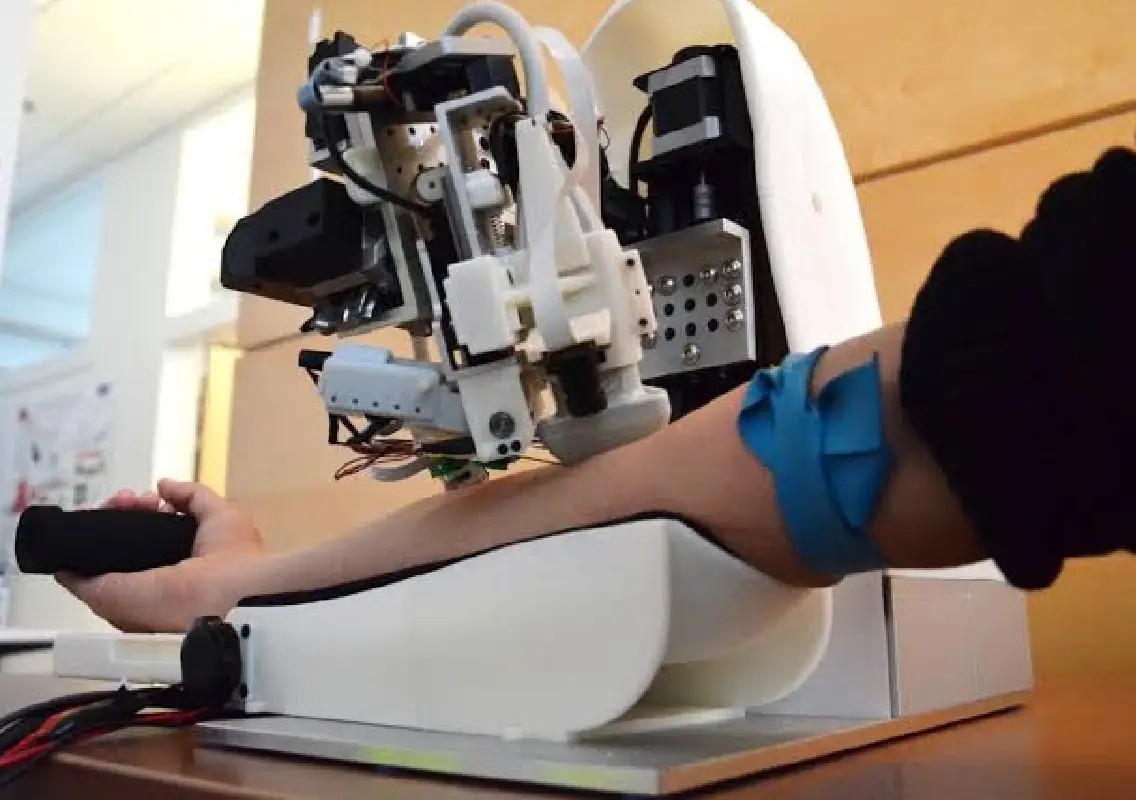


Getting a blood sample could soon become a more automated experience as AI-powered medical robots begin taking on one of the most routine tasks in healthcare.
Aletta, an autonomous blood-drawing system developed by Dutch medical robotics company Vitestro, uses imaging, ultrasound, robotics and artificial intelligence to identify a suitable vein and collect blood with minimal human intervention. The US Food and Drug Administration authorised the device on August 19 for use in adults in non-hospital settings.
Robot finds the vein and collects the sample
The system uses near-infrared imaging to locate veins, while ultrasound helps determine their depth and direction. Doppler technology helps distinguish blood vessels and supports safer needle placement.
In a Dutch clinical trial involving more than 1,600 people, Aletta successfully collected blood on the first attempt in 94.5% of cases, including people with difficult-to-access veins and older adults. A trained phlebotomist can take over when the robot cannot identify a suitable vein.
Could ease pressure on busy laboratories
The technology could prove useful as healthcare systems face shortages of trained phlebotomists. According to IEEE Spectrum, one phlebotomist could supervise as many as three Aletta machines, potentially allowing laboratories to handle more routine blood testing.
For patients, automation could also reduce repeated needle attempts and make the experience more consistent.
Important questions still remain
Despite its promise, the technology is not without limitations. The machine fails to identify a suitable vein in roughly one case out of 20, while researchers are continuing to examine whether its performance is equally reliable across different skin tones. Questions about the quality of robot-collected samples also require further study.
The development nevertheless points towards a future in which robotics could handle more routine healthcare procedures while trained professionals remain available for cases requiring human judgement and care.