







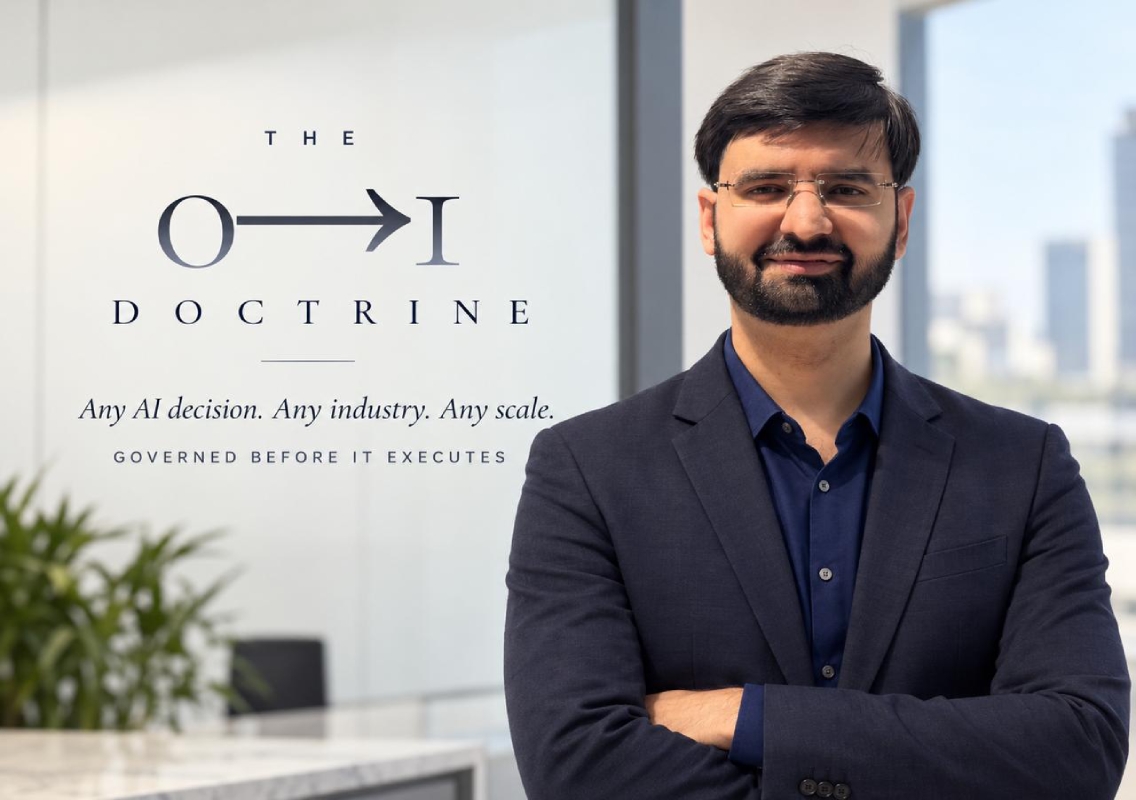


THE MOMENT REVIEW STOPPED BEING POSSIBLE
The 0→1 Doctrine is a universal governance framework applied here to a machine-speed problem. For nearly two centuries, every institution relied on one shared assumption to make that possible: a person would always be faster than the thing being reviewed. AI agents, and increasingly whole swarms of them coordinating with each other, now propose and act faster than any person can read the first line — breaking that assumption at the exact moment it mattered most.
The Doctrine answers with one simple test, spoken in a language every system can share regardless of what produced it: does this action fall inside what’s actually allowed, or not? A yes lets it proceed. A no stops it cold. Anything genuinely unclear goes to a real person, not a guess — the same test whether one agent acts once or a million act simultaneously.
THE HUMAN REACTION PROBLEM IS ABOUT TO GET EXPENSIVE
A human can review one AI decision. But what happens when one agent becomes ten thousand, or actions arrive faster than a team can review them? That is where human-in-the-loop thinking begins to strain.
PRE-EXECUTION CHANGES THE TIMING OF CONTROL
The old sequence: AI acts, human notices, investigates, responds.
The proposed sequence: AI proposes, governance checks at zero latency, authority resolves, execution occurs.
For a machine-speed economy, that reordering may matter as much as another model improvement.
PLANNING STAYS FREE. COMMITTING DOES NOT.
An agentic system sourcing a component from several candidate suppliers may independently decide which to query and in what order — entirely its own reasoning, never inspected. But each time it is ready to actually commit to one supplier, that specific commitment is tested against the same fiduciary boundary on its own.
Autonomy does not accumulate across a multi-step transaction. Ten planning steps do not earn ten steps of unchecked authority — each eventual commitment is tested like the first one, regardless of prior planning.
THE THREE-STATE ANSWER
A binary yes/no path breaks when a case cannot safely become either. HOLD is a controlled refusal to manufacture certainty.
THREE AGENTS, THREE OUTCOMES
RESOURCE ALLOCATION AGENT — APPROVED
[0.71, 0.77] falls inside the authorized [0.65, 0.80] band. Result: the allocation proceeds on schedule, with a sealed record proving why.
CONTRACT-STATE AGENT — REJECTED
[0.86, 0.92] falls outside the same [0.65, 0.80] band. Result: a contract change that would have created downstream liability never executes.
SYSTEM-MODIFICATION AGENT — HELD
[0.78, 0.83] narrowly overlaps [0.65, 0.80], but a jurisdictional condition applies. Result: the change waits for a verified person’s decision — the delay is the safeguard.
Each agent reasons differently; the governance sequence doesn’t: capture, normalize, band, compare, apply conditions, authorize or reject or hold, then seal the record.
THE GOVERNANCE STACK IS LARGER THAN ONE TOKEN
Around that spine sit supervisory layers.
EMERGE — Emergent Meta-Environmental Response and Governance Envelope — provides pre-context oversight by analysing aggregated signals for systemic or environmental instability.
PRAT — Predictive Risk Advisory Token — provides forward-looking risk analysis and advisory signals.
PARR — Post-ACR Remediation and Resolution Framework — governs corrective action after actuation.
RECAP — Regenerative Evaluation and Civic Accountability Protocol — provides system-level evaluation and accountability reporting.
HUPA — Hybrid Universal Privacy Architecture — defines privacy-preserving processing, consent and disclosure boundaries.
CTIE — Civic Trust Infrastructure Extension — maintains rule versioning, capability-band lineage and provenance. Together, these extend governance beyond authorization into oversight, prediction, remediation, evaluation, privacy and provenance.
PRAT, EMERGE AND THE EARLY-WARNING IDEA
The supervisory layer matters most when the signal is movement toward a breach, not a breach itself. A predictive halt and a compulsory halt are genuinely distinct: one responds to a projected future breach before it happens; the other responds only once a parameter is already outside its authorized range.
EVERY HOUR OF WARNING IS A GOVERNANCE DECISION
A storm can be forecast hours or days out; some disasters give only seconds. Extra time does not save lives on its own — its use does. The 0→1 Doctrine governs that gap: testing whether the available window is enough for the required response.
WHY THIS IS DIFFERENT FROM “AI SAFETY”
AI safety is a vast field covering model evaluation, cybersecurity, sandboxing, access controls and monitoring. The 0→1 proposition is narrower: can the transition from proposal to execution itself become governed? It adds a governance layer above runtime controls and separate from the intelligence producing the proposal.
BIOLOGICAL AGE INDEX
The same normalisation concept extends into human systems. A Biological Age Index can synthesise measurable indicators into a directional age-gap representation, recognising that calendar age and biological profile need not be identical variables. The architecture does not determine exact years added to life; clinical action requires expert judgement.
THE RECEIPT BECOMES PART OF THE PRODUCT
If an agent acts, an institution may later need to answer who authorized it. The ACR Actuation Compliance Receipt is a cryptographically bound record of the governed outcome — moving accountability from narrative toward evidence. It cannot make bad policy good; it can make the pathway reconstructable.
THE SINGULARITY PROBLEM MAY BE AN AUTHORITY PROBLEM
The Singularity is usually framed as a question of intelligence. An investor may care more about consequence: a machine does not need to be superintelligent to move money or alter software.
Even a hypothetical superintelligent system still faces an institutional question: what is it permitted to cause? The Doctrine does not claim to solve the Singularity — governance remains meaningful as capability rises.
THE NEW ASSET CLASS MAY BE TRUSTED AUTONOMY
The winning question for funds is not how much CapEx buys, but how much autonomy an institution can safely authorize and prove. OpEx scales with unreviewed risk after deployment; ROI depends on capital never quietly leaking through an unauthorized action. If machine speed becomes abundant, a measurable boundary becomes the scarce asset funds price.
CLOSING NOTE
“When millions of agents move capital across any domain simultaneously, human attention becomes the bottleneck, not intelligence. The next trillion may belong to whoever makes fiduciary authority machine-readable before autonomy becomes irreversible.”
Live: www.0to1doctrine.com
This can be tested, live, via API, governed against ungoverned, side by side.
THE INVENTOR
Vatsal Soin is a serial inventor and entrepreneur with patent filings across six continents and grants in the US, India, Japan and South Africa. He is a SIM–RMIT alumnus and an alumnus of Nanyang Technological University, Singapore. His latest grant, dated August 14, 2026, introduces an AI-powered footwear system and Global Sharable Size Card invention.
SELECTED REFERENCES
Granted: US Patent 12,446,652 B2 · Japan Patent 7560909 · India Patents 454081 and 599317 · Filed: PCT/IN2025/051943 · US 19/489,595 · India 202511115781 · Australia AU2022450649
DISCLAIMER
Informational only. Not certified. No endorsement implied. Not investment advice. Examples are illustrative, not field results. Vatsal Soin · © 2026 All Rights Reserved.